
By Armin Sijamić
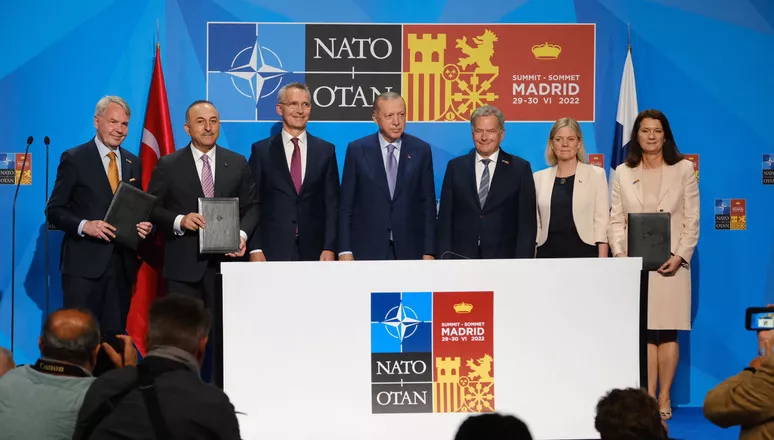
The decision of Sweden and Finland to become NATO members is one of those events of immense historical significance. The intention to join NATO has led to a change in the geopolitical map of Northern Europe. This is an opportunity that Washington does not want to miss. Ever since mid-May, when Sweden and Finland applied for NATO membership, it was clear that Turkey would set conditions for them to meet. Turkey has a veto right, like other members of the alliance, and this time it has used it. Ankara demanded from Sweden and Finland cooperation regarding individuals and organizations operating in those countries, which Turkey accuses of terrorism and an attempted coup. The last straw was the act of burning the Quran by Rasmus Paludan.
The leader of a far-right extremist party from Denmark caused outrage in Turkey and complicated the path to NATO for Sweden, whose passport he holds. The shameful act of burning the Quran was carried out, with police presence, in front of the Turkish diplomatic mission in Sweden. Formally, the act was not "illegal," but it was "terrible," summarized US State Department spokesperson Ned Price.
Sweden distanced itself from Paludan and called on Turkey to resume trilateral negotiations, which include Finland, as soon as possible. Finland called for a break in negotiations for several weeks, and both countries expressed a desire to become NATO members simultaneously. Turkey announced that Sweden no longer has their support to join the alliance.
American Plan
The United States knows how important it is for these two countries to join NATO, which is why, since April, along with the United Kingdom, it has been engaged in expediting the membership procedure. Washington and London wanted to capitalize on the fear, primarily of Finland and then Sweden, following the start of Russian aggression against Ukraine. The membership of these two countries in NATO would deal a strong blow to Russia and strengthen their own positions.
The US, as the undisputed leader of NATO, engaged in negotiations with Turkey, seeking a way to reach an agreement as soon as possible. However, Turkey did not give the green light for Sweden and Finland to join the alliance, and the aforementioned Scandinavian countries did not meet Ankara's demands. As the stakes are too high, the US and UK did not stand idly by and offered Sweden and Finland something that could be described as a transitional solution before full membership. Namely, security guarantees were offered that these two countries would be defended by Washington and London in case of an attack. But before we delve into this issue, let's mention just a part of what makes Sweden and Finland so important to NATO, Washington, London, and Moscow.
Forces on Russia's Border
In less than two months from the moment of application, Sweden and Finland received an invitation to join the alliance. It is clear that Brussels was in a hurry, but it is not surprising. These two countries are economically and militarily developed, and the state of democracy there is better than in most NATO members. Although these two countries have undoubtedly been in the Western camp for decades, they still have their specificities. Sweden refused to join any military alliance during the Cold War, and Finland did its best not to anger neighboring Russia. These two countries have developed strong armies that are hard to match among countries with such small populations. Fear of invasion by great powers and maintaining a neutral position led to their armies relying on their own capabilities. Sweden, among other things, produces fighter jets, submarines, warships, tanks, missiles, armored vehicles, and artillery, while Finland produces combat transporters, armored vehicles, warships, artillery, trucks, sniper rifles, assault rifles, machine guns, mines, communication equipment... The cooperation between these two countries is excellent, so their armies are equipped with equipment they sell to each other.
Excellent ties with Washington and London are the reason why Sweden and Finland also procure weapons from the West, and even jointly develop them. For example, Finland has 55 American F-18s and has ordered as many as 64 F-35 aircraft. The war in Ukraine now shows that Moscow would not easily deal with one of these countries, and their membership in NATO makes an intervention from Russia seem impossible.
Vladimir Putin said that the membership of these two countries in NATO is not a threat to Russia, yet a few weeks earlier he attacked Ukraine under the pretext that its entry into NATO would be a "mortal danger" to his country. With Finland's membership in NATO, Russia's land border with the alliance would almost double, and Putin's native St. Petersburg is about 160 kilometers from the Finnish border, while Moscow is about 780 kilometers away, which is approximately the distance from the Russian capital to Ukrainian Kyiv.
This would mean that Russia would have to deploy additional forces to the 1335-kilometer border with Finland, but this is just the beginning of the problems that Finland's and Sweden's membership in NATO brings to Moscow. Namely, the Baltic Sea would then become a zone of Western dominance, and the Swedish island of Gotland, which is to the Baltic Sea what Crimea is to the Black Sea, plays a particularly important role. Thus, the Kaliningrad exclave would become, in a strategic sense, even more distant from the rest of Russia. This pleases Estonia, Latvia, and Lithuania, which considered themselves the weakest link in NATO. Then, the strategically important port in the Murmansk region, which is the center of the Russian Arctic fleet, becomes closer to NATO. Submarines with nuclear weapons, as well as the only Russian aircraft carrier, Admiral Kuznetsov, sail from there. From Murmansk, Russia plans to project its power into the Arctic, which is very rich in resources (natural gas and oil, for example) and could become an important sea route in the future. With the melting of ice, the possibility of traveling from Europe to East Asia in less time than currently is opening up.
Russia has been developing capabilities for years to defend its interests there. With Finland and Sweden in the alliance, the task becomes more difficult because Russia's Baltic fleet will be more threatened than ever, and part of its tasks includes sailing the Northern Sea Route. Norway, which is closest to Murmansk, can act jointly with Finland and Sweden in the Arctic, which is part of American, Canadian, Danish, and Icelandic plans. Joint NATO action could negate the advantage that Russia currently has in this part of the world.
Political and Strategic Decision
The US does not want to wait and do nothing. The entry of Finland and Sweden into NATO would be a significant political and strategic victory at a time when Russia is seeking to prevent the alliance from expanding. Until then, nothing should cause missed opportunities, so the US and UK have offered security guarantees to Sweden and Finland and strengthened their presence in this part of Europe. This practically means that Sweden and Finland have come under the security umbrella of the West, and that American and British influence in the fields of security, politics, economy, and transport will increase in Northern Europe through various arrangements.
At the beginning of the month, Finnish Foreign Minister Pekka Haavisto stated that the US had sent a proposal for cooperation between the two countries, similar to what Washington signed with Norway in June, and in May, London gave such guarantees to Sweden and Finland, strengthening the UK's traditionally strong ties with this part of the world.
The expansion of NATO to include Sweden and Finland would complete the strategic positioning of the West in Europe, as almost all important points on the continent's geopolitical map would be in the hands of Brussels, precisely at a time when Russia is waging an exhausting war with Ukraine. Until Sweden and Finland become NATO members, the US and UK do not want to leave anything to chance, because these two Scandinavian countries are geopolitically worth a great deal.
Komentari (0)
Prijavite se za komentiranje
PrijavaJos nema komentara. Budite prvi!
Minuta
Sve →Iz drugih kategorija

High Representative Not Elected: Germans, French and British Sabotaged Americans, New Attempt at End of June

ČOVIĆ WITHOUT MERCY: How Those Who Brought Ademović to Office Created a Political Hell for Him



Sunny Saturday, quite warm



Tragedy in Albanian resort: Two minors drown












