
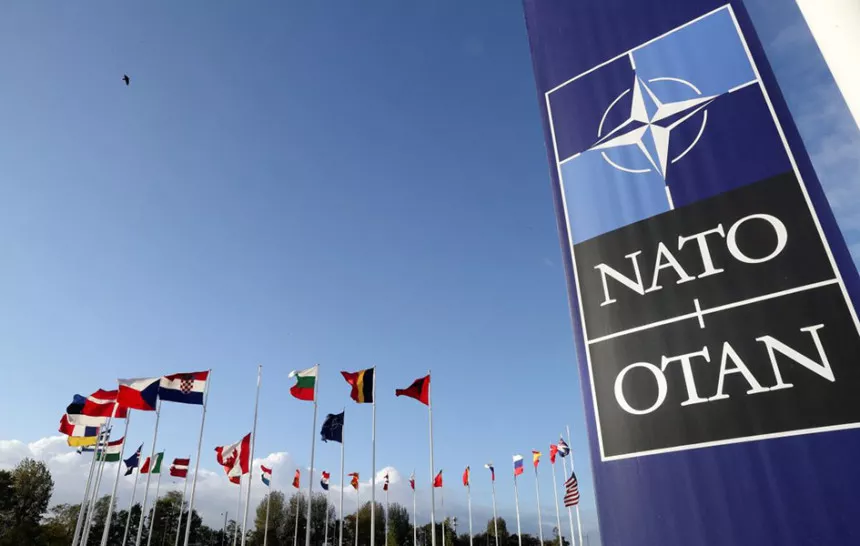
(Patria) - Leaders of 32 NATO member states will gather on Tuesday and Wednesday for a historic summit in The Hague, where they are expected to confirm an increase in defense spending to five percent of GDP by 2035.
Foreign ministers of NATO member states and Ukraine will meet for a working dinner within the framework of the NATO-Ukraine Council. At the same time, defense ministers of NATO member states will also meet.
On Wednesday morning, the North Atlantic Council will convene at the level of heads of state or government, and the meeting is expected to last only two and a half hours.
German newspaper Der Spiegel writes that this was done to prevent US President Donald Trump from getting bored and leaving the meeting prematurely.
The key decision of the summit in the Netherlands will be a new and significantly higher defense spending target, which was insisted upon by Trump, who asked allies to increase their defense budgets to five percent of GDP, which is completely unrealistic for many of them.
However, Secretary General Mark Rutte has come up with a compromise proposal that will allow Trump to claim victory, while setting more realistic goals for most allies.
Thus, this five percent is divided into 3.5 percent for purely military expenditures, and the remaining 1.5 percent is allocated for broader defense and security costs, such as adapting roads, bridges, and ports to accommodate heavy armored vehicles, investments in cybersecurity, protection of gas pipelines, and similar.
These defense-related costs can be interpreted very broadly, including, among other things, the bridge over the Strait of Messina, which would connect Sicily with the rest of mainland Italy in the name of military mobility, then border protection costs due to migration control, broadband internet upgrades, or a third runway at London Heathrow Airport.
The existing goal for increasing defense budgets was set in 2014 at two percent of GDP by 2024. Trump, during his first term from 2017 to 2021, when most allies were nowhere near the set goal, insisted and threatened not to come to the aid of those who did not increase defense spending if needed.
Only this year will all or almost all member states meet the two percent target. This is now being raised to 3.5 percent of GDP, which should be reached by 2035.
Some countries, like the Baltic states, requested the deadline be shortened to 2030. Rutte, however, proposed it be by 2032, and most requested an even longer period. A change in the target percentage is also possible in 2029, as a review is planned then.
Increasing spending to five percent of GDP represents an increase measured in tens of billions of euros for the major members.
The publication Le Grand Continent, which deals with geopolitical issues, calculated that increasing spending to five percent by 2032 would mean Italy would have to spend an additional 83 billion euros annually, an increase of almost 12 billion compared to current spending.
France would have to allocate an additional approximately 93 billion annually, about 13 billion more than today. Germany, the strongest economy in the EU, would have to allocate an additional 136 billion euros annually, close to 19.5 billion euros more than now.
Additional funds will be invested in new military capability targets agreed upon this month for each member country. These are classified data, and Secretary General Rutte cites investments in air defense, fighter jets, tanks, drones, and logistics as examples.
It is precisely these military capability targets that Spanish Prime Minister Pedro Sanchez refers to, stating that he does not intend to meet the five percent target.
Sanchez says Spain can meet its military capability goals by increasing spending to 2.1 percent of GDP.
The Spanish government has approved the final declaration of the summit, which mentions the five percent target, but has stated that it does not intend to allocate that much.
Rutte says there are no exceptions in NATO and that the new target applies to everyone.
US Ambassador to NATO Matthew Whitaker said at a press conference on Monday that member states will submit annual reports on defense spending.
“We will regularly report on defense spending so that we can all monitor each other’s progress and hold each other accountable,” Whitaker said.
Komentari (0)
Prijavite se za komentiranje
PrijavaJos nema komentara. Budite prvi!
Minuta
Sve →Iz drugih kategorija

High Representative Not Elected: Germans, French and British Sabotaged Americans, New Attempt at End of June

ČOVIĆ WITHOUT MERCY: How Those Who Brought Ademović to Office Created a Political Hell for Him



Sunny Saturday, quite warm



Tragedy in Albanian resort: Two minors drown












