
By Armin Sijamić
Russia's aggression against Ukraine and the sanctions imposed on Moscow by the West have slowed down and halted some projects, while others have become important out of necessity. One of them is the transport corridor that would connect the Caspian Sea and the Persian Gulf, i.e., Russia with the Indian Ocean.
Although Russia is the largest country in the world by area, its geography sometimes does not help. Russia's centuries-old endeavor to reach warm seas has been further complicated by NATO's expansion into Eastern Europe, and the war in Ukraine has made things more difficult for Moscow. More precisely, it has become unsustainable in a strategic sense if the confrontation with the West continues.
With the termination of the Ukrainian grain deal, Kyiv announced that Russian ships are targets in the Black Sea, and Moscow has no other access to the Mediterranean. With the entry of Finland and Sweden into NATO, the situation in northwestern Russia is becoming unsustainable in the long term – the Baltic Sea is becoming a NATO backyard, making St. Petersburg seem further from the rest of the world than before.
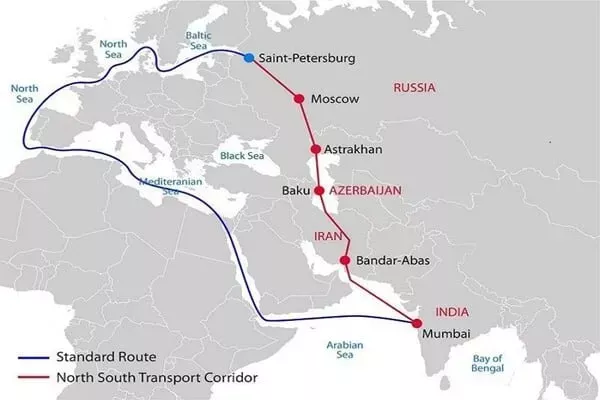
If the conflict continues, things will become more complicated for Russia. This could ultimately increase the cost of Russian trade, especially when it comes to Moscow and Russian European cities. For example, in peacetime, it takes about 40 days to deliver goods from Mumbai, India, to Moscow via the Suez Canal. With the project that Russia and Iran want to implement, these two cities could be "only" 14 days apart.
The "North-South" Corridor
Since the beginning of this century, Russia, with varying enthusiasm and with or without interruptions, has been working on building a 7.2 thousand kilometer long corridor. In 2000, Russia, Iran, and India signed, and two years later ratified, an agreement to build a corridor that will connect Moscow, via the Caucasus, the Caspian Sea, and the Persian Gulf, to Indian ports.
This project was slowed down due to high costs, and sometimes due to political reasons, because in addition to Russia and Iran, which would benefit the most economically and politically from the "North-South" corridor, it also involves Azerbaijan, Armenia, Turkmenistan, India, Kazakhstan, and directly Oman, Turkey, Georgia, Belarus, Syria, Pakistan, and the Arab countries of the Persian Gulf.
However, this project is becoming increasingly important for Russia as the conflict with the West continues. Sanctions and broken ties will not be overcome overnight, so the Kremlin must look for alternatives.
During the Russia-Africa summit held at the end of July, Russian President Vladimir Putin said that Moscow is working rapidly on the aforementioned corridor and that it would be good to build several ports on the eastern coast of Africa to serve as a link between his country and allies on the African continent.
On May 17, Putin and Iranian President Ebrahim Raisi signed an agreement to build a railway from Rasht to Astara. The approximately 160 kilometers of railway will cost Russia 1.6 billion euros, and Iran 4.6 billion. Construction is expected to be completed in four years, adding a missing link to the corridor, meaning Iranian cities would be connected to Russian cities by a railway running along the western shores of the Caspian Sea.
This act does not complete the corridor, as the transport of large quantities of goods requires the reconstruction of railways, and then the construction of a series of hubs, roads, and even ports and waterways, because one of the ideas associated with this corridor is the digging of a canal between the Caspian Sea and the Persian Gulf for maritime freight transport.
The canal would be about 700 kilometers long and would be of great importance to Iran, not only politically and economically, but it would also help bring drinking water to the arid parts of the country. Iran has been negotiating this with Russia since the 1990s. Moscow has experience in building canals, such as the White Sea-Baltic Canal, Volga-Baltic Waterway, Volga-Don Canal, and others. Experts have developed projects, but the work has not been completed. One of the reasons is also Western sanctions against Iran.
Thus, for a quarter of a century, for political reasons, there has been no canal, just as there hasn't been for the last 130 years since the idea first emerged. Even then, Russia wanted to avoid the Bosphorus, the Dardanelles, and European rivals. European powers, in various ways, prevented the construction of this canal, which would have competed with the Suez Canal and opened Russia's path to South Asia.
Now that Russia is also under sanctions and further away from the West, there is no doubt that this project will be considered. Until then, the focus will be on railway infrastructure. In June last year, Russia "tested" the transfer of a shipment from the Finnish border to India, via the Caspian Sea and Iran. According to the report, 41 tons of wood laminate arrived in 24 days.
In August, the customs authorities of Iran, Russia, and Azerbaijan signed an agreement on facilitated transit between the three countries. In September, Turkmenistan joined the agreement on the "North-South" corridor. In November, Iran invested ten million dollars in the Russian port of Astrakhan on the Volga. In April this year, Armenia, Iran, and India discussed economic cooperation and trade.
In the first three months of this year, compared to the previous year, according to official Russian data, the volume of goods transported via the "North-South" corridor has doubled.
Geopolitical Implications
Since the West began imposing sanctions on Russia for its invasion of Ukraine, Moscow has sent messages that the country cannot be isolated. After eighteen months of war, it is clear that Russia can be isolated in some parts of the world, but not in others. Circumventing sanctions is an Iranian specialty, and now its neighbor is going through a similar situation. Therefore, it is logical for Russia to move closer to Iran. Tehran will accept cooperation, but not at any cost. Iran is among the countries that pursue an independent policy and does not accept tutelage of any kind.
The construction of the "North-South" corridor would bring many benefits to Iran and Russia. Tehran has stated that it is ready to invest in this project, even through foreign investment. After Russia's doors have been closed in most of Europe, Moscow must turn to Asia, primarily Iran and Central Asia, and then further towards India, China, and South Asia.
The Russian-Iranian version of the "Silk Road" would bring transit revenue and immense political power to both countries. This is especially true for Iran, which would hold the keys to access Central Asia and Russia, which is certainly not good news for Iran's rivals, the West, as well as Egypt and Turkey, which benefit greatly as important transport hubs. For example, the railway connecting Kazakhstan with Turkey passes through Iran. In addition, there are plans to connect Europe and Turkey with the countries of the Persian Gulf, and Iran could play a crucial role there as well.
In parallel, a logistics base is being built in Turkmenistan with the help of Iran, which will become an extension of the "North-South" corridor towards the central parts of Asia and the Russian Far East. In a short period, all these corridors could also become energy corridors, i.e., transporting energy resources from the Middle East and Central Asia to the European market, or Russian energy resources to India and Asia.
The shortest route between India and Europe, the intersection of important transport corridors, and trade in natural gas and oil are just some of the factors at play that will determine the fate of this project. As it involves huge sums of money and immense influence of the states that would manage these processes, the final outcome is uncertain, as many oppose this idea.
For example, Russia benefits from the transport corridor, but not from natural gas and oil from the Middle East being transported to Turkey and Europe. This does not please the proponents of building LNG terminals either. Therefore, for this project to be implemented, a great deal of trust and the building of friendly relations between all the countries involved in the project will be necessary. In recent months, there are additional reasons for Russia and Iran – to survive Western sanctions and launch a counter-strike.
Komentari (0)
Prijavite se za komentiranje
PrijavaJos nema komentara. Budite prvi!
Minuta
Sve →Iz drugih kategorija

High Representative Not Elected: Germans, French and British Sabotaged Americans, New Attempt at End of June

ČOVIĆ WITHOUT MERCY: How Those Who Brought Ademović to Office Created a Political Hell for Him



Sunny Saturday, quite warm



Tragedy in Albanian resort: Two minors drown












