
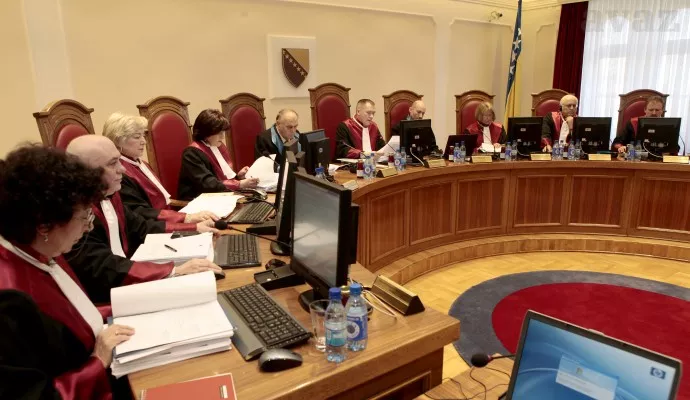
Non-execution of final and binding decisions of the Constitutional Court of Bosnia and Herzegovina constitutes a criminal offense, for which proceedings in such cases should be conducted before the Court of BiH, and according to the records of the Constitutional Court of BiH, as many as 89 of their decisions have not been executed, writes the Patria news agency.
As many as 89 Enforcement Orders have been issued, and among them are appeals filed by officials who can submit them ex officio by the late Sulejman Tihić, Bakir Izetbegović, as well as ordinary citizens.
According to the orders, it is evident that even the Parliamentary Assembly of Bosnia and Herzegovina has not complied with the decision of the Constitutional Court of BiH, so it states, for example, that the Constitutional Court of Bosnia and Herzegovina, by its Decision from 2011, adopted the request of Bakir Izetbegović, member of the Presidency of Bosnia and Herzegovina, for an assessment of the constitutionality of Articles 17 and 39 of the Law on Citizenship of Bosnia and Herzegovina.
In the said decision, the Constitutional Court determined that Articles 17 and 39, paragraph 1, of the Law on Citizenship are not in accordance with Article I/7.(b) and (d) of the Constitution of Bosnia and Herzegovina.
In the said decision, the Constitutional Court ordered the Parliamentary Assembly of Bosnia and Herzegovina to amend and supplement the unconstitutional provisions of the Law on Citizenship in accordance with that decision, within six months from the date of delivery of that decision to the Parliamentary Assembly, but this has not been done to this day!
The number of unimplemented decisions speaks to the state of the judiciary and respect for the Constitution, and the Constitutional Court of Bosnia and Herzegovina, as the highest judicial instance in the country, oversees the work of all types and levels of government, and plays an important role as a protector of the constitutional order and constitutionally guaranteed rights and fundamental freedoms.
However, for this role to be fully fulfilled, it is not enough for the Court to make quality decisions; they must also be adequately and timely implemented.
And although the non-implementation of the Constitutional Court's decision is a criminal offense, so far no one has been held accountable for it, nor has the BiH Prosecutor's Office done anything in this regard. This criminal offense carries a prison sentence of 6 months to five years.
Therefore, the statement by Meddžida Kreso, President of the Court of BiH, who openly stated that there is a "judicial mafia" in BiH, should not be surprising, and given the numerous cases we are witnessing, it can rightly be said that it is a political-judicial mafia.
The largest portion of unimplemented decisions are those that contain orders to regular courts to promptly adopt new decisions or urgently conclude ongoing court proceedings due to the established violation of the appellant's right to a trial within a reasonable time.
Courts do not implement these, but they are very prompt in issuing judgments that are in the interest of political elites, and these are also implemented very promptly.
The latest such example is Dragan Lukač, who received an order to be reinstated as director of the FUP, while his colleagues, for example Jozo Anđić and Momčilo Tubić, have been waiting for hearings for several years... even with final decisions in hand, which are somewhere in FUP drawers, they have no right to return to work or to the restoration of certain rights that belong to them.
How is it possible that the decisions of the highest judicial instance in this country, the Constitutional Court of BiH, are not respected, and no one is punished for their non-implementation, while the decisions of municipal courts, which suit certain politicians, who are clearly in collusion with the judicial mafia, are immediately executed?
Therefore, it is clear that politicians in BiH have a significant influence on the judiciary, so it cannot yet be considered independent as it should be in a democratic society.
The Open Society Fund of Bosnia and Herzegovina has also addressed this issue, and a study has been prepared which states that "a significant number of important decisions of the Constitutional Court of Bosnia and Herzegovina are not adequately implemented by the responsible institutions, and the responsible persons from these institutions do not bear any consequences for this.
- On the one hand, this is a direct consequence of the still underdeveloped rule of law culture and the lack of accountability of domestic actors. On the other hand, under such conditions, the existing mechanisms for enforcing these decisions also demonstrate shortcomings that do not contribute to the situation - the study states.
Komentari (0)
Prijavite se za komentiranje
PrijavaJos nema komentara. Budite prvi!
Minuta
Sve →Iz drugih kategorija

High Representative Not Elected: Germans, French and British Against Americans, New Attempt at End of June

ČOVIĆ WITHOUT MERCY: How Those Who Brought Ademović to Office Created a Political Hell for Him



Sunny Saturday, quite warm



Tragedy in Albanian resort: Two minors drown












