
By Sifet Kukuruz, Legal Expert
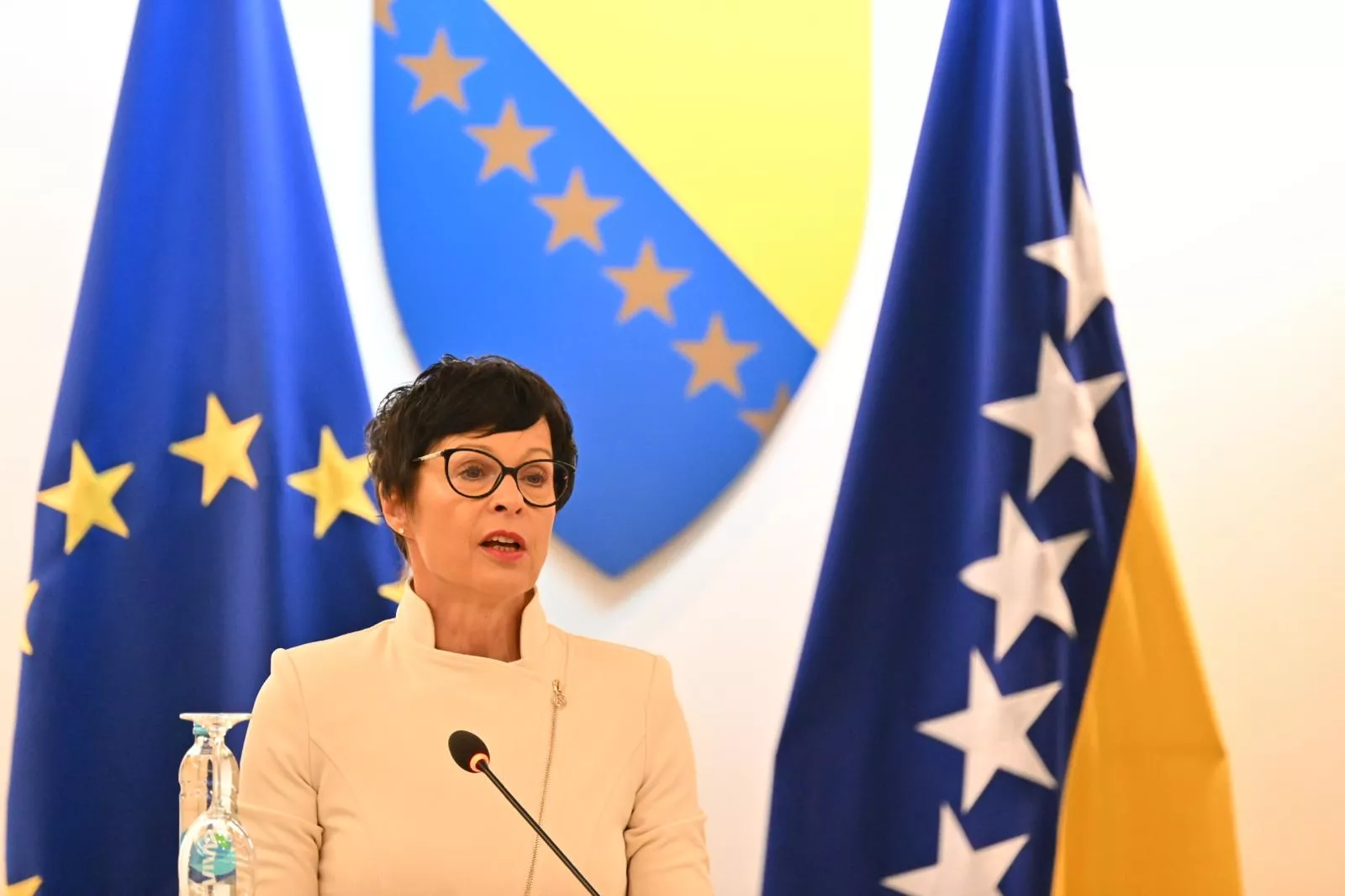
European Commissioner for Enlargement Marta Kos sent a strong message to the domestic public about the importance and necessity of media freedom for a democratic society during her visit to Bosnia and Herzegovina. There would be nothing controversial in that statement if Europe today were not experiencing widespread media control, censorship, and even the prohibition of freedom of public thought and speech. This hypocritical attitude of the EU towards media freedom and BiH's European path perhaps best illustrates why BiH's European perspective is more uncertain than even climbing the highest mountain peak in Bosnia and Herzegovina.
And another important note.
Marta Kos stated that media that have lost USAID support will have EU support! Therefore, these are media that the American administration has officially declared corrupt. Such a statement from the European Commissioner only confirms that corruption fits perfectly into the system of European values or, more precisely, that hypocrisy is a significant determinant of the identity of European policy. And the strength of such a policy is such that it can move mountains. Therefore, less concern should be given to BiH's European path, and more to the future of Maglić mountain.
Since there are no coincidences in politics, one should wonder if Marta Kos accidentally chose Maglić mountain in her message. Perhaps the symbolism of the name of the mountain on which the European Commissioner, along with domestic politicians, would climb embodies all the past, and likely future, insincerity of EU policy towards BiH.
The EU's friendship towards BiH has never been sincere; it has always been apparent and hypocritical. Proof of this is the period of aggression against RBiH, the Dayton arrangement which, in itself, is more of a political-legal misunderstanding than an agreement, as well as the entire post-Dayton period of stagnation in which BiH finds itself, thanks to retrograde domestic policies which, under some unclear circumstances, always find support and helpers in the EU.
Domestic retrograde political forces, without similar or identical policies in the EU, simply could neither exist nor successfully block BiH's path to the EU. In this regard, it would be more politically correct to talk about the stagnation on the EU's path towards BiH, rather than constantly accusing domestic politicians. Of course, the guilt of certain domestic actors is undeniable, but the policies of those actors could not exist and operate effectively without allies and political sustenance precisely within EU institutions.
Even in a situation where domestic political actors achieve a certain degree of common interest on issues of importance for European integration, bureaucrats from the EU would find a way to divert such developments in the wrong direction, even before reaching the "finish line." For example, during the adoption of "European laws" which, by their nature, objectively do not meet European standards, domestic actors are given alleged European support, but only to have this supposed success challenged when measuring the "second passing time."
Hypocritical European policy requires great skill in manipulation, which allows for the creation not only of the appearance of success on the European path but also the appearance of providing support for that success. The fact that the European approach to BiH is not based on sincere intentions is best shown by the situation where, when policies in BiH muster the strength to make concrete progress on the path of European integration, they are always left at the mercy of domestic retrograde policies, with a strong message from the EU that internal consensus is necessary and that the EU cannot do the work for domestic politicians and domestic institutions.
And instead of offering sincere support and a "lifeline" to BiH at these crucial moments, the EU always withdraws that hand. In all situations where BiH needed its support, the EU withdrew its hand, forgetting that BiH is in its current state largely due to European hypocrisy.
Ancient wisdom teaches us that a true friend always offers a hand of help and support when it is most needed and when you are in distress. This wisdom also teaches us that a true friend is not one who expresses readiness to establish friendship, but primarily one who strives and endeavors to become a friend. If the EU's relationship with BiH were measured by this universally applicable criterion, the only conclusion that would naturally arise is that the EU's friendship towards BiH has never been sincere.
After all, in a situation where the EU, due to internal weaknesses and security threats, faces the challenge of its own institutional survival, the question is whether and to what extent BiH, at least in this period, should become a member of a system that is in serious crisis and in a state of collapse. BiH left such a system in the 1990s, and the question is whether, when, and at what cost it should integrate into a new system whose future is extremely uncertain.
Komentari (0)
Prijavite se za komentiranje
PrijavaJos nema komentara. Budite prvi!
Minuta
Sve →Iz drugih kategorija

High Representative Not Elected: Germans, French and British Against Americans, New Attempt at End of June

ČOVIĆ WITHOUT MERCY: How Those Who Brought Ademović to Office Created a Political Hell for Him



Sunny Saturday, quite warm



Tragedy in Albanian resort: Two minors drown












