
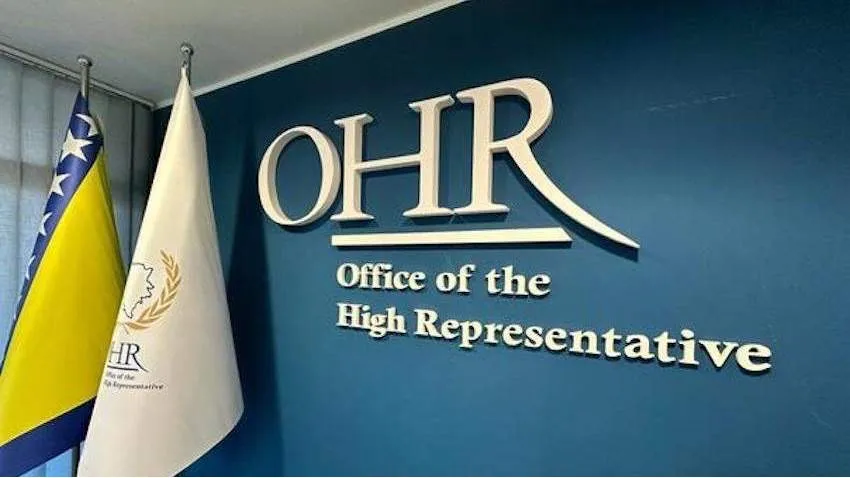
It is already quite clear to everyone that without fulfilling the famous "5+2" agenda, there can be no closure of the OHR, nor a real withdrawal of the international supervisory mechanism from Bosnia and Herzegovina.
And that is not a political wish, but a framework that the international system itself set as a condition for the transition to "local ownership."
And it is precisely here that the paradox begins, which today both the political elites and the public are swallowing, instead of a serious discussion on how to meet these conditions, BiH again returns to the level of mutual accusations and symbolic wars over whether the OHR should be "stronger" or "abolished immediately."
In that vacuum, both the parties that seek the OHR's stay, and Milorad Dodik on the other side, offer two extremes that, each in its own way, seem almost incoherent.
On one hand, insisting that Bosnia and Herzegovina is in a permanent existential crisis that can be kept under control only with a maximally active OHR, with "full Bonn Powers" as a daily political instrument, turns the state into a space of permanent protectorate.
To pray for the survival of such a model, without any clear strategy on how to exit it, is actually an admission of the political impotence of domestic institutions. And even more than that, it is humiliating for a society that has paid a high price for statehood and has formal sovereignty, however fragile and limited it may be in practice. But it has it, paid for in blood!
It is particularly sensitive when such discourse is presented as the only dam against the disintegration of the state, because it implicitly conveys that without international tutelage, Bosnia and Herzegovina cannot function even in its most basic form. That is a political message that, in the long run, does not strengthen the state, but keeps it in a state of dependency.
On the other hand, Milorad Dodik offers an equally problematic, but opposite extreme, the idea that the solution lies in a "peaceful separation," accompanied by the discrediting of the PIC and the OHR as bureaucratic constructs without real legitimacy.
Such a story ignores the basic fact that the Dayton Peace Agreement, regardless of all its shortcomings, does not recognize the option of unilateral separation or a political "reset" of the state.
And that is a rhetorical pressure that has been used for years for internal mobilization and international testing of the limits of tolerance. And Dodik has tried everything. He understood that he could push boundaries by force, but the pro-Bosnian side seems to have learned nothing.
They didn't even learn from the mistake when they didn't arrest him at the moment of the coup d'état, again justifying it with fear!
But Dodik, in fact, knows very well that a "peaceful separation" is not a realistic option within the existing international order in BiH. That is why his politics moves in the zone of constantly raising the stakes, where every new statement is used as a tool for negotiation, not as an actual plan. The time has passed when, as colleague Rasim Belko wrote, 'Go ahead, Milorade,' describing the force waiting for him on the other side.
But politics is not yet ready to straighten its spine.
In this clash of two extremes, one that relies on a permanent international protectorate and the other that denies it to the point of political absurdity, the key question is lost: how to build a functional state that will depend neither on interventionism nor on threats of disintegration.
Threats should be answered clearly, Bosniaks are not afraid of Dodik or his stories, which are particularly pronounced in the election year, so political representatives should also adopt such a stance.
The OHR exists because the political system of BiH has not yet reached the level of self-sustainability foreseen by the "5+2" conditions. But equally, the political responsibility of domestic actors cannot be permanently delegated to international offices, nor can the state crisis be used as a permanent instrument of internal or foreign policy.
Dodik's message that "no one in BiH should be afraid" may sound like political rhetoric, but it ignores the fact that stability is not built on assurances, but on institutions.
Similarly, insisting on the OHR as the sole guarantor of the state's survival ignores the fact that no state can permanently remain under external management without eroding its own political maturity.
Ultimately, Bosnia and Herzegovina needs neither a policy of fear of disintegration nor a policy of dependence on international tutelage.
It needs an exit from both narratives, through a serious political agreement that, instead of constantly returning to the same trenches, will begin to answer the question of how to fulfill the conditions that would one day make the OHR redundant. And that is the only point at which this discussion can return from propaganda to politics.
If a "peaceful separation" is indeed a plan, and not a political performance, then it is time to stop speaking in codes. Let it be shown what that would look like, based on which law, which agreement, and with whose support. The answer to all these questions is known in advance.
That is why perhaps it is time for the simplest message: go ahead, Milorade. Try it. So we can all see together where political fantasies end (we showed that in the 90s) when they collide with reality.
Komentari (0)
Prijavite se za komentiranje
PrijavaJos nema komentara. Budite prvi!
Minuta
Sve →Iz drugih kategorija

High Representative Not Elected: Germans, French and British Sabotaged Americans, New Attempt at End of June

ČOVIĆ WITHOUT MERCY: How Those Who Brought Ademović to Office Created a Political Hell for Him



Sunny Saturday, quite warm



Tragedy in Albanian resort: Two minors drown












