
By: Sead Omeragić
In the western part of Mostar, twenty years ago today, September 19, 1997, a car bomb exploded. 50 people were injured, 157 cars were destroyed, and 190 apartments were damaged. The car bomb exploded in Splitska Street in the city center. According to some reports, the explosive device that detonated in the square in Mostar consisted of 15 anti-tank mines, 10,450 grams of TNT blocks, 20 anti-personnel mines, and 15 kg of plastic explosives.
In his book “The Other Side of the Rubicon”, Miroslav Tuđman cited Ahmed Zuhair Handala as an example of an alleged Bosnian terrorist, who was suspected of the terrorist act in Mostar at the time. He is a man of low education, who worked as a sheep trader and whose exact arrival in Croatia is unknown. There is no clear evidence that he came to Bosnia and Herzegovina and under what circumstances. Ahmed Zuhair Handala, according to all available data, never had a Bosnian and Herzegovinian passport, but he did have Croatian documents.
In 1995, he worked for the Al-Haramain International Foundation based in Croatia.
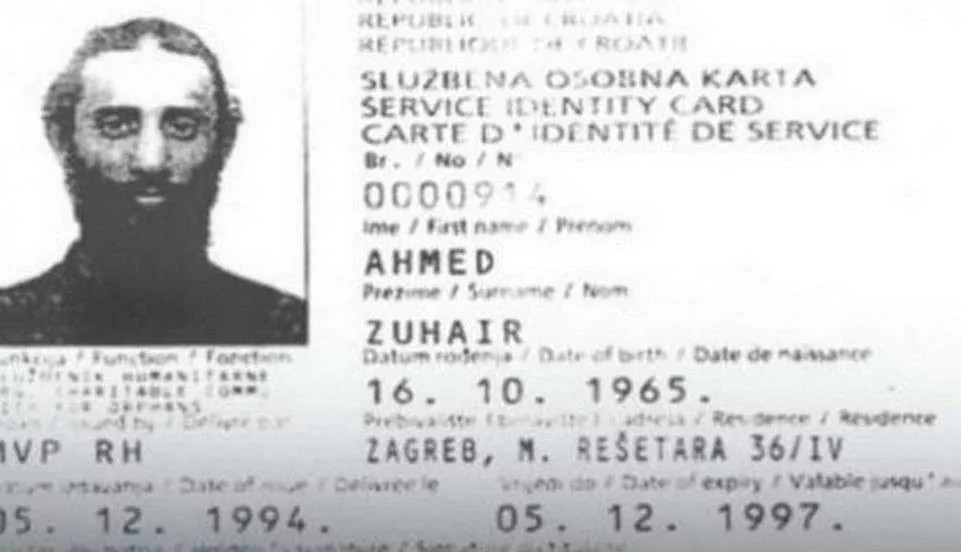
According to data from Western intelligence services, Ahmed Zuhair Handala married a Croatian citizen, who soon after moved to the USA and still lives in Virginia today. The identity of Ahmed Zuhair Handala is confirmed by the date of birth on his ID card: October 16, 1965. His ID card was issued in Zagreb on December 5, 1994, and was valid until December 5, 1997. The story of his stay in Bosnia is difficult to sustain.
Namely, the Washington Agreement, which brought peace between Croats and Bosniaks, was signed on March 31, 1994. Things had not settled down even by September of that year due to constant tensions. How did Ahmed Zuhair obtain a legal ID card in December 1994? Of course, this is a suspicious issuance of a document. Ahmed Zuhair Handala, as a foreigner in Croatia, could only have refugee status, regardless of his mysterious and brief marriage to a Croatian citizen.
While countries do not allow their asylum seekers to leave the country, according to intelligence data, Ahmed Zuhair traveled freely throughout the Middle East, from Saudi Arabia to Yemen, while he had Croatian identity documents.
In 1996, Zuhair traveled to Jeddah and returned to Croatia again. According to reports from an arbitrary and even biased BiH commission on terrorism, he was allegedly arrested in Bosnia for a traffic accident, for which he received a five-year prison sentence.
How is it possible that all this unfolded around one person in such a short period? This can only be clear to those who wrote reports on Ahmed Zuhair Handala's activities in the Ministry of Security of BiH afterwards. In fact, all these data are missing at least ten years to draw a logical path of this Mostar bomber terrorist.
It is constantly said that the explosion in Mostar was allegedly Ahmed Zuhair's revenge. The question is, whom and why did he want to take revenge on? And who is Ahmed Zuhair really? Intelligence services treat him as a Saudi, while the Croatian security service treats him as a Sudanese. Handala's last conversation was with a Croatian Telecom user, and those suspected and detained for the terrorist act were precisely Croats. International security forces SFOR immediately suspected the Croatian version of the terrorist act in Mostar. The explosion occurred twenty minutes before midnight. It is a miracle that with the horrific amount of explosives in a huge parking lot area on Splitska Street and on the street, no one was present, and there were no fatalities.
How is it possible that Ahmed Zuhair escaped justice? Domestic media later invented a story that he lived in Želježno Polje, in central Bosnia, that he was supposed to be arrested, but then escaped after being warned by police officers. No one at the time wondered how he escaped from Mostar, where, it was said, he was detained. His assistants from Bahrain and Yemen were sentenced to five and seven years in prison for this terrorist act. Handala is gone, disappeared without a trace. As many as 11 years later, in 2008, American troops arrested him in Afghanistan and imprisoned him as a member of Al-Qaeda. Shortly thereafter, he was released and went to Saudi Arabia.
Finally, the question: Why did Croatia, which convicted Ahmed Zuhair Handala in absentia, never request his extradition? The question is constantly asked cynically how it is possible that the terrorist's ID card is regularly found at the scene of terrorist crimes. Here is the ID card of Ahmed Zuhair Handala, issued in Croatia, under which Miroslav Tuđman had absolute intelligence oversight.
Komentari (0)
Prijavite se za komentiranje
PrijavaJos nema komentara. Budite prvi!
Minuta
Sve →Iz drugih kategorija

High Representative Not Elected: Germans, French and British Sabotaged Americans, New Attempt at End of June

ČOVIĆ WITHOUT MERCY: How Those Who Brought Ademović to Office Created a Political Hell for Him



Sunny Saturday, quite warm



Tragedy in Albanian resort: Two minors drown












