
By: Armin Sijamić
The so-called Western Balkans has not been in the focus of the major world powers for a long time, which is good news, at least if we know what sparked interest in this part of the world at the beginning of May. Two news articles and two massacres in Serbia have precisely depicted today's Serbia, and consequently the entire region where nationalism is returning, as the German president also noted yesterday.
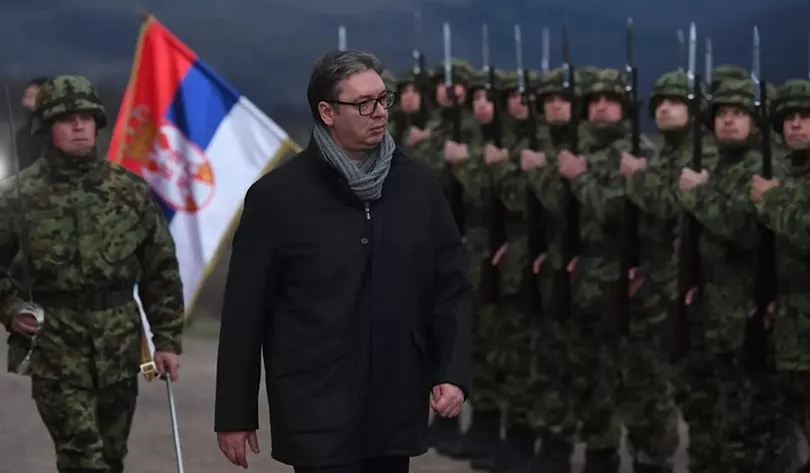
On the day when thirteen-year-old Kosta Kecmanović committed a massacre at an elementary school in Belgrade, the American The New York Times published an unusually long article about the President of Serbia. Aleksandar Vučić was described in that article as a "football hooligan" who authoritatively rules Serbia with the help of criminal groups and media outlets that do not shy away from broadcasting any content, including the disfigured bodies of victims of mafia showdowns, which he comments on for hours on television. The article explains how fan groups operate in Serbia and mentions their involvement during the aggression against Croatia and Bosnia and Herzegovina.
The article leads to the conclusion that these fan groups are an extended arm of the government in Serbia and that fanning nationalism and promoting it is one of the tasks these groups have. This has not escaped foreign powers, so Russia counts on the fact that such a Serbia can be a destabilizing factor for neighboring countries. "The banditry that has flourished under Vučić" along with "occasional threats" that Serbia will "protect Serbs" in neighboring countries "could threaten the peace" that was achieved in Dayton in 1995, writes the NYT. "Vučić's brand of ethnic chauvinism and demagoguery resembles that of his ally Putin; the spread of illiberal democracy – already gaining ground in parts of Europe – poses an equal, perhaps more ominous, threat," it further states. All this indicates that Serbia's current policy is not a deviation but a clear plan that Belgrade is implementing as much as others allow.
Such an article in the NYT about a country's president would surely be the main news for days. The massacre committed by the thirteen-year-old completely pushed that article aside, and when Uroš Blažić committed a massacre in Mladenovac the next day, no one remembered it. Thus, the perspective of foreign journalists on the processes happening in our region remained unnoticed in our public, and consequently, there was no critical reflection on the text published in one of the most widely read media outlets in the world.
Two days ago, The Guardian also wrote about Vučić and Serbia, calling him a "populist" and "authoritarian" leader looking towards the Kremlin, who governs a "divided nation" that is armed to the teeth with legal and illegal weapons. The Guardian also writes about Vučić's intention to "disarm" Serbia, as well as the protests that followed two massacres in which 18 people were killed and 21 injured. This article also did not receive the necessary attention, as if the public had resigned itself to the fact that "what we already know" was written in the text. This is precisely what is worrying, when events cannot attract the attention of the majority of people, which consequently leads to no reaction. And there are more than enough reasons to talk about it.
Debate on "Values"
After Kecmanović and Blažić committed the massacres, the media in Serbia were flooded with content about what drove the boy and the young man to kill according to a list and without a list. Kecmanović's crime is shocking due to the fact that a thirteen-year-old boy coldly kills "enemies" he was looking for at school, and Blažić's crime is shocking due to the fact that a twenty-year-old man, in a fit of rage, killed whoever he found on the street.
Many tried to answer what led to such a situation in Serbia. As expected, in a "divided nation," the answers were also different, so some claimed that the "system" that has existed in Serbia for thirty years, the legacy of nationalism and chauvinism in the structures of politics and the church, was to blame for the crimes. The more numerous blamed Vučić and "Western values" for everything, which corrupted the idyllic "traditional family values".
Things were trivialized to the point that the culprit was found in reality shows, social networks, and media content. The government spoke about "controlling" the internet, the destructive influence of video games and media that bring "values" from the West to Serbia, as if the internet is not free in other countries, children do not play video games, and there is no bad media content and their own "reality stars" whose task is to keep people away from politics. In their confrontation with the West, it did not occur to them that, for example, Greece is the West and a Orthodox country, or that Switzerland and Finland are the West and their populations are armed, that in the Czech Republic the majority of the population are atheists, and that in Lithuania and Romania the population is almost unarmed.
Few are those who blamed the government, nationalism, the actions of the Serbian Orthodox Church, wars, the cult of weapons, corruption, poverty, the glorification of war criminals, and the devaluation of victims by claiming they were to blame and that many of them were killed by their own compatriots who wanted to blame others for their murders. Thus, for example, if we look back at the last few years, we can see military exercises in which people who admire the weapons Serbia is buying participate, the undisguised enthusiasm on social networks for every new arms purchase that one of the poorest countries in Europe has paid for dearly, a political elite that does not respect the verdicts of international courts, convicted war criminals in the media, support for the destruction of Ukraine, denial of neighboring nations and states...
The government could stop most of the above, but it does not. In addition, this same government has convinced many that it has changed compared to the nineties of the last century and that neighboring countries and peoples do not want cooperation. Those who swallowed that bait should ask themselves where Germany was thirty years after World War II, and where Serbia is thirty years after its elite decided to wipe entire countries and peoples off the face of the earth.
This time too, Vučić played one of the main roles in the media. He said that one of the measures for the current situation would be the "death penalty," which he cannot introduce because Europe prohibits it. So, he would respond to violence with violence, not with societal change. However, that is not the worst that could be heard and read in this debate. In a series of media appearances, many called for more weapons, arguing that an armed populace is a more difficult target than an unarmed one. Some argued that only an armed populace can prevent the state from abolishing citizens' freedoms and that only weapons guarantee that the ruler will not become a dictator.
Regional Realignment
In the last few years, processes have been taking place in the region, supported by some Western countries. In short, the goal of these processes is to remove a certain number of politicians and a new regional redistribution of power in which Serbia will have a central role as the largest country in this part of Europe, as part of the "Open Balkan" project. This "reformed" Serbia should be the leader of the entire region on the path to Euro-Atlantic integration, which is an illusion that costs a lot.
One of the first regional politicians who had to leave was the Montenegrin president Milo Đukanović, who, among other things, resisted the "Open Balkan" concept based on unclear economic and political settings. The West insisted on his departure, while Belgrade media furiously attacked Đukanović, actually targeting Montenegro and the region. Đukanović received confirmation that this was the wrong path yesterday in Berlin.
On his farewell visit to Berlin, his host was German President Frank-Walter Steinmeier, who did not spare words in praising his guest, which is less important now. What is important is the statement by the German president and former foreign minister that "unfortunately, Đukanović's warnings about the return of nationalism" in the region are correct and that it is a "frightening tendency that we must take seriously." Therefore, what The New York Times writes and what many in this part of Europe have been saying for years is true: dangerous nationalism has not gone anywhere, it has just been successfully repackaged and disguised.
Komentari (0)
Prijavite se za komentiranje
PrijavaJos nema komentara. Budite prvi!
Minuta
Sve →Iz drugih kategorija

High Representative Not Elected: Germans, French and British Sabotaged Americans, New Attempt at End of June

ČOVIĆ WITHOUT MERCY: How Those Who Brought Ademović to Office Created a Political Hell for Him



Sunny Saturday, quite warm



Tragedy in Albanian resort: Two minors drown












