
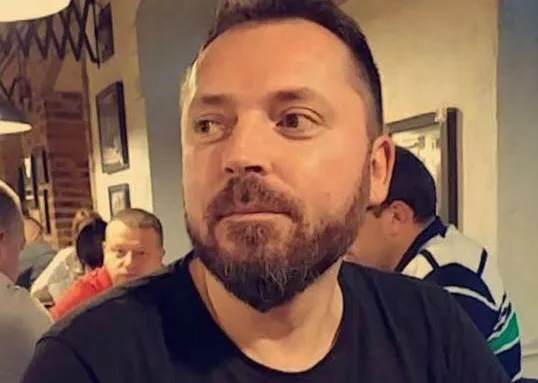
Dragan Bursać can be described as a Bosnian journalist and columnist who currently faces perhaps the most open threats due to his extremely sharp stances towards the country's authorities.
In an interview with the Patria agency, he talks about these threats to his family and himself, from whom he receives the most support, what he expects from the announced Fund for Assistance to Journalists, and how much the media and journalists themselves participate in the degradation of Bosnian society.
Bursać is a philosophy professor. He works as a columnist and journalist for the BUKA portal and the Al Jazeera Balkans portal.
NAP: The death threats you received shocked public opinion in BiH? The person who threatened you has been identified. What were the consequences of such an act for your family and you? What legal actions have been taken against the person who made the threats?
BURSAĆ: Let's go in order. Three death threats have been brought before the court. The first, according to the prosecutor, has expired. The second is being processed ex officio. The third, the most serious one, the Court has not yet begun to resolve. Unfortunately, as I have been informed, laws have been changed in the meantime, so if an individual does not pursue the primary defendant in a private lawsuit, they are often given some ridiculous suspended sentences: bans from social networks, and the like.
As you can see, the direct consequence is that a journalist and columnist becomes a lawyer (laughs). But, seriously, my family felt the worst of it all, because the threats were partly directed at them as well. Simply put, I was put in a rather selfish position, where, because of my work, I would be the one endangering my family's lives. Of course, this will not deter me from continuing my work. On the other hand, certain legal measures have been taken to protect me and my family. And I must emphasize this, in the last six months, I have spent more time at the Ministry of Internal Affairs, courts, and prosecutor's office than in newsrooms. It is exhausting, but I must thank the employees at the Ministry of Internal Affairs for their excellent work, as much as their material resources allow. Believe me, these people are paid miserably, and their working conditions are frozen somewhere in 1984.
NAP: The Dutch Ambassador to BiH, Reinout Vos, emphasized that journalists represent the conscience of society and must be protected in any case. He also recalled your case. What were the domestic, and what were the foreign reactions to these threats?
BURSAĆ: I wouldn't be able to divide it so crudely into domestic and foreign reactions. I have already said that I had support from the Ministry of Internal Affairs. There are colleagues from Al Jazeera, BUKA portal, Analiziraj.ba portal, where I work, then colleagues from almost all BiH's umbrella journalistic associations and journalists. On the other hand, in Banja Luka, the city where I live - SILENCE. With a few honorable exceptions, it turned out that my colleagues either don't understand my situation or, which is terrible, rejoice in it. That was a terrible realization.
“Foreigners,” representatives of foreign embassies, from American, Dutch, German, to representatives of the EU, have helped me immensely by advocating for me. They were almost constantly available to me. In those moments, it truly meant a lot to me and my family. Because, when you are in a city that ignores you, to put it mildly, any support is welcome.
NAP: Unfortunately, we don't know what domestic political support would be for. They live on national divisions and bear the main responsibility for numerous tensions. Everything that emerges in BiH society emerges under their umbrella...
BURSAĆ: Exactly. And I wouldn't have anything to add to that. Looking at the current government and opposition in RS, I am simply glad that none of them have offered me any support.
NAP: The establishment of a fund to help journalists is just one step that should help maintain this profession at a decent level. Do you have any ideas about what other solutions could bring relief to people in this profession?
BURSAĆ: The fund for assisting journalists will be functional if journalists first realize that they are being mobbed, threatened, manipulated... You know, it's like abuse or mobbing. Often, the victim justifies their attacker. Sometimes I get the impression that journalists consciously justify their editors, justify their existential situation, justify everything, just so they don't admit how threatened they are. And then, we must be COLLEAGUES. I felt firsthand how much a kind word means, or rather, how bitter indifference and a silent call for lynching are. I think we generally lack that collegiality. Simply put, the Fund will come to life when journalists understand its importance, not just when it is active in incident situations, out of necessity. It must prevent, not heal already created wounds and gaps.
NAP: It is a general opinion that only journalists, through their professional struggle, can move this country forward towards a democratic and civilized better tomorrow. On the other hand, when you criticize the authorities in Banja Luka, it seems that mostly Bosniaks and Croats applaud you. Has our society matured enough to accept the truth that journalists speak about?
BURSAĆ: Journalists are the ones who should present reality. Period. Columnists can comment on it. Period. Journalists have neither a legal nor a pedagogical function. We have long since mixed things up. So, what do our schools, faculties, families do? What do our judiciary, prosecution, politics do in the end? A big NOTHING. But, please, journalists can't do everything and also be clay pigeons for everyone. As for the applause in Sarajevo and Mostar, for criticizing Banja Luka and vice versa, I absolutely agree. There is a general social hypocrisy at play. Here in BiH and the region, the public is not interested in reality and the actual situation, but in stances and the defense of stances. So, I have a situation where the "patters on the shoulder" in Sarajevo praise me to the skies when I call out Serbian war criminals and their glorification, but these same people will gladly "spit" on my work when, for example, I write about the rise of Bosniak neo-fascism. Complete hypocrisy!
NAP: Viktor Ivančić once said, paraphrasing, that the media also often participate in the collapse of society. He meant that authorities often misuse the media. Do you share his opinion?
BURSAĆ: I agree with Viktor. Especially in the Balkans, the media have not only been unfree but ordinary political weapons that have ignited nationalist fires and were in the hands of executioners. And that's how it is, let's be clear, just in a different form even today. So, just take RTRS. It's Dodik's fanzine. And they don't hide it at all. But that's not the problem. The problem is the "genetics" of such media. Specifically, RTRS was Karadžić's and Biljana Plavšić's, and before that, they were proven cadres of the League of Communists... I want to tell you, the principle is the same, everything else is nuances. There is no "j" of journalism there, they are distributors of information, couriers... And it seems to me that we should first solve that cancerous sore in the territory of our countries, before even engaging in serious journalistic stories.
Komentari (0)
Prijavite se za komentiranje
PrijavaJos nema komentara. Budite prvi!
Minuta
Sve →Iz drugih kategorija

High Representative Not Elected: Germans, French and British Against Americans, New Attempt at End of June

ČOVIĆ WITHOUT MERCY: How Those Who Brought Ademović to Office Created a Political Hell for Him



Sunny Saturday, quite warm



Tragedy in Albanian resort: Two minors drown












