
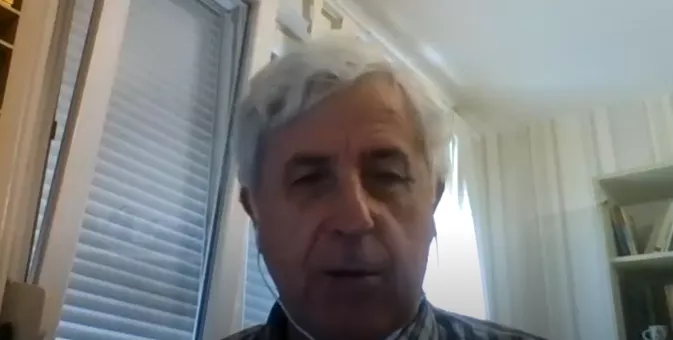
(Patria) - Today's session of Krug 99 is dedicated to a very important topic - Are we facing a crisis in food supply and production?
Dr. Hamid Čustović, professor emeritus, stated that from the perspective of food supply and production, dramatic changes have occurred in the recent period, especially since the outbreak of the Covid-19 pandemic and the Russian invasion of Ukraine on February 24, 2022.
"From the moment of Russia's invasion of Ukraine, it was clear that it would affect the food supply process and create a serious problem of hunger on a global level. These two countries are significant producers and suppliers of food, primarily wheat, corn, barley, sunflower, and other products such as mineral fertilizers.
All world organizations immediately warned that the war would cause an increase in food prices, and many people around the world would not be able to afford sufficient quantities of these products for their nutrition. After three months, these ominous predictions have come true. It is difficult to precisely say how much the war in Ukraine itself impacts the crisis of food production and supply on a global level, as other problems in food production and supply are also linked to this, such as droughts of varying intensity in different parts of the world, and the economic consequences of the pandemic, which caused many people to be unable to buy enough food for themselves and their families.
Transport of goods was very limited. A jump in energy prices and, consequently, an increase in the prices of raw materials and services. According to UN FAO, food prices increased by 12% from February to March alone, which is the largest increase in food prices for such a short period ever. The number of people in need of food and facing supply insecurity is alarmingly growing. The most vulnerable areas in terms of food shortages due to the consequences of drought and wars are Afghanistan with 65% of the population, West Africa with about 27 million, and this number is expected to grow to as high as 40 million. Major humanitarian problems are present in Somalia, Kenya, and Ethiopia, among others. Even before the war, there were similar problems, as wealthy countries did not provide enough money for humanitarian funds. When it comes to Ukraine, that situation has changed. WHO Director-General Tedros Adhanom Ghebreyesus openly called on the World Community, stating that all the money is going to Ukraine, which is good, but a portion of it should also go to Tigray in Ethiopia, Yemen, Afghanistan, and Syria, also war-torn areas where people are suffering, and that the International Community should treat all lives equally.
Humanity needs productive land to feed nearly 8 billion people on planet Earth. Globally, almost 2 billion people live below the level of safe access to sufficient quantities of quality food. The world is not on track to achieve SDG goal zero hunger by 2030. If this trend continues, about 10% of the world's population will be hungry in 2030.
By 2050, global food production should increase by up to 50% to feed, as expected, more than 9 billion people. But how will we even meet these growing food needs when it is predicted that land degradation and climate change will together reduce crop yields by an average of 10% globally and up to 50% in certain regions?
Bosnia and Herzegovina generally has little quality agricultural land. Across the entire territory of Bosnia and Herzegovina, the top three quality categories occupy only 14.2% of the area. In rural municipalities, space devastation is present due to de-agrarianization, with abandoned land being influenced by natural processes that lead to the complete destruction of the agrarian landscape that has been established for centuries. The efficient use and protection of agricultural land is one of the most important tasks for all levels of government.
According to data from the Agency for Statistics of Bosnia and Herzegovina for 2021, in the structure of total sown areas (spring sowing), cereals account for 75.8%, industrial crops for 5.09%, vegetables for 9.3%, and fodder crops for 8.4%. Other crops represent 1.37%. More than 50% of arable land is not used in agricultural production. One-third of rural areas are abandoned and left to degrading processes, especially in mountainous regions.
Agricultural production takes place on small, fragmented land holdings and is characterized by a low share of production for the market. The application of agrotechnical measures is at a low level, and farms are insufficiently equipped. Most arable land is not irrigated, and the level of protection against adverse weather conditions is low, resulting in low and unstable yields.
Bosnia and Herzegovina is a net importer of agricultural and food products. In 2020, the export of agricultural products amounted to 846.40 million KM, while the import of agricultural products was 3.01 billion KM, resulting in a deficit in agricultural trade of 2.16 billion KM. In the observed year, compared to 2019, there was a 3% increase in agricultural product exports, a 5% decrease in imports, and a 7% decrease in the deficit. The coverage of imports by exports of BiH in agricultural product trade was 28.16%. The trade deficit in agricultural product trade is essentially a reflection of the overall situation in agriculture in Bosnia and Herzegovina.
Agricultural product prices in 2021, compared to the average prices from 2015, are higher by 26.9 percent, announced the state Agency for Statistics. In 2021, compared to prices from 2015, there was a 37.5 percent increase in crop production prices and a 16.4 percent increase in livestock production prices. Prices of goods and services for current consumption in agricultural production in 2021, compared to the average prices from 2015, are higher by 12.1 percent.
Is there hope for better times? New initiatives are opening up space and providing opportunities for major changes in sustainable agricultural management at the global level. The restoration of degraded landscapes and rural areas has the potential to become a new business paradigm, the so-called economic recovery and green economy. New business models are emerging, technology is advancing, and world governments are showing political will. This is excellent news for investors looking for economic growth opportunities. This is also good news for the economy, jobs, food security, and planet Earth. By protecting, securing, and rehabilitating key ecosystems, we can ensure a safer future for generations to come.
Are the authorities at the BiH level capable of responding to these challenges and crisis situations that are increasingly occurring, such as pandemics, regional wars in Ukraine, or natural disasters, droughts, floods, fires, etc.? Obviously not. For decades, we have been going in circles at a level that does not ensure progress and security for the population in terms of sufficient supply of basic food products. This is shown by the decrease in agriculture's share in GDP from 9% in 2000 to 6.08% in 2020. Employment in the agricultural sector was 20.6% in 2006, while it was 12% in 2020. Budget funds for incentives serve more to maintain social peace than to improve production and raise it to a higher level. The non-transparent spending of these funds allows ruling parties to achieve their particular interests with their voter base, while general interests and integration into modern production flows are neglected. BiH certainly has solid potential for such an approach, but it lacks the vision for adaptation and adjustment to changes.
These opportunities can be realized in a secure environment, without constant tensions from peace disruptions, an integrated market, and the development of a political system of an efficient and functional state. The formation of a Ministry of Agriculture at the state level would be an expression, as well as a strong incentive, for dynamizing initiatives and successful businesses in food production in BiH," stated Dr. Čustović.
Komentari (0)
Prijavite se za komentiranje
PrijavaJos nema komentara. Budite prvi!
Minuta
Sve →Iz drugih kategorija

High Representative Not Elected: Germans, French and British Sabotaged Americans, New Attempt at End of June

ČOVIĆ WITHOUT MERCY: How Those Who Brought Ademović to Office Created a Political Hell for Him



Sunny Saturday, quite warm



Tragedy in Albanian resort: Two minors drown












