
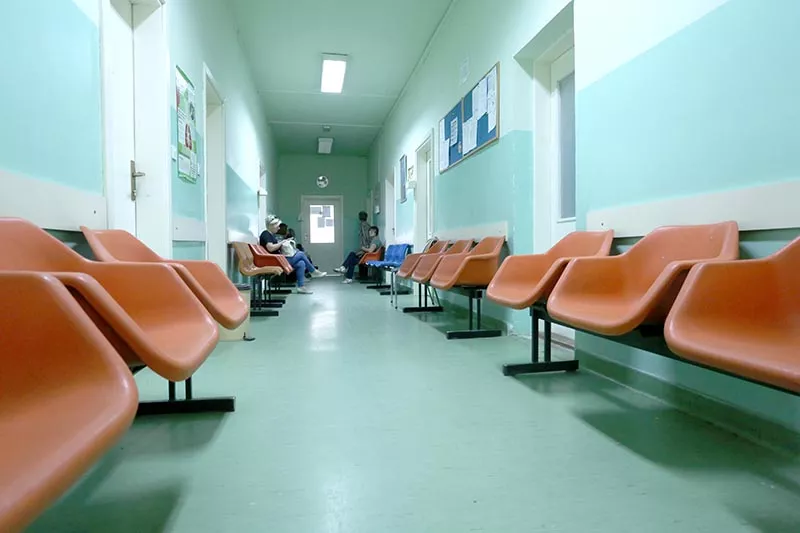
If a major accident had occurred in the area of East Sarajevo in July this year, the local health center would not have been able to provide adequate medical services. Consumables, including infusions, were on reserve, and employees were demotivated due to a two-month delay in salaries.
Difficulties in operations arose because local politicians could not agree for months on the appointment of a director for the "Istočno Sarajevo" Health Center. These are representatives of different political options in the two municipalities that are co-founders of this healthcare institution. In the Municipality of Istočno Novo Sarajevo, the parliamentary majority is led by the Alliance of Independent Social Democrats (SNSD), and in Istočna Ilidža, by the Serbian Democratic Party (SDS).
In their political struggle, they went so far that for a time each municipality had its own acting director, but neither had official authority to sign payment orders. Because of this, in mid-July this year, the health center employees organized a strike. They only provided services to emergency cases.
Shortly thereafter, the two municipalities reached an agreement. To satisfy the appetites of political forces, instead of one, two heads of the Health Center were appointed for both municipalities. Zoran Krstović was appointed director representing Istočna Ilidža, and Danilo Kujačić was appointed to the position of deputy representing Istočno Novo Sarajevo. The agreement was reached at the expense of the Health Center, which will now pay two managers instead of one.
Both have identical authorities, and all decisions must be made jointly.
Two Directors in One Health Center
The Speaker of the Assembly of Istočno Novo Sarajevo, Dejan Šantić, says that the process of appointing directors was simpler before when the same political options were in charge of the two municipalities. The director was chosen by the councilors of one municipality, confirmed by the councilors of the other, and then the agreement was formalized through a public tender. The Secretary of the Assembly of Istočno Novo Sarajevo, Dragan Cvjetić, says that the tender is a farce. He confirms that tenders are tailored to the criteria of the chosen candidate: "They only fail to paste the picture."
In September 2011, Dragan Krstović, a social work graduate, was elected director of the Health Center. As a member of the Party of Democratic Progress (PDP), he became part of the ruling coalition the following year after the 2012 Local Elections, also serving as a councilor in the Assembly of the Municipality of Istočno Novo Sarajevo.
"I think that councilor position did strengthen my position as director. It would be dishonest to say it didn't," Krstović said in an interview with the Center for Investigative Journalism (CIN).
CIN's interviewees believe that Krstović's position as a councilor helped him remain director of the Health Center until the end of May this year, even though it was determined in 2014 that he had met the conditions for retirement. Additionally, his four-year term expired in October 2015. An initiative was launched, but his dismissal did not occur.
Without waiting for a decision from the councilors in Istočno Novo Sarajevo, their colleagues in Istočna Ilidža withdrew their consent for the appointment of Dragan Krstović in January this year. They appointed his cousin, Zoran Krstović, a general medicine specialist at a local clinic of this health center, as the acting director of the "Istočno Sarajevo" Health Center.
This appointment was not accepted by the Municipality of Istočno Novo Sarajevo, which, after a series of failed negotiations in May, dismissed Dragan Krstović and appointed its own acting director, also a councilor from the Assembly, Danilo Kujačić, an agricultural engineering graduate.
Šantić says that Kujačić was appointed solely because he was the only candidate on whom the majority of councilors could agree. He himself proposed Kujačić as acting director because, during the exhaustive assembly debate, councilors could not come up with any candidate proposals.
The Health Center operated with two acting directors for about a month and a half, but neither was registered in the court register. Therefore, neither of them could sign orders for salary payments or the purchase of consumables.
Salaries were delayed, and consumables became scarce. Patients claim they had to buy them themselves. "Believe me, we only have five infusions left, which we are saving for emergencies," nurse Borka Šućur told CIN journalists just before the strike. During the one-day work stoppage, they only provided emergency services to patients.
After that, an agreement was reached that satisfied the political interests of both municipalities. The Statute of the Health Center was amended, and a deputy director was introduced alongside the director in the Management Board. They agreed that Zoran Krstović and Danilo Kujačić would serve as heads until September of this year, when they will elect management for a four-year term. For the first four years, the director will be chosen by the Municipality of Istočna Ilidža, and the deputy by the Municipality of Istočno Novo Sarajevo, and vice versa thereafter.
Politics in Health Centers
According to the Law on Healthcare of Republika Srpska (RS), health centers are founded by municipalities and cities, whose representatives in the assembly elect the directors. "Most often, a political person, politically suitable, is appointed, regardless of whether they are professional or capable, just to satisfy the form of political parties," says Milenko Granulić, president of the Healthcare and Social Protection Union of RS.
He says that the "Istočno Sarajevo" Health Center cannot benefit from an agricultural engineer: "God forbid if any epidemic or anything else appears, what will he discuss?! How will he organize to suppress it?! He has no idea. It's nonsense."
According to CIN's research, at least 30 current and former directors of health centers in RS are members of political parties. At least nine of them were both directors and councilors at the same time, and 15 health center directors are candidates in this year's elections.
Among them is Saša Jovičić. As a councilor in the Assembly of the Municipality of Srbac, he voted for his appointment as director of the local health center. Jovičić is no longer a councilor but remains director.
"Look, you are a councilor in the city assembly that appoints you as director, that approves your final accounts, that approves your work plan and reports. That's nonsense," says Granulić.
This is confirmed by the minutes of the assemblies of the Municipality of Istočno Novo Sarajevo, where councilors did not discuss much when the work reports of the Health Center, managed by their fellow councilor Dragan Krstović, were on the agenda. Although patients had complaints about the services in this healthcare institution, councilors only spoke up to praise the director's work. Few engaged in discussions about the quality of service.
Through Directors to Jobs
CIN's interviewees explain that the director position is important for politicians because of its influence on employment. "How are elections won? By employing people in public enterprises and public institutions," says the Secretary of the Assembly of Istočno Novo Sarajevo, Dragan Cvijetić. In some health centers, the children of current employees and relatives of local politicians work.
Health center directors are generally responsible for employment. Granulić says that public tenders are rarely announced, and therefore there is no guarantee that the best staff are hired in health centers. "We know how employment works in BiH today - mostly through family ties or money. That's an open secret," says Granulić, adding that politicians do not care about the quality of healthcare services because "politics only cares about how to place its cadres and fulfill promises made before the elections."
According to data from the RS Health Insurance Fund, out of 54 health centers in this entity, 51 have excess employees. Last year, slightly over 26.3 million marks were spent on surplus employees. The most extreme examples are the "Trnovo" and "Novo Goražde" health centers, which spend over 65% of the money they receive from the Fund on excess employees. Last year, this amounted to almost 300,000 marks for these two health centers.
The Fund's representative, Biljana Rodić-Obradović, explains that if there were no excess employees, health centers could use this money to pay taxes and contributions. According to data from the Tax Administration of Republika Srpska, 43 health centers in this entity owe nearly 56 million marks.
Rodić-Obradović says that health centers would greatly benefit from paying their outstanding tax obligations. "If they paid that, it would be our revenue, and we finance them from that revenue."
Due to excess employees, the health center in Zvornik, one of the larger health centers serving about 50,000 patients, is also facing problems. Out of a total of 4.5 million KM received from the Fund last year, more than a third was spent on excess employees. Dr. Goran Birčaković, who is also in the union, says that these excess employees have also led to debts. The debt to the Tax Administration of RS amounts to slightly over 2.3 million marks.
Salaries are two months late, contributions have not been paid regularly, which often leads to strikes. The opposition and employees attribute excessive employment to the Democratic People's Alliance (DNS), whose cadres have managed this health center for the past ten years. Along with the Alliance of Independent Social Democrats and the Party of Democratic Action, the DNS forms the majority in the Assembly of the Municipality of Zvornik, which elects the health center director. The current director, Radivoje Aćimović, a former employee of the Municipality of Zvornik, is also a cadre of this party.
In an interview with CIN, he says he was the only candidate in the tender. He thinks his party membership helped him: "What do I know, I assume it did." Despite the Fund's figures on excessive employment, Aćimović believes that the "Zvornik" Health Center does not have excess employees: "We have a Rulebook on job systematization, the Ministry has confirmed it for us, and everything is in accordance with that rulebook."
Dr. Birčaković believes that problems arise because one institution elects the management, and another finances the Health Center: "The biggest problem with this financing, or rather losses, is that the municipality appoints you to a position, and you receive money from the Fund and the Ministry," says Dr. Birčaković.
However, Rodić-Obradović says that the Fund does not pay the health center based on the number of employees, but based on the number of patients and their age structure. "Whether you spend what you receive in one way or another, that is, therefore, the responsibility of the management of the healthcare institution," says Rodić-Obradović, adding that the Fund purchases services that, according to a survey they conducted among patients, could be of higher quality.
According to data from the Fund, the increase in the number of employees in health centers has recently been halted, which can also be attributed to last year's Amendments to the Law on Primary Healthcare of RS, which stipulated that the municipality that founded the health center will pay for excess employees.
"There is only as much money as there is, and it is primarily intended for financing healthcare, not for financing excess employees," says Rodić-Obradović.
Written by: Center for Investigative Journalism (CIN)
Komentari (0)
Prijavite se za komentiranje
PrijavaJos nema komentara. Budite prvi!
Minuta
Sve →Iz drugih kategorija

High Representative Not Elected: Germans, French and British Sabotaged Americans, New Attempt at End of June

ČOVIĆ WITHOUT MERCY: How Those Who Brought Ademović to Office Created a Political Hell for Him



Sunny Saturday, quite warm



Tragedy in Albanian resort: Two minors drown












