
By Sead Omeragić
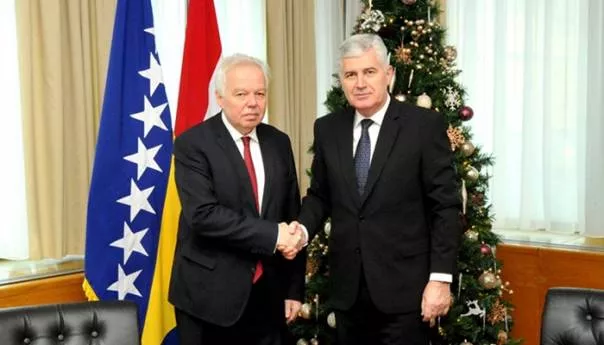
Dragan Čović met with the Russian Ambassador to BiH, Petar Ivancov, four days ago and then made a paradoxical claim that socio-economic development and dialogue are key to achieving BiH's integration into the EU and NATO. The Russian ambassador added that he "will continue to advocate for a sovereign and developed BiH, a country of all three constituent peoples, as well as for improving existing economic and political cooperation." This was something we had not seen or heard from the same actors before. What is hidden behind these paradoxical positions, we have not yet learned from our numerous media thinkers.
The current Russian ambassador, Ivancov, has rarely, or rather never, shown goodwill towards political Sarajevo as he has towards Dodik and Čović. In recent years, good relations between the Russian Federation and the Republic of Croatia have been evident. Is this perhaps why the constant and unambiguous support of Russian Ambassador Peter Ivancov for Dragan Čović and HDZ BiH is the main line of Russian policy towards BiH? After signing the ANP, what can Ivancov think of Dodik today, and then of his main political ally, Dragan Čović?
So far, Ivancov has acted only rationally politically towards these two, relying on some historical connections and facts. This is, unfortunately, just another of the many atavistic policies that plague Bosnia and Herzegovina. HDZ, first and foremost, was created as a response by the Croatian diaspora to the idea of an independent Croat state. Franjo Tuđman relied heavily on the support of Croatian emigrants in creating the state. Tuđman's Croatia, in the nineties, relied economically on cooperation with Russia, and businessmen who had good business ties with this superpower most often entered the government. This was the case until recently, when the Agrokor affair erupted and this megacorporation was evidently saved by loans from the powerful Russian Sberbank of as much as one billion and 200 million euros. Of course, such a loan could not have been approved without state approval, nor without great geostrategic interest.
The European Union and the US are confused by the unusually strong political, economic, and other ties of the Republic of Croatia with the Russian Federation. Few know that there is a deeper historical background to these relations? As we said, this is especially unknown to local politicians and, unfortunately, political analysts. The fact is that the Russian political leadership supported the first agreements between Tuđman and Milošević in the autumn of 1990. After the war, which "sifted" and bloodily divided Serbs and Croats within their two states, Bosnia and Herzegovina became the place of unity for these two Greater State ideologues. Russian policy often and uncritically supported the policies of Tuđman and Milošević towards BiH. Similarly, for a long time, His Excellency Russian Ambassador Peter Ivancov uncritically supported the positions of Dragan Čović and Milorad Dodik, even when they openly acted against their country, Bosnia and Herzegovina.
Serbs and Russians are bound by a long historical friendship. The ties between Russians and Croats are more recent, but equally strong and date back to relations from about forty years ago. Historian Prof. Dr. Tvrtko Jakovina discovered a document from 1980 in the archives of the former Yugoslav Minister of Foreign Affairs, Josip Vrhovec, about a meeting between Budimir Lončar, Yugoslavia's ambassador to the US, and Zbigniew Brzezinski, advisor to US President Jimmy Carter, which proves the claims that in the 70s and 80s of the last century, the Soviet Union, led by Leonid Brezhnev, secretly supported the Croatian political emigration in the West in the fight against Yugoslavia.
This document contains Lončar's observations: "Brzezinski was well-informed about the issue. Personally unwilling to yield to Moscow, he confirmed that the thesis that 'the activity of extreme emigration most benefits Soviet intentions' is correct." Lončar then conveys: "In strict confidence, Brzezinski tells me that they have discovered that Soviet services are involved, even financially, in the activities of Yugoslav extreme emigration. They have irrefutable evidence that Soviet services support and encourage the activity of Ustasha emigrant groups in Germany and Austria.
This is now being investigated in the US. They discussed this on several occasions in the National Security Council in the context of shaping relations with Yugoslavia"... This was written without hesitation even in the United States in the emigrant newspaper "Hrvatska borba" (Croatian Struggle), which was published in Washington.
The Croatian Revolutionary Brotherhood from Australia, at the height of this upheaval in emigration, in the early seventies, put up posters: "A Soviet Croatia is better than a US Yugoslavia." Dr. Branimir Branko Jelić was one of the most respected and powerful Croatian politicians in emigration. Dr. Jelić, president of the Croatian National Council (HNO), openly stated that Croats were betrayed by Western policy, which classified them as collaborators of Nazism and Fascism. He then made a shocking turn for the Croatian emigration towards Soviet Russia. According to serious researchers, Dr. Jelić, in a letter to the General Secretary of the Central Committee of the CPSU, Leonid Brezhnev, offered an island in the Adriatic (Krk, according to information) and the Mostar airport (opened in 1965) for military presence and the installation of missile systems, if Croatia were liberated from Josip Broz's regime.
It was a rather risky attempt at new connections. Jelić gave a series of speeches at these emigrant gatherings, in which there were no longer any anti-communist outbursts. Even these gatherings were called "plenums," and the new allies were called "our Soviet brothers."
Večernji list, on November 20, 2011, presented the reasons for Jelić's 'Russian risk': "The Soviets were not the only ones seeking space in Yugoslav conflicts. Parts of the Croatian emigration also became active, sometimes on their own initiative, and sometimes at the behest of various intelligence services. Dragutin Haramija, president of the then Government of the Socialist Republic of Croatia, on December 2, 1970, sent a letter to Mitja Ribičič, president of the Federal Government, in which he accused intelligence operative Đuro Pintarić from the Yugoslav military mission in Berlin of spreading insinuations that the Croatian leadership was in collusion with emigrant leader Dr. Branko Jelić, who had allegedly established contacts with Moscow. In the perspective of these 'contacts' would be an independent Croatia, under communist rule, from Trieste to the Drina, within the Soviet bloc and with Soviet-type socialism. In return, the USSR would gain military bases in Mostar and near Rijeka. The source of these claims was Jelić's assistant, Velimir Tomulić, actually an agent of the Yugoslav intelligence service," writes Večernji list.
These claims by Večernji list are not in line with the claims of Božo Vukušić, a publicist who has dealt with the Croatian emigration for decades. He writes that Tomulić is a CIA agent. For other connoisseurs of the situation, Tomulić was far above the intelligence milieu. On several occasions, he confirmed in the media the cooperation between Dr. Jelić and the Russians.
The portal of the Croatian Cultural Council reminded of those days in May 2010: "There are signs that the late Dr. Branko Jelić received not only confidential information from Zagreb but also accepted many suggestions for political moves, including his new political course of seeking connections with one of the Eastern European communist countries (Warsaw Pact, op.a.) and through it with the 'Soviet Union'." "Express" in an article from June 2, 2015, claims: "Russia, by the way, cooperated with the Croatian emigration in the '70s and '80s, even the truly extreme ones. Dr. Branko Jelić was considered a collaborator of Soviet services, and Tito was quite afraid of a Russian strike supported by separatist-minded Croatian organizations – he saw great danger there." Dr. Branko Jelić, prompted by the events of the Croatian Spring, wrote an open letter to Vladimir Bakarić, then the most powerful Croatian politician, with several questions.
The last in the series was whether he could "deny that a delegation of Croatian communists went to Sofia to seek help from the Bulgarians and that they went with them to Moscow to seek the restoration of the Independent State of Croatia?"
On May 5, 1971, Branko Jelić barely survived an assassination attempt in West Berlin, with more than a hundred wounds from a landmine placed under the threshold of his medical practice. Jelić died from his injuries a year later, in May 1972. Nine years ago, the portal of the Croatian Cultural Council confirmed "the secret contacts of Dr. Branko Jelić with certain diplomatic circles of the Eastern communist bloc and his open approach to Moscow through the Croatian state."
Years later, numerous authors and witnesses have confirmed this Russian and Croatian emigrant connection. Tomislav Krolo published the book "Croatian Political Emigrant 1941-1991." He writes about the situation in the HNO after Branko Jelić's death. Describing the beginning of the HNO's activities, the author states that Branko Jelić took the initiative to talk with representatives of the USSR about establishing an independent and neutral Croatia... Krolo claims that this initiative by Jelić resonated within the Croatian emigration, and according to him, Velimir Tomulić, the editor-in-chief of the newspaper Hrvatska država, founded the League of Communists of Croatia in West Germany in 1971 and launched the newspaper Socijalistička Hrvatska (Socialist Croatia).
Božo Vukušić, in his book "Udba's Secret War," confirms that Tomulić, with Tomo Sedlo, "founded the foreign section of the League of Communists of Croatia. The organization launched the newspaper 'Socijalistička Hrvatska.' This newspaper promoted pro-Soviet socialism, and since the West generously helped Yugoslavia, 'Socijalistička Hrvatska' wrote that Croats should seek help and alliance in the East, as Moscow was interested in weakening Yugoslavia and destroying Titoism," wrote Vukušić and confirmed Dr. Jelić's pro-Russian policy: "The first major surprise, and then confusion and controversy, was caused in the Croatian diaspora by the newspaper 'Hrvatska država' when the then fierce anti-communist Dr. Branko Jelić revealed his alleged contacts with official representatives of the Soviet Union, or the Warsaw Pact," writes Vukušić.
Nothing has changed. Today, Dragan Čović is a regular visitor to the Russian ambassador and will certainly be more favored than Dodik, who has recently been thrown into the fire for accepting Bosnia and Herzegovina's path to NATO. Aleksandar Vučić, who pushed him down that path, spoke Chinese last night. Without translation. Just in case.
Komentari (0)
Prijavite se za komentiranje
PrijavaJos nema komentara. Budite prvi!
Minuta
Sve →Iz drugih kategorija

High Representative Not Elected: Germans, French and British Sabotaged Americans, New Attempt at End of June

ČOVIĆ WITHOUT MERCY: How Those Who Brought Ademović to Office Created a Political Hell for Him



Sunny Saturday, quite warm



Tragedy in Albanian resort: Two minors drown












