
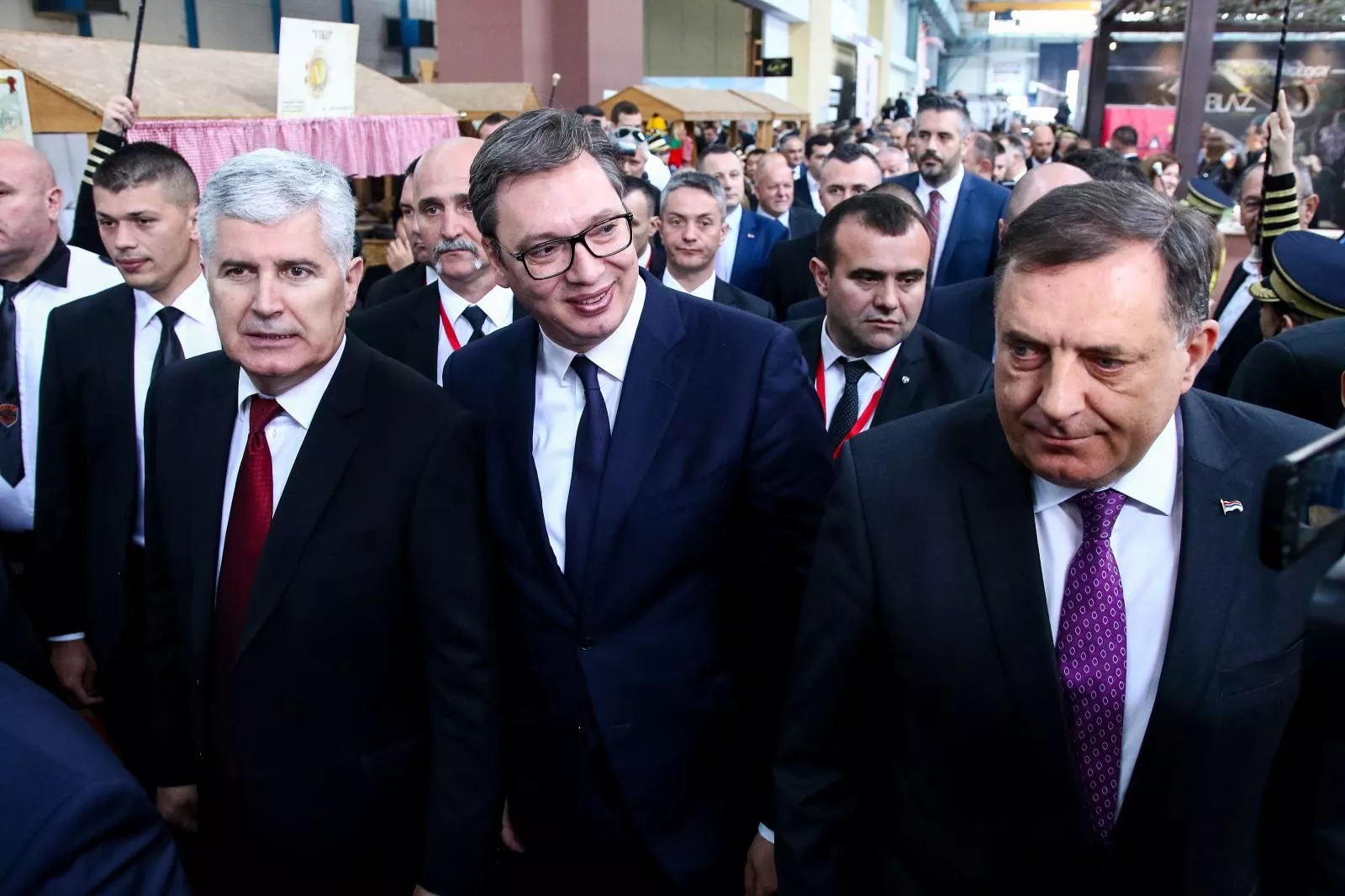
By Armin Aljović
The High Representative in Bosnia and Herzegovina Valentin Inzko once replied that the leader of the Bosnian Serb entity Republika Srpska, Milorad Dodik, is the key reason why the Security Council decided that the OHR should be present in BiH even 25 years after the war, after Dodik accused Inzko of interfering in the internal affairs of Bosnia and Herzegovina, calling on him to leave the country.
“Inzko has lost authority among the people. All his moves are more of a parade and posing to justify his salary of 24,000 euros per month…”, said Dodik.
“Precisely those who are asking for the OHR to ‘go home’ are extending its stay because they are doing nothing to fulfill the set conditions for it,” Inzko replied.
The OHR, or the Office of the High Representative, is an ad hoc international institution responsible for monitoring the implementation of the civilian aspects of the Dayton Agreement, which stopped the war in Bosnia and Herzegovina in 1995. However, since the conditions for the international community to fully hand over control of the country to the authorities in BiH have not been met to this day – international reports speak of a high degree of corruption in BiH, the judiciary is under strong political pressure, the education system is based on segregation – the Security Council repeatedly extends the mandates of the High Representative in BiH.
The relationship between Bosnia and Herzegovina and the OHR can also explain the relationship between Bosnia and Herzegovina and NATO. Although the member of the Presidency of BiH and the president of SNSD, Milorad Dodik, is one of the biggest proponents of Bosnia and Herzegovina's military neutrality, his aggressive policy in BiH is mobilizing civil forces to bring the country closer to the largest military alliance in the world. It is estimated that at this moment, only NATO, much sooner than the European Union, can be a guarantee that Dodik will not implement the policy of dividing the country, which he openly and intensively advocates, even with the help of parts of the international community.
Dodik, in fact, has transformed from a social democrat in recent years into an open right-winger, who has promised to annex Republika Srpska to Serbia, although this is contrary to the Dayton Peace Agreement, which guarantees the territorial integrity and state sovereignty of BiH.
“We have not given up on our goals, which is a more independent and finally independent Republika Srpska,” is Dodik’s stance, which he has repeated many times. He has strong support for such a policy from neighboring Serbia, and from the highest political leadership, such as Serbian President Aleksandar Vučić and his SNS party, or the Minister of Foreign Affairs of Serbia, Ivica Dačić, who heads the Socialist Party (SP), the party of the former Serbian president and Hague indictee for war crimes in the former Yugoslavia, Slobodan Milošević.
Dodik's policy is ultimately identical to that of some members of the Serbian Academy of Sciences and Arts (SANU), who advocate that all Serbs should live in one state.
Analysts assess that Dodik's resistance to NATO, as well as President Vučić's opposition to Serbia becoming a member of that military alliance, lies precisely in the fact that the plan to dismantle Bosnia and Herzegovina would be thwarted once and for all by the admission of either Bosnia or Serbia into NATO, while the bombing of Serbian positions by NATO forces during the war in BiH in the nineties and later in Kosovo – which Dodik and Vučić use as an argument against NATO – is just an excuse for the implementation of the dangerous policy of nationalists from Belgrade.
“NATO protects the territorial integrity of its members,” Zijad Bećirović, director of the International Institute for Middle Eastern and Balkan Studies (IFIMES) from Ljubljana, who also monitors and analyzes the situation in the Western Balkans, told Albanian Shekulli, explaining the possibility of annexing Kosovo and Albania.
The policy of Dodik in recent years is also followed by the president of the Croatian Democratic Union in BiH (HDZ) Dragan Čović, who demands that the country be divided into three ethnic units – one for Serbs, and two for Bosniaks and Croats, which is why Čović, apart from striking rhetorical support, does nothing concrete to bring BiH closer to NATO.
Postponing BiH's admission to NATO could lead citizens into new conflicts – not only in BiH but in the entire region. On the other hand, BiH's entry into NATO would not only prevent new conflicts but would also contribute to economic growth in the country, as has happened in other countries after joining the largest military alliance in the world, such as Montenegro, where foreign investment from NATO member states into Montenegro in 2018 increased by 64 percent compared to 2017.
Komentari (0)
Prijavite se za komentiranje
PrijavaJos nema komentara. Budite prvi!
Minuta
Sve →Iz drugih kategorija

High Representative Not Elected: Germans, French and British Sabotaged Americans, New Attempt at End of June

ČOVIĆ WITHOUT MERCY: How Those Who Brought Ademović to Office Created a Political Hell for Him



Sunny Saturday, quite warm



Tragedy in Albanian resort: Two minors drown












