
Written by: Armin Sijamić
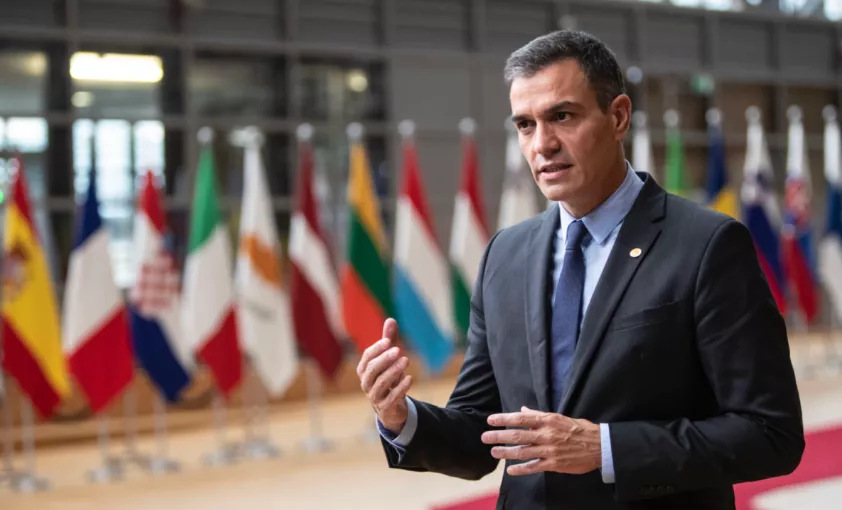
Spain is one of five European Union countries that does not recognize Kosovo's independence. The new Spanish government, led again by Pedro Sánchez, was voted in with the support of separatists from Catalonia, the Basque Country and Galicia, the result of a political deal that shook Spain. Will such a coalition lead to a change in foreign policy and will it affect Kosovo's status?
When Kosovo declared independence in 2008, a wave of recognition of the new state began. However, some countries did not recognize Kosovo. This division is also present in the European Union and NATO.
Five European Union countries do not recognize Kosovo as an independent state and resist pressure from allies to do so. Slovakia and Romania do not recognize independent Kosovo for fear that Hungarians in those two countries would follow the path of independence, Greece and Cyprus due to fear of Turkish demands on Cyprus and possible Albanian demands in Greece, and Spain due to Catalans, Basques and Galicians.
Unlike the other four countries where, among other things, the poor periphery rebels against the richer part of the state, separatist movements in Spain come from some of the richest parts of the state, so one of their arguments is that they finance poor regions and the government in Madrid.
Importance of Spain
Madrid's stance all these years has been clear – we will not recognize Kosovo's unilateral independence. Since the declaration of Kosovo's independence, three prime ministers (José Luis Rodríguez Zapatero, Mariano Rajoy and the aforementioned Sánchez) have had an identical stance. However, their predecessor, José María Aznar, who was prime minister from 1996 to 2004, said in 2007 that "European states must understand that Kosovo's independence is not the dismemberment of a national state that Serbia never was, but the end of the process of the disintegration of Yugoslavia. And that it is urgently necessary to turn the page so that Serbia can free itself from the spirit that blocks it from jumping into modernity."
However, Spain is too important for the West to ignore the fact that this large and powerful country, which has influence over twenty Spanish-speaking countries that were in various ways connected to Madrid, does not follow the policy of the alliances it belongs to. That is why winning Spain over to one's side in international disputes is very important. But not only for that reason. Spain is the sixth largest economy in Europe (fourth in the EU), the seventh largest military in NATO and the third largest navy, the fifteenth largest economy in the world...
Madrid's refusal to allow separatists to operate stems from the constitution and laws that clearly define the rights and obligations of all levels of government. The crushing of the last separatist attempt in Catalonia in 2017 was a demonstration of the rule of law, and the leaders found themselves on the receiving end of the law. But as part of the agreement on the new Sánchez government, they will return to Spain and will be granted amnesty for a series of acts punishable by imprisonment, while those already imprisoned will be released.
Serbia and Kosovo
The Balkans are nowhere near the main topics in Spanish politics. A rather distant and poor peninsula, with the exception of Turkey, is not overly interesting even for large Spanish companies. Nevertheless, the situation in the Balkans is not unknown in Madrid, at least not to Sánchez's governments, because he is a former employee of the OHR in Sarajevo and an advisor to the United Nations during the Kosovo crisis in 1999.
But the Balkans come into Madrid's focus from time to time. For example, the presidency of the European Union requires a stance on the Serbia-Kosovo dialogue. In addition, the head of European diplomacy, Spaniard Josep Borrell, together with Slovak Miroslav Lajčák, is involved in the aforementioned dialogue.
Sánchez also showed interest in the Balkans when he visited a number of countries last year, preparing for the six-month presidency of the European Union. He visited Serbia and Albania, but not Kosovo. "Spain is and will be on Serbia's side in the Kosovo dispute," Sánchez said in Belgrade.
During those months, Belgrade media wrote that Madrid was not ready to recognize Kosovo's independence, but that it was ready, at Washington's insistence, to "turn a blind eye" to Kosovo's membership in NATO and the EU, if Serbia somehow approved it. And that approval would be an agreement between Belgrade and Pristina, talks about which continue to this day, despite all obstacles.
"We are not the only ones in the world who do not recognize Kosovo's independence... But we are not more Catholic than the Pope himself, so if Serbia and Kosovo reach an agreement, we will join it," Borrell said about Spain's position, commenting on the possibility that Belgrade and Pristina reach an agreement supported by Washington and Brussels. Greece has been playing a similar game in Pristina in recent months.
A hint of a change in stance?
The reality that Kosovo exists and participates to some extent in international political, cultural or sports life has forced Madrid to change and adapt its stance. In earlier years, Spain refused to allow Kosovo to appear at international forums, conditioned its presence on placing an "asterisk on status" next to Kosovo's name, and it was even said that during a football match between the two national teams, they were not ready to display the flag and play the anthem of the guests. Prime Minister Rajoy left a meeting in 2018 due to the participation of a Kosovo representative.
This is changing in Kosovo's favor, but not as quickly as they would like. Proof of this is Sánchez's statement from June last year that he would support visa liberalization for Kosovo citizens, or the arrival of President Vjosa Osmani in Spain for the summit of the European Political Community in October this year, which was also attended by Serbian President Aleksandar Vučić.
From these recent moves and announcements by Borrell and Sánchez, it can be inferred that Madrid could recognize Kosovo's status in the way Belgrade does, as part of the ongoing negotiations with Pristina. Sánchez could receive additional impetus from coalition partners who have already dealt with Kosovo.
If Kosovo can...
Sánchez's pact with separatists in Spain has been described by some as a "coup d'état", and dissatisfied citizens took to the streets of cities. Nevertheless, Sánchez did not give in, so Carles Puigdemont's party became a coalition partner, while he managed the party from exile in Belgium.
From Brussels, from the European Parliament, Puigdemont said in May this year that "Kosovo's future is international recognition" and criticized Spain for not recognizing the new state "for reasons that have nothing to do with Kosovo." Before the aforementioned independence referendum, after which he fled Spain, the Catalan parliament adopted a law citing "recent rulings" of the International Court of Justice, an allusion to the case Serbia lost against Kosovo at that court in 2010.
Knowing that this parallel is being drawn in Spain, then-Kosovo Prime Minister Ramush Haradinaj said in an interview with the left-leaning El Pais, which supports Sánchez's government, in April 2018 that Kosovo and Catalonia "have no analogy" and that the comparison is an insult to Kosovars. "Human and political rights are respected in Spain," and we were "under the regime of Slobodan Milošević," Haradinaj said, stressing that Pristina "in no way" will recognize Catalonia's independence.
Haradinaj presented the Kosovo case as a struggle for human rights and freedom, and Catalan aspirations for independence as an expression of Catalan nationalism. This premise was put forward by some authors in Spain, even in Catalonia itself. So, these are not isolated voices. The stance of former Prime Minister Aznar, from the conservative People's Party, which is the biggest rival of Sánchez's Socialists, proves this.
Nevertheless, it should be borne in mind that Kosovo is not a subject of Spanish everyday politics and that such debates are rare and often related to overall relations in the West, i.e., stability on the borders of the EU and NATO.
Sánchez, who is a loyal ally of Washington and pro-European, could play the card of Western geopolitical interests. Therefore, in the negotiations between Belgrade and Pristina, every word could be important so that the entire agreement is "read between the lines." Given the interests of this large country, neither Belgrade nor Pristina could blame Spain for such a stance.
Komentari (0)
Prijavite se za komentiranje
PrijavaJos nema komentara. Budite prvi!
Minuta
Sve →Iz drugih kategorija

High Representative Not Elected: Germans, French and British Sabotaged Americans, New Attempt at End of June

ČOVIĆ WITHOUT MERCY: How Those Who Brought Ademović to Office Created a Political Hell for Him



Sunny Saturday, quite warm



Tragedy in Albanian resort: Two minors drown












