
In the political garden of Bosnia and Herzegovina, where parties sprout, branch out, wither, and bud again according to rules that often defy logic, perhaps the first family phenomenon of domestic politics has occurred, with one party getting a political grandchild.
The Party of Democratic Action, rightly perceived as the old, sprawling oak of the Bosniak political scene, or more precisely the “green grandfather,” has been creating cadres, factions, dissidents, and outcasts for years. From its political roots, the political organization People and Justice emerged, led by the ambitious Elmedin Konaković, who, as a rebellious son of sorts, decided to leave the family yard and build his own house.
However, the political genealogy did not end there.
With the establishment of Red Lines, formed from the cadre and ideological layers of People and Justice, with the recognizable presence of Kemal Ademović and his political legacy, the political family tree gained a new, interesting dimension. The green origin, through a rebellious descendant, produced a red grandchild.
If People and Justice was the son who went astray, then Red Lines, as a generational political corrective, perhaps quieter, perhaps more sophisticated, but by no means accidental, is a political continuation of the same lineage.
The break-up of two former close allies, and even best men, Elmedin Konaković and Kemal Ademović, gives special political symbolism to the whole story. Their political divorce, according to the information we have obtained, was not just a formal break, but a painful and almost fatal struggle for control over People and Justice.
Ademović's departure from NiP was allegedly not a passive departure, but an attempt to take over the party itself. The plan to snatch the political project Konaković had created from his hands was stopped at the last moment, by a telephone session and a narrow majority of only two votes in favor of Konaković.
Such an outcome not only indicates political disagreement but also raises a more serious question about the depth of internal relations and real centers of power. When best men become opponents, and political associates try to take over each other's entire infrastructure, it is no longer about ideology, but about inheritance.
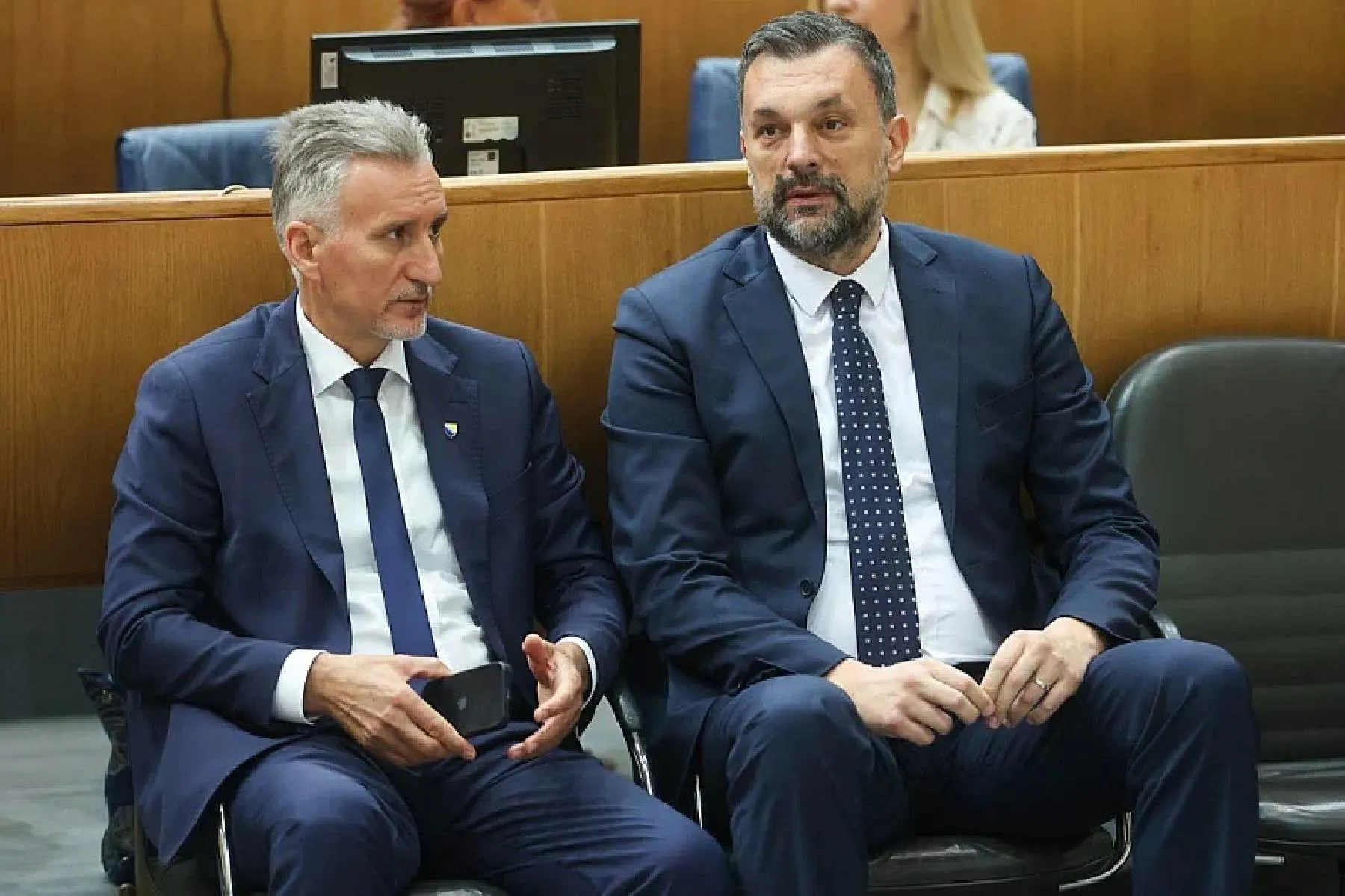 The break-up of the best men was not painless, nor friendly
What is particularly intriguing in this whole story is the fact that many key actors of this new project owe their political biographies precisely to SDA. Through People and Justice, and then through Red Lines, cadres move, change ideological jerseys, but the family political lines remain recognizable. In this sense, it is difficult to ignore the question of whether we are witnessing organic political development or a carefully controlled family regrouping?
Because, in the Balkans, political splits are rarely just splits. They are often sophisticated power transformations.
While the public is served a narrative of new ideas, fresh concepts, and modern political approaches, beneath the surface remains room for legitimate doubt as to whether the creation of new political formations is actually a continuation of the old battle for control, influence, and the disciplining of disobedient descendants?
Especially at a time when social networks are becoming a battlefield for para-intelligence operations, hybrid campaigns, and carefully placed discreditations, political coincidences seem less and less convincing.
When conflicts are produced from the shadows, alleged affairs are re-affirmed, internal tensions are reignited, and digital armies are directed, the question is no longer just who is against whom, but who is actually afraid of whom?
Is the “green grandfather” afraid for his own power, or perhaps the “red grandchild” exists precisely to remind us that family debts in politics are never erased, only reprogrammed?
And perhaps the most important question of all is the one that is only now gaining full meaning: was Kemo Ademović, from the very beginning, a political family insurance policy for Elmedin Konaković, a figure of stability, oversight, and correction within a project that was supposed to act reformist, yet remain under the control of older political genes?
Are Red Lines, in fact, only red on the outside, while being deeply, strategically, and familially green on the inside?
Perhaps the answers are not written in party statutes, but they are in cadre migrations, political alliances, sudden ideological mutations, and painful divorces of best men.
In the end, the political scene of Bosnia and Herzegovina increasingly resembles a family album where members formally disown each other, but the surname of power remains the same.
And when the surname remains the same, the question is not who left, but who still manages the family legacy.
What remains a constant is the long-ago clarified fact that Konaković was overcome by ambition far greater than his real capabilities. Because of this, a party less than a decade old has ended up in complete disarray and politically faded to the point where it is objectively questionable whether it will be able to cross the census in the elections.
And when you see such a person leading diplomacy, it becomes clear how well the international and domestic strategists predicted the damage to the country by pushing the Trojka project and Konaković as one of its figureheads!
Komentari (0)
Prijavite se za komentiranje
PrijavaJos nema komentara. Budite prvi!
Minuta
Sve →Iz drugih kategorija

High Representative Not Elected: Germans, French and British Against Americans, New Attempt at End of June

ČOVIĆ WITHOUT MERCY: How Those Who Brought Ademović to Office Created a Political Hell for Him



Sunny Saturday, quite warm



Tragedy in Albanian resort: Two minors drown












