
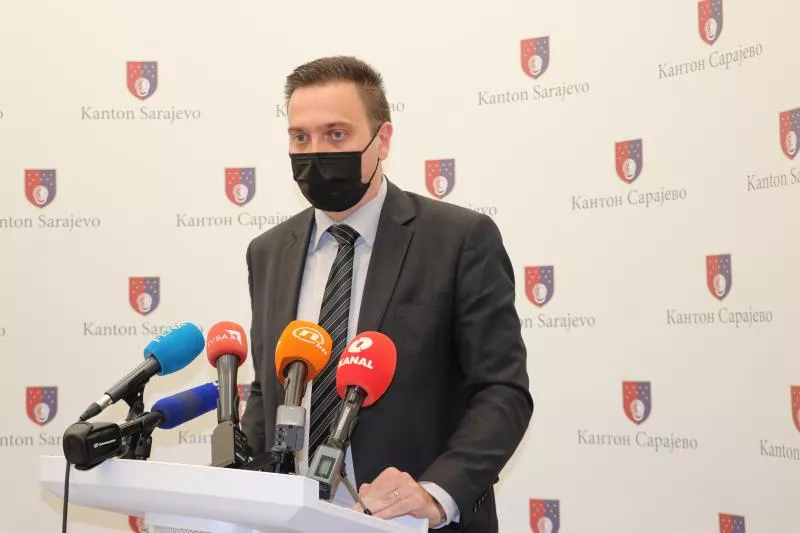
SARAJEVO, (Patria) - As the proposed amendments to the Law on Public Revenues of FBiH have been in the public focus in recent days, specifically the abolition of weight 2, according to which Sarajevo Canton is entitled to a portion of revenues from indirect taxes, the Minister of Finance of KS, Davor Čičić, spoke to BH RADIO 1 about the possible consequences of such an economic shock on the KS Budget.
He pointed out that according to any economic criterion commonly used in revenue distribution, the share of Sarajevo Canton in the Federation of BiH is greater than the funds returned to this canton through revenue distribution.
Minister Čičić reminded that the Economic Institute in Sarajevo prepared a study back in 2015 which showed that about 100 million KM of revenue from indirect taxes, generated here based on economic criteria such as share in final consumption, reported income, and added value created, should belong to Sarajevo Canton. Now, this 100 million KM is flowing to other cantons, according to the criteria in the current Law.
These statements were confirmed by the expert mission of the International Monetary Fund that visited BiH in 2015. Therefore, as Minister Čičić points out, Sarajevo Canton cannot accept the claim that it is currently in a privileged position in the distribution of public revenues.
The minister explained what the abolition of weight 2 would mean for KS, due to special expenditure needs, as stated in the current law.
“It is important to mention that the draft federal law we are discussing and its explanation ignore the fact that in the valid Law on the Allocation of Public Revenues, in force since 2006, Sarajevo Canton has been assigned weight 2 based on the so-called 'historical model', i.e., KS's share in turnover tax, which in 2005 amounted to 35.5 percent of the total tax revenues in FBiH. At that time, care was taken to maintain the KS's share in tax revenues at approximately the same level by applying the new formula. This is why weight 2 was introduced, not for the reasons stated in the explanation, that this formula was established due to war destruction and the recovery of Sarajevo”, explains Minister Čičić.
In the first year of the then new law, the KS's share in indirect taxes was 34.7 percent, and according to estimates for 2021, this share will be around 30 percent.
“We see that there are now four percent less tax revenues compared to the first year of the law's application. We consider the current formula inadequate and outdated, and we agree that it should be changed. According to all fiscal policy rules in developed countries, taxes should be returned to the place where they originated and were taxed, so that these funds can be used to solve the needs of the taxpayers who paid them”, states Čičić.
For KS, the abolition of weight 2 would be a major blow to the Budget and all public functions. As stated in the opinions of the FBiH Government and the Federal Ministry of Finance, the proposed amendments change only one part of that formula, and other elements of the formula are not taken into account. This disrupts the entire formula in such a way that KS would receive 100 million less in revenue. It is proposed in the first step to reduce weight 2 to 1.5, and each subsequent year it would be reduced by 0.1 percent until it reaches a coefficient of 1.
“Ultimately, in such a case, out of the estimated 580 million KM of tax payments in KS in 2022, 250 million would be returned to KS, and 330 million would be distributed to other cantons. This means that Sarajevo Canton would retain between 40 and 45 percent of all taxes paid here, while 55 percent would flow to other cantons. By no economic criterion can I say that this is a fair model, and we advocate for this model to be generally changed, but in a way that incorporates economic parameters”, emphasizes Minister Čičić.
He reminded that at the state level, these revenues are divided between FBiH and RS based on the criterion of final consumption. In FBiH, other, non-economic parameters are used in distribution, such as population, area, and the number of enrolled students in primary and secondary schools.
“We believe that we already have an asymmetry from the state level further down to the federal and cantonal levels. Also, FBiH announced that it is in surplus, while all cantons are in deficit, which shows that something is wrong with this vertical distribution. Therefore, we also believe that such a law is not fair, but also that a new, comprehensive solution based on economic parameters such as final consumption, income level, GDP, should be made, with a prescribed obligation for richer cantons to help poorer ones, for the balanced development of FBiH,” concluded Minister Čičić
Komentari (0)
Prijavite se za komentiranje
PrijavaJos nema komentara. Budite prvi!
Minuta
Sve →Iz drugih kategorija

High Representative Not Elected: Germans, French and British Sabotaged Americans, New Attempt at End of June

ČOVIĆ WITHOUT MERCY: How Those Who Brought Ademović to Office Created a Political Hell for Him



Sunny Saturday, quite warm



Tragedy in Albanian resort: Two minors drown












