
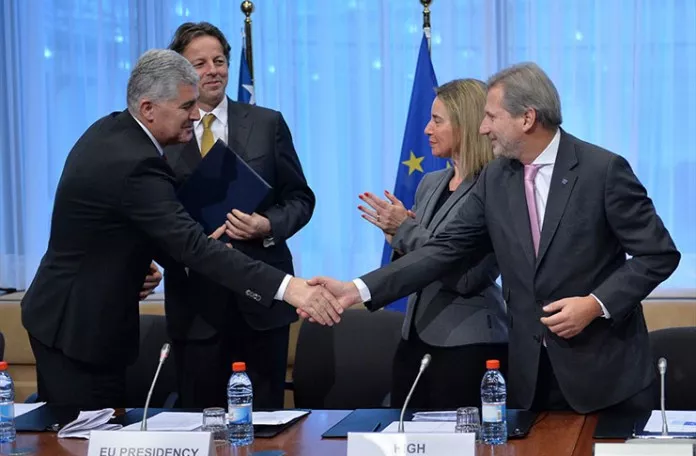
Over the past seven days, European Union officials have reviewed the remarks from letters sent to them by the BiH Presidency member from the Croat people and HDZ BiH leader Dragan Čović, regarding the Coordination Mechanism, which he claims is detrimental to the Croat people because "one level of government in decision-making - cantons" has been omitted, writes the Patria news agency.
However, neither Federica Mogherini, the High Representative of the EU for Foreign Affairs and Security Policy, nor Johannes Hahn, the Commissioner for European Neighbourhood Policy and Enlargement Negotiations, after a detailed analysis, have noticed what Čović has "serious" objections to and why he vehemently opposed the agreement reached on July 31 by the Chairman of the BiH Presidency from the Bosniak people and SDA President Bakir Izetbegović and RS President and SNSD leader Milorad Dodik.
For the European Union, the agreed Coordination Mechanism is good and allows for the representation of all levels of government in accordance with their constitutional responsibilities. Official Brussels has therefore once again called on all politicians and institutions in BiH to support the solution agreed upon by Izetbegović and Dodik.
In their first reaction (August 1), Mogherini and Hahn welcomed the agreement of the two leaders and stated:
- With such news, domestic leaders, at all levels, have further confirmed their commitment to the country's European path in line with the expectations of its citizens!
The agreement of the two leaders was immediately welcomed and supported by the ambassadors of Great Britain and the USA in BiH, Edward Ferguson and Maureen Cormack. They stated that it seemed that the months-long negotiations on the Coordination Mechanism were finally over so that BiH could progress on its path to the EU, and then everything turned into a "futile quarrel that will only further damage the international reputation of this country and its leaders."
-This must be resolved, and as soon as possible, the ambassadors said.
The agreement of Izetbegović and Dodik was also supported by the leader of SBB Fahrudin Radončić, a coalition partner of SDA and HDZ BiH, and in a direct way, the member of the BiH Presidency from the Serb people Mladen Ivanić, who only has an objection to the fact that his proposal to resolve this in institutions, as he had proposed from the beginning, was not accepted, rather than in cafes. Dodik, on the other hand, from Sunday, when the agreement was excellent, under the influence of his only and eternal partner Čović, changed his tune, wavered, and not completely and firmly, but sided with the HDZ BiH leader. However, it seems that Dodik's change of mind has either not reached Brussels or they do not take him seriously.
So what is it that bothers Dragan Čović so much, that with his displeasure and opposition to the agreed Coordination Mechanism, he has jeopardized power both in FBiH and at the state level, implying between the lines that a crisis of greater proportions could occur.
Such a thing could also be read from his absence from the agreed meeting with Izetbegović in Konjic, after which the SDA president clearly stated that he would no longer sit with his coalition partner Čović without the other partner Fahrudin Radončić. The mistrust between SDA and HDZ, long present, has now culminated.
The entire country could suffer because of Čović's actions. In layman's terms, the leader of HDZ BiH has found a "hair in the egg" and is now generating a political crisis, blocking BiH's European path, which he declaratively advocated for until February 15, when he rushed to Brussels and submitted an incredible application for BiH to obtain candidate status.
It was he who, since December 2015, had been constantly pressuring all BiH institutions to submit the application as soon as possible, i.e., while he was the chairman of the collective head of state, in order to leave an impression in Brussels as a leader who prioritizes the state of BiH and its European path and progress.
If the issue of the Coordination Mechanism is not resolved by September, which is only three weeks away, our country's application will certainly not be on the agenda of the EU Foreign Affairs Council meeting.
Furthermore, this means that BiH will not receive the European Commission's questionnaire within the foreseen timeframe, which is a new phase of accession to the great European family.
Numerous political analysts have long warned that the HDZ BiH leader is manipulating both domestic politicians (his coalition partners) and European officials, which is now, at the end of his political charade, negatively affecting the entire country.
And by an unwritten rule, as is usually the case, the truth comes out sooner or later, and things fall into place.
Čović's European mask has now definitively fallen. He is not interested in European integration or reform processes. Nor in the state of BiH.
The story of defending the "interests of the Croat national corpus" no longer works either domestically or in Brussels.
Other more significant matters are at play. From financial flows, consolidating the voter base before the elections, to achieving the much-desired dream - the third entity, so-called HR Herceg Bosna, which he would control.
Cantonal role clearly defined in Chapter VI
The Izetbegović-Dodik agreement clearly defines Chapter VI, which relates to the composition of the BiH delegation within the joint BiH and EU bodies for monitoring the implementation of the Stabilization and Association Agreement, and particularly the decision-making process and the functionality of decision-making.
It was agreed that all decisions would be made by consensus, and that all institutions at all levels of government are obliged to ensure the presence of their representatives at the meetings of the bodies. Solutions for ensuring the functionality of the Coordination Mechanism are also foreseen.
The quorum for holding meetings and adopting decisions in the bodies, as defined by the agreement, "shall mandatorily include authorized representatives of the Council of Ministers, the Government of RS and the Government of FBiH and cantons, in accordance with constitutional responsibilities for the matter being considered at the session, or which is the subject of the decision."
All decisions adopted in various bodies of the coordination system can be reviewed by a higher body in the coordination system within 10 days of their adoption, by authorized representatives of the Council of Ministers, the Government of RS and the Government of FBiH.
-In cases where any of the bodies in the coordination system does not agree on a position regarding a certain issue, it will be forwarded to a higher level in the coordination system, up to the collegium for European integration, which meets and acts in accordance with Article 4 of this decision, it is stated, among other things, in the agreement signed in East Sarajevo.
Komentari (0)
Prijavite se za komentiranje
PrijavaJos nema komentara. Budite prvi!
Minuta
Sve →Iz drugih kategorija

High Representative Not Elected: Germans, French and British Sabotaged Americans, New Attempt at End of June

ČOVIĆ WITHOUT MERCY: How Those Who Brought Ademović to Office Created a Political Hell for Him



Sunny Saturday, quite warm



Tragedy in Albanian resort: Two minors drown












