
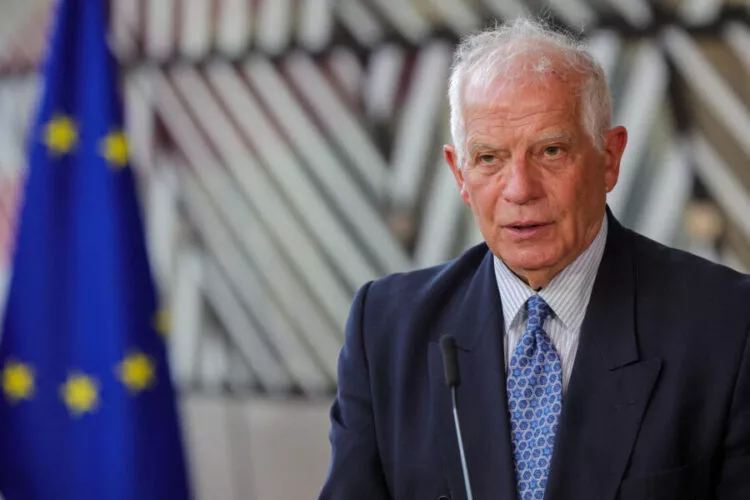
Blog by Josep Borrell, High Representative of the European Union for Foreign Affairs and Security Policy/Vice-President of the European Commission
On 17 July, almost a year after signing it in Istanbul, Russia decided to withdraw from the Black Sea Grain Initiative (BSGI) which allows Ukraine to export agricultural products to the world market. As the UN Secretary-General underlined, this initiative was a "ray of hope in a world that desperately needs it".
Before Russia's aggressive war against Ukraine, a key global food supplier, Ukraine accounted for a fifth of the world's barley, as well as a sixth of its corn and an eighth of its wheat. After Russia attacked Ukraine, targeting grain fields and silos and blocking Ukrainian ports, world food prices soared to record levels and threatened the much-needed food supplies of many importing countries. The goal of the BSGI was to re-establish a key route for the export of agricultural products from Ukraine and to reduce global food prices.
Despite many challenges, the initiative achieved its main goal. Since August 2022, the export of nearly 33 million tonnes of grain and food products from Ukraine to 45 countries has played a key role in reducing global food prices by about 25% from the record highs reached shortly after the Russian attack. As public trade data shows, more than half of the grain, including two-thirds of the wheat, went to developing countries.
In addition, the BSGI ensured continued access to grain for the World Food Programme (WFP). In 2023, Ukraine provided 80% of the wheat to support humanitarian operations in the most food-insecure countries, such as Afghanistan, Djibouti, Ethiopia, Kenya, Somalia, Sudan and Yemen. Without the Black Sea route, the WFP must procure grain elsewhere at higher prices and with longer delivery times at a time when the world is facing an unprecedented food crisis.
Russia's decision was taken despite repeated proposals by the UN Secretary-General to resolve these issues. To shift the blame, Russia claims that its own exports of agricultural products are not sufficiently facilitated. This is not confirmed by publicly available trade data, which shows that Russia's agricultural exports are thriving. Russia also benefited greatly from the Memorandum of Understanding with the UN on fertiliser exports, which was agreed at the same time as the BSGI. The United Nations is tirelessly trying to clarify regulatory frameworks and cooperate with the private sector to find tailored solutions in the banking and insurance sectors. These efforts are carried out in close cooperation with the EU and its partners.
Regardless of the lies Russia spreads, the EU has indeed ensured that our sanctions do not affect global food supply security. There are no sanctions on Russian exports of food and fertilisers to third countries, and the EU has provided extensive guidance to economic operators, clarifying that transfers to third countries are permitted. We are cooperating with the UN to allow related payments.
Despite these well-known and verifiable facts, Russia decided to withdraw from the BSGI, using food as a weapon and threatening global food supply. A few hours after withdrawing from the initiative, Russia began destroying Ukrainian grain storage facilities and port infrastructure with daily attacks, not only in the Black Sea itself but also on the Danube. As a direct consequence, wholesale prices of wheat and corn have risen to record levels since the start of Russia's aggressive war. Increased food price volatility is likely to persist as long as Russia deliberately increases pressure on global food supply, thus worsening the global cost-of-living crisis, most of all for people with insecure food supplies in countries dependent on imports. This is unacceptable and must be strongly condemned.
As the world struggles with disrupted supplies and higher prices, Russia is now approaching vulnerable countries, especially in Africa, with bilateral offers of limited grain deliveries, pretending to solve a problem it created itself. This is a cynical policy of deliberately using food as a weapon.
In response to Russia's irresponsible moves, the EU is active on three main fronts. First, we will continue to support the tireless efforts of the United Nations and Turkey to resume the Black Sea Grain Initiative. Second, we continue to strengthen the Solidarity Lanes as alternative routes for exporting Ukrainian agricultural products to global markets through the EU. These lanes have so far enabled the export of more than 41 million tonnes of agricultural products from Ukraine, and we are increasing this export as much as possible to mitigate the consequences of Russia's suspension of participation in the BSGI. Third, we have increased financial assistance to the countries and people most in need, providing €18 billion to address food security issues by 2024.
We call on the international community and all countries to increase aid to support global food security. We ask all partners to call on Russia to return to negotiations, as the African Union has already done, and to stop targeting Ukrainian agricultural infrastructure. With a clear and united voice, we can force Russia to renew its participation in the BSGI. The common interest of the world is responsible management of global food supply. We owe it to the people who need it most.
Komentari (0)
Prijavite se za komentiranje
PrijavaJos nema komentara. Budite prvi!
Minuta
Sve →Iz drugih kategorija

High Representative Not Elected: Germans, French and British Sabotaged Americans, New Attempt at End of June

ČOVIĆ WITHOUT MERCY: How Those Who Brought Ademović to Office Created a Political Hell for Him



Sunny Saturday, quite warm



Tragedy in Albanian resort: Two minors drown












