
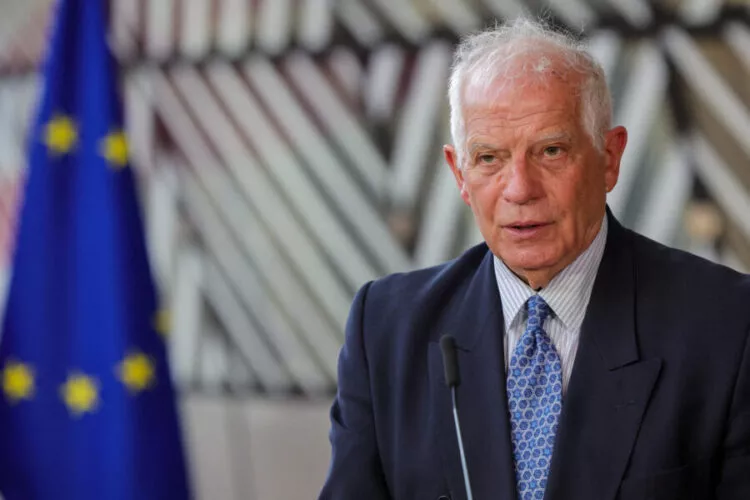
Blog by the High Representative of the European Union for Foreign Affairs and Security Policy and Vice-President of the European Commission Josep Borrell
Defense was at the center of attention at the last meeting of the Council of the European Union. It was the culmination of intensive work on EU defense and security issues, with the preparation of the European Defense Industrial Strategy and the creation of a new fund to enhance our support for Ukraine. We also reviewed the progress made in implementing the Strategic Compass.
“Europe is in danger. Much has been done to improve European defense, but much more is needed. And quickly.”
Power politics are reshaping our world. With Russia's aggression against Ukraine, the war that has erupted in the Middle East, attacks in the Sahel region, tensions in Asia… we are witnessing, at the same time, the return of “old,” conventional wars and the emergence of “new,” hybrid warfare characterized by cyber attacks and the weaponization of everything from trade to migration. This erosion of the geopolitical environment puts Europe in danger, as I predicted when I presented the Strategic Compass, the EU's new security and defense strategy, in 2022.
Four years ago, as we faced the COVID-19 pandemic, many said the EU was experiencing a “Hamiltonian” moment, as we decided to take on joint debt repayment to mitigate the consequences of that crisis, just as Alexander Hamilton did after the US War of Independence. We are now likely entering a Demosthenian moment, recalling the great Greek statesman who, 2400 years ago, called on his Athenian fellow citizens to resist Macedonian imperialism: we are finally becoming aware of the numerous security challenges in our dangerous environment.
What are we doing to respond to these diverse threats? March marks two anniversaries: the third since the establishment of the European Peace Facility (EPF) and the second since the adoption of the Strategic Compass. These tools are at the very heart of our geopolitical awakening in recent years. It is the right time to reflect on what has been done and where we are going in security and defense.
Unprecedented military support for Ukraine
The European Peace Facility (EPF) is an intergovernmental instrument and an extra-budgetary fund of the EU. It was established in 2021 to help our partners with military equipment, which was not possible through the EU budget. We started with 5 billion euros, and today the upper financial limit of this fund stands at 17 billion euros.
Although not originally formed for these purposes, the EPF is the basis of our military support for Ukraine. So far, we have used 6.1 billion euros from the EPF to incentivize EU member states' assistance to Ukraine, and together with them, from the beginning of the war to the present day, the EU has delivered military equipment to Ukraine worth a total of 31 billion euros. This figure is also increasing daily.
Thanks to these funds, we have maintained our military support for Ukraine. Among other activities, by the summer, we will have completed the training of 60,000 Ukrainian soldiers; we have donated 500,000 artillery shells to Ukraine, and by the end of the year, it will be over a million. In addition, the European defense industry is providing Ukraine with another 400,000 shells through commercial contracts. The Czech initiative to purchase ammunition outside the EU is an addition to these efforts. However, all of this is far from enough, and we must improve both our production capacities and financial resources to support Ukraine.
Last Monday, at the Foreign Affairs Council meeting, we decided to establish a new Ukraine Assistance Fund within the EPF, totaling 5 billion euros, to continue military support for Ukraine. Last Wednesday, I also proposed to the Council that 90% of the extraordinary revenues from immobilized Russian assets be redirected to the EPF to enhance the financial capacity for military support to Ukraine.
Strengthening our partnerships for global security and defense
However, the European Peace Facility (EPF) does not only help Ukraine. So far, we have used it to support 22 partners and organizations. Since 2021, we have allocated almost one billion euros to operations led by the African Union and regional organizations, as well as the armed forces of eight partner countries in Africa. In the Western Balkans, we support regional military cooperation, as well as Bosnia and Herzegovina and North Macedonia. We also support Moldova and Georgia in the Eastern Neighborhood, and Jordan and Lebanon in the Southern Neighborhood.
Since the beginning of my mandate, we have launched nine missions and operations under our Common Security and Defense Policy (CSDP). The latest, Operation ASPIDES in the Red Sea and Persian Gulf region, aimed at protecting commercial vessels, was established in record time. Together with Operation Irini in the Mediterranean, Operation Atalanta near the Horn of Africa, and our Coordinated Maritime Presence in the Gulf of Guinea and the Indian Ocean, we are increasingly becoming a provider of global maritime security. Last year, we also launched two new civilian missions in Armenia and the Republic of Moldova.
However, our operation in Niger had to be suspended due to a military coup, and our military mission in Mali has been put on hold. We are currently reviewing the form of support we can offer partners in the region: in this context, last December, we established a new type of civilian-military initiative to help partner countries in the Gulf of Guinea counter terrorist threats coming from the Sahel region.
We have also strengthened cooperation with NATO structures in several key areas such as space, cyberspace, climate, defense, and critical infrastructure. We have expanded and deepened our network of bilateral security and defense partnerships with Norway, Canada, and countries in the Eastern Neighborhood (Georgia, Moldova), in Africa (South Africa, Rwanda), the Indo-Pacific region (Japan, Republic of Korea, Australia), and Latin America (Chile, Colombia). The first Schuman Forum on Security and Defense, held in March last year, which brought together security and defense partners from more than 50 countries, was successful. We will build on this success when we meet for the next Schuman Forum on May 28 and 29 this year.
Enhancing capabilities for overseas crisis response
One of the most important concrete results foreseen by the Strategic Compass was the establishment of the EU Rapid Deployment Capacity, aimed at rapid autonomous response to crisis situations such as, for example, the evacuation of Europeans in emergencies like those we experienced in Afghanistan in August 2021 or in Sudan in April 2023.
It will become operational next year, but to prepare for it, last October, we organized the first full EU military exercise in Cadiz, Spain. 31 military units, 25 aircraft, 6 ships, and 2800 personnel from the armed forces of member states participated. The second full military exercise will be held at the end of this year in Germany.
And the new Crisis Response Centre is now operational within the EEAS to coordinate EU activities in emergency situations, including the evacuation of European citizens. We are also strengthening our military and civilian command in Brussels.
Greater joint investment in defense and boosting the EU defense industry
At home, we must also invest more and help our defense industry improve its production capacities. There is no other solution if we are to match the scale of Ukraine's defense needs, as well as the needs of member states that must replenish stocks and acquire new equipment.
EU member states are already spending significantly more on defense, with defense budgets increasing by 40% in the last ten years and a jump of 50 billion euros from 2022 to 2023.
EU member states are already spending significantly more on defense, with defense budgets increasing by 40% and a jump of 50 billion from 2022 to 2023. However, the EU's defense budget for 2023 of 290 billion euros represents only 1.7% of our GDP compared to the 2% threshold set by NATO. And in the current geopolitical context, this could be considered a minimum condition.
However, the total amount of our spending is not the only figure we need to monitor carefully. To use our defense spending effectively, we must also address the gaps that need to be filled and avoid duplication. As I have often mentioned, we must spend more, but also better, and better means together.
European armies invested 58 billion in new equipment in 2022. For the fourth consecutive year, this is above the 20% threshold of defense spending. However, only 18% of these defense investments are currently made collaboratively, which is far from the 35% threshold that member states set for themselves in 2007. Since the beginning of the Russian aggression, 78% of the equipment purchased by EU armies comes from outside the EU. We are also lagging in investing in research and development.
That is why, at the beginning of this month, together with the Commission, I presented the first European Defense Industrial Strategy. We need to encourage much more joint procurement, better ensure security of supply, firmly anchor Ukraine's defense industry in Europe, and organize a major industrial leap. We need to catch up with the development of new military technologies such as drones and artificial intelligence. With its innovation center, the European Defence Agency will continue to play a key role in these efforts.
To succeed, we must ensure better access for the European defense industry to financial resources, specifically through the adaptation of the European Investment Bank's lending policy. We must consider issuing joint debt to help finance the extensive and necessary investments in defense capabilities and the defense industry, just as we did in facing the crisis caused by COVID-19. But there is still much work ahead of us to reach an agreement on this issue.
Finally, we must strengthen defense against hybrid and cyber threats, foreign information manipulation, interference, and the resilience of our critical infrastructure.
As described here, much has been done in recent years, but I am aware that there is still much work ahead of us to reach a scale commensurate with the scope of the threats we face. We need a leap forward in European defense and the European defense industry.
Komentari (0)
Prijavite se za komentiranje
PrijavaJos nema komentara. Budite prvi!
Minuta
Sve →Iz drugih kategorija

High Representative Not Elected: Germans, French and British Sabotaged Americans, New Attempt at End of June

ČOVIĆ WITHOUT MERCY: How Those Who Brought Ademović to Office Created a Political Hell for Him



Sunny Saturday, quite warm



Tragedy in Albanian resort: Two minors drown












