

By Armin Sijamić
Ever since the Kosovo police were attacked ten days ago, a "damage control" operation has begun, attempting to prove that official Belgrade is not guilty and that the terrorist attack should be forgotten as soon as possible, as if nothing happened, all in the interest of "regional stability."
Since the attack on the Kosovo police in the village of Banjska, we have witnessed attempts to absolve Aleksandar Vučić, the President of Serbia and "all Serbs," as his supporters chanted, of any responsibility.
The fact that the public still does not have precise information about what actually happened in Banjska, who the people were who clashed with the police, and how they ended up in Serbian hospitals and in the media sending letters (Milan Radoičić) through a lawyer whom Kosovo Albanians remember as part of the judicial system that carried out repression during Slobodan Milošević's regime, speaks volumes about this being a deception, a wrong and unfair approach towards the citizens of Serbia, Kosovo, and the region.
Saving the "pro-Western" Vučić
The spin doctors from Belgrade, some of whom presented themselves as pro-Western before the events in Banjska, began attributing the attack to "rogue" Kosovo Serbs controlled by Radoičić, while others attributed it to Russia, which "has an interest" in destabilizing the Balkans and diverting the West's focus from Ukraine.
To make matters even more difficult for the citizens of Serbia to understand, the same media outlets featured those who claim that the United Kingdom, Germany, and the United States, and even Albin Kurti, who staged the attack to blame Vučić, are behind the attack.
Interestingly, there is no one calling for the resignations of those responsible, even though four people lost their lives.
This is an attempt to save official Belgrade, i.e., to protect a policy that has diligently worked to destroy surrounding countries and peoples since the 1990s. The aim is to convince citizens that the "reformed" Vučić and Ivica Dačić will lead the country into the European Union and distance Serbia from Russia.
The delusion that Serbia will distance itself from Russia persists among some Western countries and causes enormous damage to neighboring states.
The insistence on the narrative that the Kremlin controls processes in Serbia, i.e., organizes groups that attack neighboring countries without the knowledge of official Belgrade, proves this. This narrative is precisely what is prevalent in Serbia in recent days, as is the message to the West not to condemn Vučić, even though under his rule, Serbian media have become more pro-Kremlin than ever before. Whether the West will swallow the bait remains to be seen, but it would be logical to conclude that such a Vučić carries Russian influence with him, even if he formally moves closer to the West.
On the other hand, if it is true that Russia is organizing private armies in Serbia to attack Kosovo, what guarantee is there that some other armed group will not attack Bosnia and Herzegovina, Montenegro, Croatia, or Serbia? How many "private" armies are there in Serbia if Radoičić has one that operates independently of official Belgrade? How many such armed groups are there in the region?
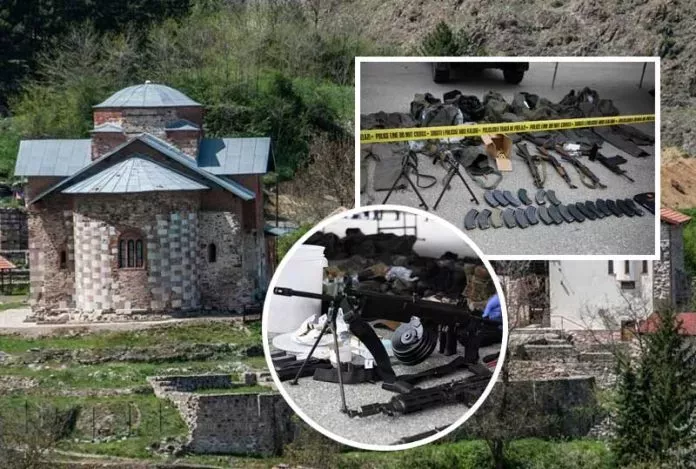
And so, before the investigation even began, the media were flooded with stories that Vučić did not know about the attack, or that his close associate Radoičić acted alone. Kosovo police claim that the weapons found after the attack in Banjska are worth five million euros and were produced in Serbia. Is it possible for Vučić's close associate to acquire so many weapons without Vučić and his associates knowing?
Anyone who has even superficially followed the media from Serbia in recent years could have seen that military camps are being organized in Serbia, with some even involving children. Furthermore, war criminals are lecturers at military academies and "heroes" celebrated in the media and on the streets. In recent days, the situation has worsened, with the authorities and media inciting further conflicts by falsely accusing everyone except the real culprits.
All of this was enough for those who accuse British parliamentarian Alicia Kearns of fabricating that weapons are being stockpiled in the Serbian Orthodox Church, to notice that Vučić's government is militarizing society, based on the belief that Serbs are victims of the wars of the 1990s, which will have a continuation.
This brutal campaign against its own population must produce an effect, which is the goal. It seeks homogenization and the spread of an anti-Western narrative. All the harsh words directed at Albanians and Kurti in recent days would, in decent countries, mean the end of any further talks.
Regional Aspect and Vučić's Messages to the West
It didn't take long for the attack from Banjska to be linked to Bosnia and Herzegovina. Spin doctors from Belgrade warn that the crisis from Banjska could spread to our country. Are they sending us a message from Belgrade that Bosniaks and Croats are preparing to attack Serbs because of Albin Kurti?
This perfidious threat is proof that the Belgrade regime was aware of the attack in Banjska, and with the theses about the conflict spilling over from Kosovo, it wants to send a message to the West not to punish them, because they could "set fire" to a neighboring country. In such a scenario, "Kurti's terror" could be replaced by the "terror" of the courts, the OHR, or the West, as they prevent the normal life of Serbs in BiH.
A climate has been created in Serbia similar to the years when Milošević rose to power, when propaganda claimed that Kosovo Serbs could not live due to Albanian terror, and that Zagreb and Sarajevo were working to destroy Serbs. Since the public in Serbia was not confronted with the misdeeds of the Serbian regime during the 1990s, such a narrative can be successfully imposed on them once again.
But those who should not fall for these deceptions are in the West, because they control the political, economic, financial, and almost all other processes in the countries of the former Yugoslavia. Their attitude towards the fact that armed groups are killing police officers will tell us what they actually think about this region and the peoples who live there. What is the point that disqualifies Balkan leaders in the eyes of the West is one of the most important questions after Banjska.
Should citizens who are accustomed to celebrating war criminals and considering crime and corruption normal, now accept that it is normal to kill a police officer and receive state protection? If armed men can attack the Kosovo police, what prevents them from attacking anyone they want in Belgrade? What kind of message is the West sending to the region that is on the "European path"?
The attack in Kosovo raises the question of whether the West will make the same mistake again as in the case of Russia. Angela Merkel forgave Vladimir Putin for the attack on Georgia, the secession of Abkhazia and South Ossetia, Donbas, and the annexation of Crimea, but he did not stop and rushed into Kyiv. That experience shows that retreating from an attacker is actually an invitation to attack again. Will the West retreat this time in front of a incomparably weaker state that it is trying to attract to its side and distance from Russia?
While waiting for answers, let's recall an example that connects Belgrade and the war in Ukraine. Vučić refused for days to condemn Russia's attack as aggression, while postponing his address on the matter, likely waiting for the outcome of Russia's attack on Kyiv. After that, he delayed forming a government, although he had no need to do so as he had a convincing majority. The West tacitly accepted such a maneuver.
According to his latest statements, Vučić is preparing for early elections in December, which irresistibly resembles the aforementioned example and the refusal to provide clear and precise answers.
The question remains whether the West will once again turn a blind eye, "believing" that Vučić is preserving "regional stability."
Komentari (0)
Prijavite se za komentiranje
PrijavaJos nema komentara. Budite prvi!
Minuta
Sve →Iz drugih kategorija

High Representative Not Elected: Germans, French and British Sabotaged Americans, New Attempt at End of June

ČOVIĆ WITHOUT MERCY: How Those Who Brought Ademović to Office Created a Political Hell for Him



Sunny Saturday, quite warm



Tragedy in Albanian resort: Two minors drown












