
The statement of protected witness KW-586, who testified in favor of Radovan Karadžić before the International Criminal Tribunal for the former Yugoslavia, has been refuted by many military experts, writes the BiH news agency Patria.
Witness KW-586, a former member of the Bisere unit, which was responsible for the security of the Presidency of Bosnia and Herzegovina during the aggression against BiH, stated that Alija Izetbegović ordered the provocation of Serbian units located around Sarajevo, so that Serbian forces would kill as many civilians as possible and thus attract the wrath of the international community.
The witness described how the police would close off one of the Sarajevo intersections for traffic for about ten minutes. A few mortar shells would be fired from the intersection towards Serbian positions from the body of a small truck, which would then leave the intersection, traffic would be allowed, and about ten minutes after the firing, most likely when the Serbian positions determined where the fire came from, fire would follow from their positions, and it was always on a larger scale than the fire from the Army of the Republic of Bosnia and Herzegovina towards them.
- At the moment when Serbian shells were falling, the intersection would be open to the civilian population, and casualties would occur. I know that from the Serbian side, for every one of our shells, they always responded with at least two or more shells – said witness KW-586.
However, it is difficult for anyone to believe such claims by Karadžić's witness. Experts warn that in the very first sentence, when he said that traffic in Sarajevo was closed and then reopened, witness KW-586 told an unbelievable lie, because during the aggression against BiH, there were almost no cars in Sarajevo, except for those used for the needs of the Army of the Republic of Bosnia and Herzegovina.
The claims of witness KW-586 were also refuted by Nedžad Ahatović, a professor of defense and security from Sarajevo, who said that this is another attempt to discredit the defense of Sarajevo. He said that there have been unsuccessful attempts in the past to show that the Army of the Republic of Bosnia and Herzegovina provoked the Serbian side to retaliate with artillery.
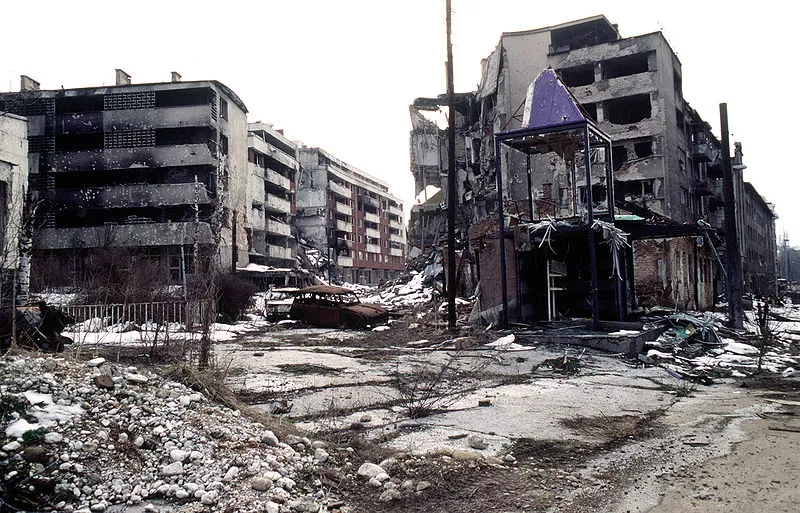
- Sarajevo, according to estimates, was targeted by an average of 450 heavy artillery pieces, 200 tank barrels, and at least 350 anti-aircraft weapons located in divisions and units around the city. Any provocation of such an artillery encirclement would have to involve heavy losses of our own artillery, which the Army of the Republic of Bosnia and Herzegovina lacked throughout the war – explained Professor Ahatović.
- Every location from which an artillery piece would be deployed from Sarajevo was monitored not only visually but also by other means such as the SNAR 10 artillery radar used by the former JNA. It was a radar system on an armored personnel carrier that operated under the command of a JNA brigade.
If we consider the fact that a battery of 122 mm D-30 howitzers, which Serbian forces used to shell Sarajevo, has a shell weighing 21.76 kg, and if it is known that a well-trained crew can fire three shells per minute from this weapon (65.28 kg), it means that a battery of 122 mm D-30 howitzers expels four tons of steel in just ten minutes. If, in addition, Serbian soldiers know the firing elements without calculation, meaning they knew the exact location of the Army of the Republic of Bosnia and Herzegovina's weapon, the chances of the Army of the Republic of Bosnia and Herzegovina's weapon being able to escape such an artillery barrage are very slim.
And, according to Professor Ahatović, several batteries of these howitzers operated against Sarajevo throughout the war from positions in Hreša, Borije, and Poljine.
- If we know that every artillery piece in Sarajevo was more valuable than life, then risking it in such a way without any major military actions is truly unnecessary. The tactic the witness talks about could have worked once, maybe twice, and the next time the Army of the Republic of Bosnia and Herzegovina's weapon would have been disabled by a direct hit from a mortar, howitzer, or tank.
Bosnia and Herzegovina was not attacked by the SDS party's army, concludes Professor Ahatović. Bosnia was attacked by the fourth military power in Europe, in full formation strength of four corps with aviation, artillery, armored units, and trained officer corps, writes Patria.
Komentari (0)
Prijavite se za komentiranje
PrijavaJos nema komentara. Budite prvi!
Minuta
Sve →Iz drugih kategorija

High Representative Not Elected: Germans, French and British Sabotaged Americans, New Attempt at End of June

ČOVIĆ WITHOUT MERCY: How Those Who Brought Ademović to Office Created a Political Hell for Him



Sunny Saturday, quite warm



Tragedy in Albanian resort: Two minors drown












