
By Armin Sijamić
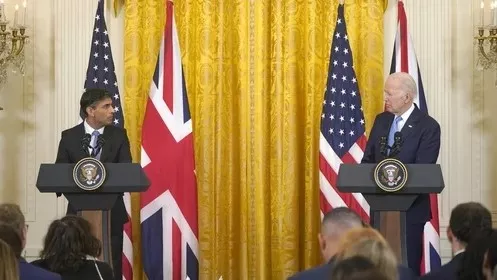
Prime Minister of the United Kingdom Rishi Sunak arrived in the United States on Tuesday for a two-day visit and held a series of meetings with leading officials in the country. Sunak met with congressional leaders, members of the American business community, and concluded his visit with a meeting with President Joseph Biden.
The strength of the Washington-London ties and their importance to the rest of the world is highlighted by the event that preceded the meeting between Biden and Sunak at the White House. Biden, in front of the cameras, welcomed his guest and jokingly said that they would solve all the world's problems in "the next twenty minutes".
After the meeting concluded, Biden recalled that they had met four times in four months. In March in San Diego, together with the Prime Minister of Australia, they discussed the actions of AUKUS; in April, they met in Belfast on the anniversary of the Good Friday Agreement; in May in Hiroshima during the G7 meeting; and yesterday in Washington.
Biden emphasized that there is no important global issue on which the US and the UK do not stand together, that they have been allies throughout history, and that they are now building a "21st-century partnership" based on the economy, the transition to clean energy, agreements on advanced technologies that will "shape our future," protecting technologies that are important for the national security of both countries, and strengthening supply chains so that their economies do not depend on any other country.
Technologies of the Future
Biden and Sunak spoke concretely, leaving no doubt about their ultimate goal. Biden said that the two countries will work on developing technologies used by the "military" and "intelligence services" and that they will be protected from those who "do not share our values." Although they spoke little about third countries, Biden and Sunak emphasized that the two countries will continue to fight against Russia and China, which, according to Sunak, "steal our intellectual property." This classic display of realpolitik announced to the public speaks volumes about how much, especially China, has advanced in the race with the West.
Biden and Sunak signed the "Atlantic Declaration," which they described as the first of its kind in the area of economic partnership, relating to artificial intelligence, easing trade barriers between the two countries, closer ties in military matters, access to mineral markets, data protection, and a range of other economic issues.
Biden emphasized that the two countries will work on developing the semiconductor industry, quantum computing, and artificial intelligence, while Sunak stated that London will host the first summit on artificial intelligence, through which the country will try to establish itself as a leading power in this field. This appears to be laying the foundation for Washington and London to once again secure better positions relative to the rest of the world.
Before the meeting with Biden, Sunak said that economic cooperation is crucial for security, just as defense alliances are. "Just as interoperability between our militaries has given us an advantage on the battlefield over our adversaries, greater economic interoperability will give us a crucial advantage in the decades to come," Sunak said before the talks. In other words, the two countries are seeking to leverage the advantage that leadership in artificial intelligence will provide, denying these technologies to all those "who do not share the values" of the US and the UK, as Biden put it.
Essentially, this is an announcement of a confrontation with China in the economic and security spheres, as China is the only country capable of matching them in this field at the moment. China's strong development of 5G networks was met with a response from Washington back when Donald Trump was in office. He imposed sanctions on Chinese companies, and then other countries canceled contracts with Chinese firms. Even then, it was clear that a new Western policy was being created, different from what we know. A free and open market could become a thing of the past, at least when it comes to relations with China.
In the case of artificial intelligence, the confrontation could be more drastic, given the unforeseen possibilities of using such technologies. Some leaders in the field of artificial intelligence have already spoken out, calling for a "slowdown" in its development, as it is becoming a danger to the world as we know it. Therefore, Washington and London have decided to create legal and other frameworks for the use of artificial intelligence, which will undoubtedly give them an advantage over others.
The significant advantage they have due to the fact that almost all major companies in this field are located in the West is likely a decisive factor in moving in this direction, coupled with the fear that China, which Biden previously identified as the only power that can rival the US globally and in almost all areas, might not do so. Thus, it is possible that many new technologies will not be ceded to rivals.
Let us remember that China's economic miracle began the moment US companies decided to open factories in China. The use of artificial intelligence could give an advantage to whoever uses it, just as the use of machines provided an advantage over those who still relied on manual labor.
Leading Powers and a Rising Power
Biden said that the US and the UK "lead" processes around the world and that their partnership is strong. He emphasized that "there is no closer country" to the United States than the United Kingdom. Sunak stressed that the two countries will work on security in the "Atlantic and Pacific regions," which is literally the entire world. There is no doubt that the main targets of this policy will be Russia and China, and that the battle will be fought for Africa, which Biden also mentioned.
Biden and Sunak emphasized that the two countries will continue to support Ukraine in its defense against Russian aggression, and the guest was interested in the possibility of his Defense Secretary Ben Wallace becoming the new NATO Secretary General after Jens Stoltenberg leaves the position in September. Biden replied that it was "possible" and that "it remains to be seen," as allies will also decide on this. Although this issue seems less important than others discussed, it is very important for London, especially after the United Kingdom left the European Union. Leadership in an alliance where almost all members are from Europe and part of the EU would become an important tool for London to have a greater presence on the European continent, especially in its eastern part.
During the meeting of the two leaders, the deep historical ties between Washington and London and their friendship were mentioned multiple times, as were anecdotes with Winston Churchill. The mention of one of the most successful and original politicians in world history is not accidental, given that after World War II he advocated for a united Europe while London maintained strong ties with the US. Today, with London outside the EU, staying close to Washington is likely the only way for the UK to play a global role. Sunak's readiness to sign agreements that further bind London to the US proves this.
The relationship between the long-time allies will deepen and adapt to the times to come, and the Washington-London partnership will remain the main force of the West. On the other hand, changes have occurred compared to previous decades. The main rival of Washington and London is no longer Russia. China has become an economic, technological, and ultimately political giant whose containment has become the most important foreign policy issue for Washington and London.
Komentari (0)
Prijavite se za komentiranje
PrijavaJos nema komentara. Budite prvi!
Minuta
Sve →Iz drugih kategorija

High Representative Not Elected: Germans, French and British Sabotaged Americans, New Attempt at End of June

ČOVIĆ WITHOUT MERCY: How Those Who Brought Ademović to Office Created a Political Hell for Him



Sunny Saturday, quite warm



Tragedy in Albanian resort: Two minors drown












