
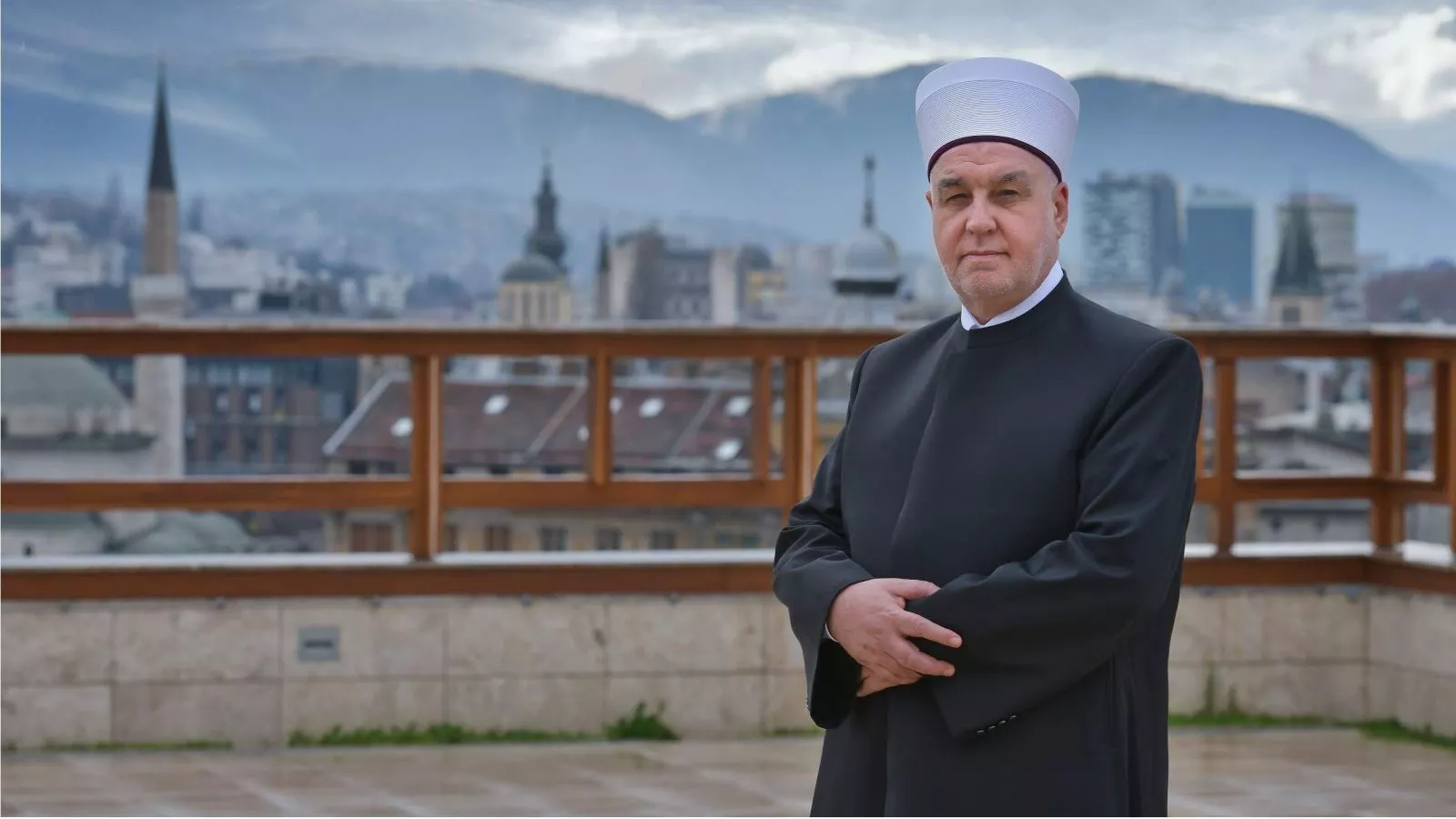
SARAJEVO, (Patria) - The Head of the Islamic Community in Bosnia and Herzegovina, Husein ef. Kavazović, in a pre-Ramadan interview for Preporod, spoke about Ramadan and its perspectives, spirituality, contemporary challenges and current problems of our society, and the ideological background of attacks on the Islamic Community.
In addition, he revealed some details from his daily life, ways of interacting with his surroundings, and gave readers a unique insight into what he likes to read and what art is close and dear to him, writes Preporod.info.
Preporod: Ten years have passed since you took on the responsibility of leading the Islamic Community in Bosnia and Herzegovina as the Head of the Islamic Community. Was the burden of this responsibility greater in the first years or today, considering the changes and challenges that both the Community and the people are facing? Also, have you changed in these ten years?
Head of the Islamic Community: Every time has its challenges. Imam Shafi'i says in his verses: "We blame time – zeman / but the flaw is within us / time has no greater flaw than us." Every time has challenges to be dealt with, as well as trials, greater or smaller. Let's go back in history, and imagine what the fall of our Bosnian Kingdom meant for Bosniaks: they probably thought it was the end of the world, of our people and state. The same happened when the Ottoman Empire fell and we were left exposed, then the domination of neighbors, then the communist regime, and then the aggression and genocide. Each of those stages brought with it massacres of our people, restrictions on our freedom, and attacks on our state.
Probably today's trials are smaller in comparison, but that doesn't mean they are any less important, because we don't know what the day will bring, and what the night will bring. Therefore, perhaps we should think more about whether we are up to the task and how we are dealing with today's challenges. This occupies me the most.
The first and most difficult is the question of personal responsibility: that each of us starts with ourselves and asks ourselves every day if we could have done more to ensure that justice is respected among us, that peace prevails, and that the evil of the past is not repeated.
When it comes to the challenges facing our people, community, and state, the continuity of malicious policies seems to be the greatest. Unfortunately, we are used to them and have gotten used to dealing with them. They use every opportunity to achieve dishonorable goals. However, we as a people have also learned a lot from our overall experience, and I think we are in a far better position than when I started my work as an imam, and even when I took on the position of Head of the Islamic Community. We should not spread pessimism, but neither should we ignore dangerous trends when they appear. To believe and to strive – that is our path!
I cannot speak about whether I have changed; others are better judges of that.
Preporod: What does the Head of the Islamic Community do in his free time, if he manages to find any?
Head of the Islamic Community: I try to spend as much time as possible with my grandchildren. I have heard about the love of grandmothers and grandfathers for their grandchildren. However, only when we realize how quickly our children have grown up and how, busy with other challenges, we were not sufficiently with them, do we understand that the time we miss spending with our loved ones, with our family, children, is difficult to make up for.
The Prophet Muhammad (peace be upon him) compares God's love for people to a mother's love for her child. The family is truly the place where we all mature, not just our children, and where true values nest. I wish I had more time now to dedicate to it, to my wife and daughters, and especially to my grandchildren.
I also have a small piece of land, which I have leased and cultivate. I sow something in the ground. I am a child of the village. Our generations have lived from the land and with the land, this Bosnian land of ours. In it lies our worldly peace, but also peace from trials and challenges. Returning to the land is returning to the origin.
Preporod: Besides the literature that is the foundation of your academic career, and that which is a source of inspiration for spiritual topics, what literary works and other forms of art do you relax with?
Head of the Islamic Community: A book is truly a best friend. It will never leave you, unless you leave it, and yet, it will always welcome you gladly. Our time has accelerated. Perhaps it seemed that way to those before us as well. Books are my wealth, and everything valuable I have from this world is in books. I love reading our classics: M. Selimović, D. Sušić, S. Kulenović, N. Ibrišimović, but also our contemporaries: the brilliant Dž. Karahasan, E. Karić, poets Dž. Latić, H. Hajdarević, G. Gojer, M. Stojić... In their works, I search for our people and our Bosnia, our fears and hopes, our sorrows and griefs.
I have a dream that, when God willing I retire, I will go to my zawiya, read, and not go out anywhere. I love listening to the Quran, but also Andalusian music, with which I relax.
Preporod: In this burdensome time, with numerous challenges and pressures of new paradigms that alienate people from each other, regardless of their proximity and virtual connection, what do you most often tell your children as a father, and only then as the Head of the Islamic Community?
Head of the Islamic Community: I tell them to be considerate of people, not to judge too harshly, because people are not perfect. I tell them that the world has its limitations, that it is fleeting, challenging, and unstable. That they should not rely on it alone. I tell them that Faith and Goodness are firm supports in our transient life.
Preporod: Given the abundance of religious literature, lectures, media appearances, and the presence of religious patterns in society, a believer might wish to easily and simply access sincere spirituality or experience someone talking about their personal experience of faith. How can we bring a person back to themselves, to exploring their personal universe, and how much can Ramadan help us in this?
Head of the Islamic Community: We live in a time of haste, superficiality, and simplification of everything. It is a time of deconstruction, demystification, and desecration of everything valuable and sacred. In such a time, it is logical to expect people to reach for "instant religiosity" or "instant spirituality." However, instant is, by definition, only a substitute for something that actually exists and should superficially satisfy our need for it, to deceive us. This is also the case with religiosity, which is not it, which is focused on the external, on the formal, on the conspicuous, while the essential and real is often the first victim of such a turn towards apparent spirituality.
Ramadan teaches us precisely that good cannot be achieved quickly and easily. Every goal, including spiritual growth, requires sacrifice and renunciation.
Ramadan helps us to distance ourselves from everything that distracts us from the real, essential, and primary. It helps us to prioritize our tasks, to remove the veil from our eyes, to pause in our daily lives and to question the meaning of existence and our place in the world that surrounds us and on which we consciously or unconsciously have an impact, making it better or worse.
Preporod: In Ramadan, believers show their readiness for sacrifice. There is a challenge in how to achieve that readiness when it comes to other obligations, such as education or building better relationships within the family?
Head of the Islamic Community: This year's slogan for our Ramadan activities is "Ramadan in the Family and the Family in Ramadan." With it, we want to direct our believers to pay attention to the challenges facing families.
Today, when some in our country are once again problematizing the issue of Islam in the public sphere and when they are trying to take away our freedom of speech and religion, let us remember that in the time of Yugoslavia, when religion was banished from public spaces, from schools and media, Islam survived precisely in families. At a time when the state was trying to control the Muslim religious community and when it imposed numerous restrictions, faith was preserved primarily within the family.
Preporod: Can it be said that we, as Muslims, lack Islamic ethics, for example, in social relations and processes, such as workers' rights, the proper relationship towards common goods, etc.? Are we, from the position of the religious community, ready to speak about this more strongly and openly?
Head of the Islamic Community: Certainly. Both I, as the Head of the Islamic Community, and other imams and scholars, try to stay away from daily politics, and very often, when we talk about ethical principles that we would like to see in society, we are accused of meddling in politics, of de-secularizing society, of Islamizing society. Regardless of these accusations, the Community will take care of the concerns of its members, without taking over the state's job, but always clearly stating its position.
The task of us from religious communities is to teach fundamental values and rights, such as the right to life, work, property, and human dignity, and to hope that they will come to life in our society. When we invoke rights, we invoke the natural rights of man, which are inalienable and inseparable from his personality. We do not have authority or power over those who have committed to guaranteeing them to others, but we must be consistent with our religious teachings and always be on the side of the disenfranchised and those in need of help.
Preporod: What is the greatest danger that threatens the ulema when "dealing" with religion and fulfilling duties that require both faith and the status of a religious figure?
Head of the Islamic Community: Consistency with oneself and the values advocated is probably one of the most difficult challenges. It was said long ago that it is not important how grand the ideals you defend are, but how consistent you are in doing so. Because inconsistency indicates hypocrisy, and hypocrisy is treated more in the Quran than disbelief. Inconsistency compromises the ideal and the values being advocated. Therefore, for the ulema, but not only for the ulema, the greatest challenge is to be consistent with what one claims to believe and advocate. One must confirm with one's actions what one says is in one's heart and on one's tongue. This is also the path of sincerity, without which there is no Goodness.
Komentari (0)
Prijavite se za komentiranje
PrijavaJos nema komentara. Budite prvi!
Minuta
Sve →Iz drugih kategorija

High Representative Not Elected: Germans, French and British Sabotaged Americans, New Attempt at End of June

ČOVIĆ WITHOUT MERCY: How Those Who Brought Ademović to Office Created a Political Hell for Him



Sunny Saturday, quite warm



Tragedy in Albanian resort: Two minors drown












