
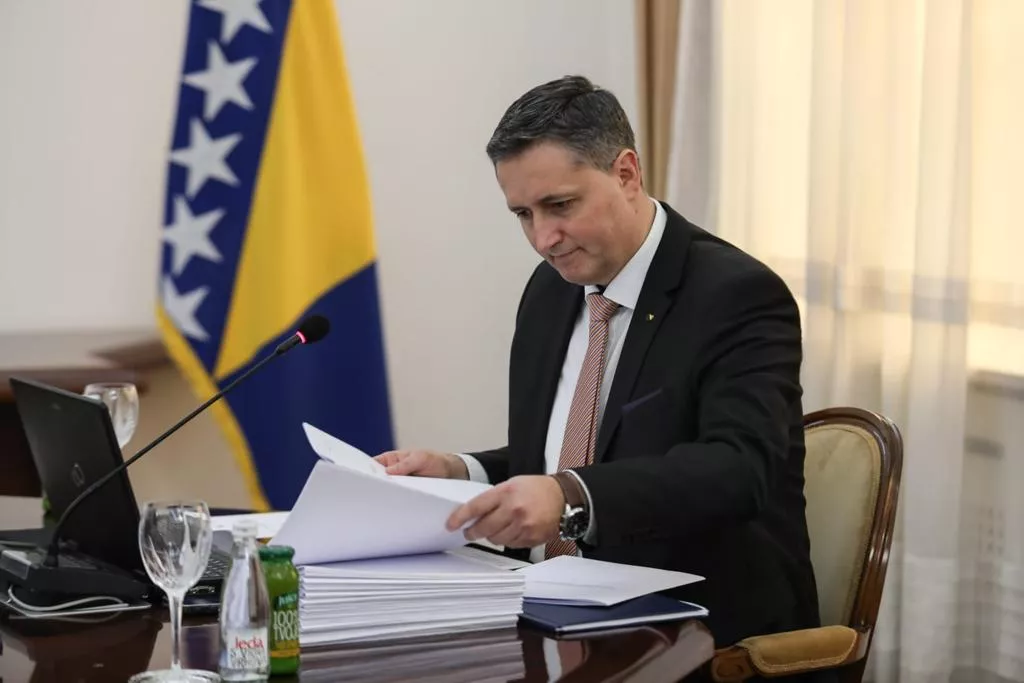
(Patria) - BiH Presidency member Denis Bećirović issued a statement on the occasion of the pronouncement of the verdict by the International Residual Mechanism for Criminal Courts in the case "Prosecutor v. Stanišić and Simatović".
You can read Bećirović's statement below.
Dear families of victims of genocide and war crimes,
esteemed media representatives,
ladies and gentlemen,
citizens of Bosnia and Herzegovina!
At the beginning of my address, I want to remind you once again that we mark May 31st as the Day of White Ribbons in remembrance and deep respect for the 3,176 Prijedor residents killed during the aggression against the Republic of Bosnia and Herzegovina. Among the killed were 102 murdered children. We must never forget the innocent victims.
Today is an important day for Bosnia and Herzegovina, the region, Europe, and the world. Behind us are 30 years of the history of the Hague Tribunal (International Criminal Tribunal for the former Yugoslavia - ICTY and its legal successor, the International Residual Mechanism for Criminal Courts - IRMCT). On the foundations of this Tribunal's verdicts, we must continue our journey towards justice and truth.
With today's final verdict against the leaders of the State Security Service (SDB) of Serbia, Jovica Stanišić and Franko Simatović, we are closer to establishing the full truth about the aggression against the Republic of Bosnia and Herzegovina.
The Tribunal was established in accordance with Chapter VII of the United Nations (UN) Charter due to crimes committed in the former SFRY, and particularly in the Republic of Bosnia and Herzegovina, which, according to the UN Security Council, then represented a threat to international peace and security.
The President of the International Residual Mechanism for Criminal Courts (IRMCT), Judge Graciela Gatti Santana, emphasized, among other things, that the pursuit of international criminal justice is "a journey that never ends." Recalling the significance of the ICTY's establishment, the President of the IRMCT stressed that the pronouncement of the appellate judgment in the case of Prosecutor v. Stanišić and Simatović "marks a firm milestone in progress towards achieving justice."
The establishment of the ICTY had legal, historical, civilizational, and moral significance.
The Tribunal was the first international criminal court established after the Nuremberg and Tokyo tribunals, which prosecuted war criminals after World War II.
The Hague Tribunal left behind a vast archive of committed genocide, crimes against humanity, and other crimes. Among other things, the Hague legacy includes: 2.5 million transcripts of court proceedings, 422,000 documents, and 30,000 video recordings. There were 10,800 days of trials held at the Hague Tribunal, and over 4,600 witnesses testified. A total of nearly 1,500 years in prison and 7 life sentences were imposed. The Tribunal did not try peoples but established individual responsibility.
After this verdict as well, politicians from neighboring countries, as well as some from Bosnia and Herzegovina, must understand that the policy of force, aggression, and crime does not pay off and that there are always mechanisms to sanction such policies.
One of the goals of the ICTY was to bring to justice those responsible for the most brutal crimes committed after World War II.
The Hague Tribunal contributed to establishing historical facts, fighting against the denial of truth, and helping the states that emerged after the dissolution of the former SFRY to confront their past.
The truth about the committed genocide and the legacy of the Hague Tribunal remain a permanent warning to humanity.
The civilizational achievement of the ICTY is that some of the highest officials responsible for genocide, crimes against humanity, and other crimes were brought to justice. Bringing presidents, generals, camp commanders, and other responsible individuals before the Hague Tribunal exceeded even the initial expectations at the beginning of this international ad hoc court's work. Through decisions concerning the genocide committed against Bosniaks, crimes against humanity, and other war crimes, the IRMCT showed that a person's high position can no longer be a shield from criminal prosecution.
The Tribunal also confirmed the legal nature of the war waged against the internationally recognized state of the Republic of Bosnia and Herzegovina.
Through final verdicts of the Hague Tribunal, including verdicts on joint criminal enterprises, it was proven that this was an international armed conflict. Neighboring countries waged war for territories with the aim of creating a Greater Serbia, and for a period of the war, a Greater Croatia. These facts were established in 8 final verdicts of the IRMCT.
Today's verdict against Stanišić and Simatović is important because two former heads of the Serbian security service have been finally convicted, confirming Milošević's command role, given that this verdict relates to the Serbian SDB and its crimes in Bosnia and Herzegovina, as well as in Croatia.
The particular importance of this verdict lies in the fact that the highest leaders of the Serbian security service have been finally convicted for crimes and involvement in the aggression against the Republic of Bosnia and Herzegovina. Stanišić and Simatović acted on the direct orders of Milošević, who controlled his secret police and its special operations unit. Let's not forget, these special units were designed to conceal the Serbian government's responsibility for some of the most brutal crimes committed against civilians outside of Serbia.
The Appeals Chamber, among other things, found "that a joint criminal enterprise existed and that its common purpose was the forcible and permanent removal of the majority of non-Serbs from large parts of Croatia and Bosnia and Herzegovina through the commission of murder, deportation, inhumane acts (forcible transfer), and persecution, as charged in the indictment. (...) The Appeals Chamber found that Mr. Stanišić and Mr. Simatović are responsible as members of a joint criminal enterprise for the crimes committed by various Serbian forces in 1992 in Bosnia and Herzegovina, in Bijeljina, Zvornik, Bosanski Šamac, Doboj, and Sanski Most, and for the crimes committed in 1995 in Trnovo and Sanski Most" (...).
Transcripts from the Hague Tribunal trials, as well as documented digital evidence, provide much more detailed information about the role of Slobodan Milošević and Serbia than the verdicts themselves.
The vast archive of the Hague Tribunal awaits researchers. In the trial of Slobodan Milošević, Serbia's aggressive role was comprehensively examined. Although it was widely assumed that, under Milošević's regime, Serbia supported Serb proto-states in Croatia and Bosnia and Herzegovina, the full extent of that support and the mechanisms by which it was provided were not revealed to the public until this trial. Slobodan Milošević's death prevented a verdict against him, but it did not erase the facts.
Considering the aforementioned facts, as a member of the BiH Presidency, I emphasize the following:
1. The verdicts of the Hague Tribunal are of paramount importance for international law and order as a whole. The verdicts of the highest UN courts have established that genocide was committed against Bosniaks. They are also verdicts against Greater-state policies that, through a joint criminal enterprise, attempted to divide and destroy Bosnia and Herzegovina as an independent, sovereign, indivisible, and internationally recognized state.
2. The verdicts of the Hague Tribunal, including today's verdict in the case of Prosecutor v. Stanišić and Simatović, have established not only individual but also institutional responsibility of high-ranking political, military, and police leaders of Serbia for crimes against humanity and violations of the laws or customs of war.
3. The international community and the state of Bosnia and Herzegovina have a legal, political, moral, and historical obligation to the victims and future generations to seek:
- revision of history and other textbooks in the countries of the region to incorporate the final verdicts of the highest UN courts;
- revision of criminal legislation in the countries of the region to adequately prosecute and punish all those who glorify convicted war criminals;
- prosecution and punishment of the remaining individuals responsible for committed genocide, crimes against humanity, and other war crimes;
- justice and truth for thousands of people who are still searching for the truth about the fate of their loved ones;
- implementation of transitional justice mechanisms.
4. On the occasion of the 30th anniversary of the establishment of the Hague Tribunal, I once again call on the UN to make a just decision and to deposit the complete original archive of the Hague Tribunal in Sarajevo, the capital of Bosnia and Herzegovina.
Namely, as a member of the BiH Presidency, at the beginning of this year, I requested the UN Secretary-General, the President of the UN General Assembly, and the President of the Residual Mechanism for Criminal Courts to deposit the archival material of the Hague Tribunal in the capital of Bosnia and Herzegovina.
Millions of printed pages, audio recordings, video recordings, photographs, political agreements, and classified data, which clearly depict what happened during the aggression against the Republic of Bosnia and Herzegovina from 1992 to 1995, should be stored in Sarajevo.
5. The international community should not allow legally binding court verdicts to be merely archived and then forgotten. Bosnia and Herzegovina has the right to demand that:
- the international community, in the interest of all humanity, send a message that the results of committed genocide, crimes against humanity, and other crimes cannot and must not be permanently recognized;
- representatives of the international community insist on and encourage member states to fulfill their international obligations in good faith. Against states that refuse to do so, it is necessary to take all necessary measures provided for by the UN Charter and other relevant international acts.
- the UN, and especially the EU countries, sanction all politicians who threaten and work to break up the state of Bosnia and Herzegovina and glorify legally convicted war criminals as a prerequisite for such evils never to happen again to anyone.
6. It is in the best interest of preserving peace, stability, and good neighborly cooperation that the highest authorities and officials of the Republic of Serbia:
- responsibly confront the consequences of the actions of their highest officials and institutions in the 1990s;
- cease denying the judicially convicted genocide against Bosniaks. No genocide after World War II has been as extensively and factually documented as the genocide against Bosniaks committed during the aggression against the internationally recognized state of the Republic of Bosnia and Herzegovina;
- allow access to key archives, declassify them, and ensure full access to documents of the Supreme Defense Council of the FRY that have not yet been published;
- condemn the Greater Serbia criminal project and permanently cease threatening the independence, sovereignty, and territorial integrity of Bosnia and Herzegovina;
- draw a long-term lesson from the fact that Serbia is the only country judicially convicted of violating the UN Convention on the Prevention and Punishment of the Crime of Genocide;
- cease the policy of undermining and disrespecting Bosnia and Herzegovina, and especially by denying the final and binding decisions of the Constitutional Court of BiH;
- normatively and factually commit to establishing good neighborly relations between independent and sovereign states in accordance with the principles of international law;
- condemn and ostracize perpetrators of genocide, crimes against humanity, and other crimes, rather than glorify them;
- cease the practice of providing refuge to convicted war criminals.
7. Today's verdict is a new opportunity for Serbia to clearly distance itself from the architects, organizers, and perpetrators of genocide, crimes against humanity, and other crimes, so that together we can turn towards building a prosperous future.
The future of Bosnia and Herzegovina, Serbia, and the wider region does not lie in hegemonic policies, conflicts, and quarrels. The condemnation of criminals and their policies is an important prerequisite for strengthening good neighborly relations, stability, and sustainable development. It is time to decisively begin the process of raising awareness and pursuing reasonable and peaceful policies.
Finally, citizens of Bosnia and Herzegovina, let us turn towards the future, but with constant vigilance and caution, because genocide is repeatable. Let's not forget that planners, instigators, and perpetrators of genocide only respect those who are capable of defense and who show a desire to defend themselves. This is a lesson we must all learn well.
Long live our proud and unyielding state of Bosnia and Herzegovina!
Komentari (0)
Prijavite se za komentiranje
PrijavaJos nema komentara. Budite prvi!
Minuta
Sve →Iz drugih kategorija

High Representative Not Elected: Germans, French and British Sabotaged Americans, New Attempt at End of June

ČOVIĆ WITHOUT MERCY: How Those Who Brought Ademović to Office Created a Political Hell for Him



Sunny Saturday, quite warm



Tragedy in Albanian resort: Two minors drown












