
By Miran Videtich
Elections in Slovenia have shown a deep societal division. Four years of Robert Golob's rule, with a program that a programmatically "empty" politician took over from the far-left party Levica, along with rising corruption (as indicated by international institutions) and crime in the country, brought nearly 70 percent of citizens to the polls.
 Miran Videtich
Unfortunately, these elections did not bring a clear change. A strong division remained, concentrated in two political blocs. The pre-election campaign was not based on different programs and visions for the future, but on a fabricated scandal through which the government, its media, and ideological NGOs tried to cover up the shameful fact that Robert Golob's government withdrew Slovenia's participation in South Africa's lawsuit against Israel over military operations in Gaza at the last minute.
Under pressure from leaked footage allegedly showing corrupt activities by individuals close to Robert Golob, the political struggle intensified.
In four years, Robert Golob has shown himself to be a populist like Aleksandar Vučić or Milorad Dodik, which is not surprising given that his biggest supporter is the mayor of Ljubljana, Zoran Janković, who publicly supports Aleksandar Vučić's policies in Serbia and Milorad Dodik's policies in Bosnia and Herzegovina (Republika Srpska).
This fact is not changed by the (likely) commissioned promotion of Golob and the distortion of truth that can be read these days in statements from self-proclaimed independent institutes and in media focused on the Balkan region (example: the well-known institute IFIMES in Bosnia and Herzegovina, which is closely connected to people from Golob's and Janković's circles, in the media outlet Novi dani).
The election results showed:
• an almost equal result between the Freedom Movement and the Slovenian Democratic Party, with a difference of less than one percent,
• growth of the moderate right, which gathered in a "trio" under the umbrella of the New Slovenia party,
• the first entry into parliament of the pro-Russian party Resnica, which began its political career as an anti-vaccine party during COVID and is presumed to represent the interests of Moscow and Belgrade, thereby "relieving" Zoran Janković's role,
• a weak result for the two coalition parties (Social Democrats and Levica) from Golob's government, indicating that their cooperation with him did not bring them political capital – quite the opposite.
It should be emphasized that the SD party, a sister party to the SDP in Bosnia and Herzegovina, needs a thorough renewal and a conceptual departure from communism. Levica describes itself as a pro-Soros party, whose leadership consists of politically exposed NGO actors who, according to some media, are connected to the sexual assault scandal known as "Fotopub".
The biggest loser of the election is Anže Logar, a young and ambitious politician who continued his political career after leaving the SDS party. Significantly more was expected from him.
Among the losers, we can also include the party Prerod, led by MEP Vladimir Prebilič, which failed to enter parliament, despite high expectations – especially in terms of normalizing the left-wing political spectrum.
The Freedom Movement achieved a minimal victory on the wings of populism, using the "well-known" political model of Aleksandar Vučić – mobilizing those over 65 and public sector employees.
They won over the elderly through the media, including state media, which over four years turned into propaganda channels for one party, following the example of Orban's Hungary. They attracted public sector employees with budget funds, which, on the other hand, weakened the economy.
Compared to 2022, they lost almost 80,000 voters, which is a very indicative figure. During their term, according to criticism, they gained control over repressive bodies, some supervisory institutions, majority media, and parts of the state economy.
On the other hand, Janez Janša and his party gained almost 50,000 new voters and surpassed the 300,000 mark. His slogan "in coalition with voters" has clearly partially succeeded.
His goal was a constitutional majority (60 seats), but he failed to achieve even a relative victory, although polls indicated otherwise until recently.
One of the winners of the election is New Slovenia, which, under the leadership of Jernej Vrtovec, managed to strengthen its position and establish itself as an important political factor. With moderate right-wing views and a focus on the economy and healthcare, it achieved visible progress.
The new party Democrats, led by Anže Logar, who is nevertheless dissatisfied with the result, will also play an important role in forming the government. He based his campaign on the fight against corruption and the idea of a "third bloc".
A complicating factor for him is the fact that he personally did not enter Parliament, although this can still change with votes from the diaspora.
What awaits Slovenia?
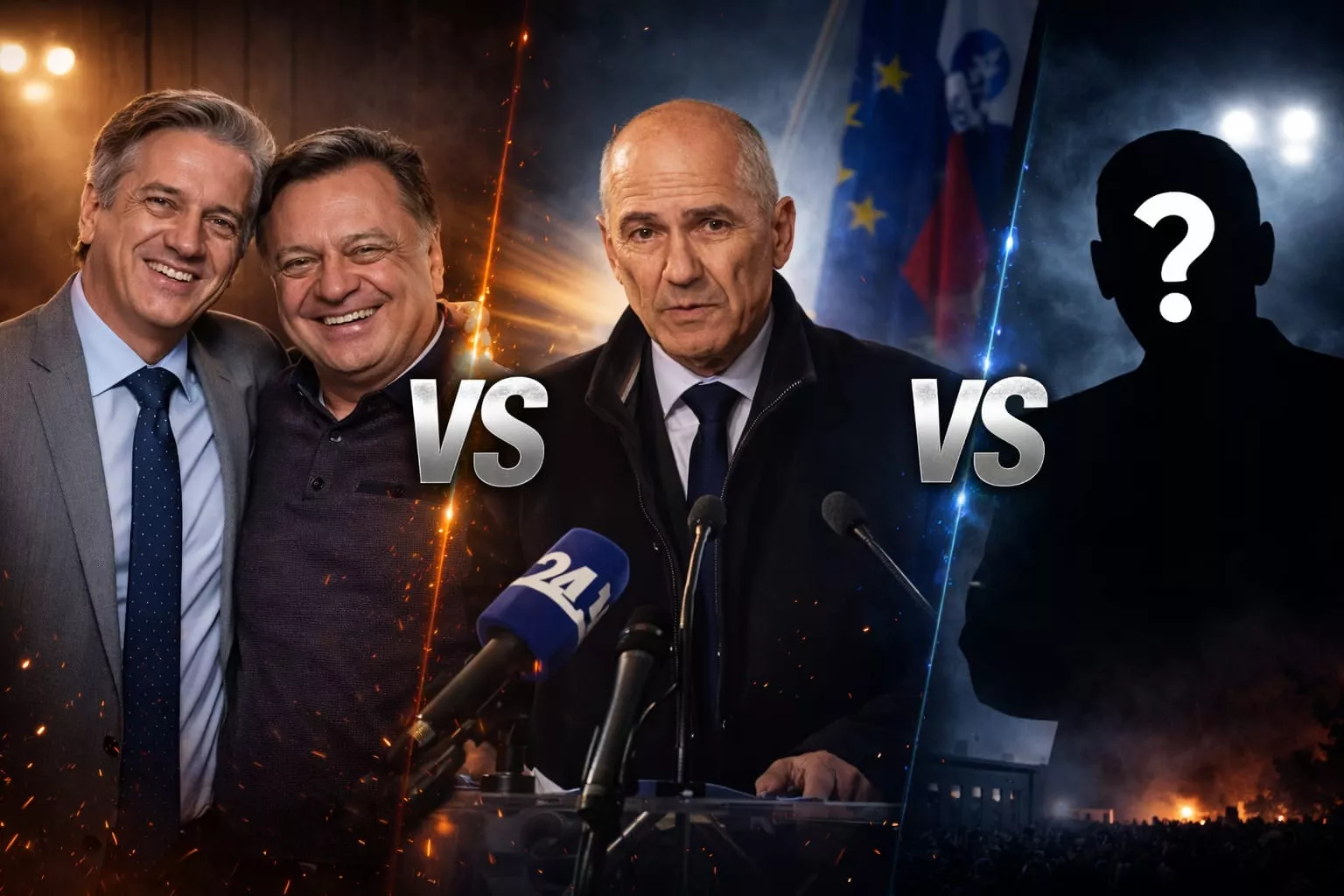
Forming a coalition will be challenging. As the title suggests, the decision will be between continuing corrupt governance from the shadows, under the influence of Zoran Janković... such a government would certainly be led by Robert Golob...
(I am not stating this about corruption without basis. In the footage allegedly obtained by Israeli services, former Minister of Justice Dominka Švarc Pipan appears, speaking about the existence of a corrupt network and her role in it, including contacts with Golob, his partner Tina Gaber, and Zoran Janković.)
...or a government will be formed "for the future of youth" and economic recovery, which will not be led by Robert Golob.
Such a government would be politically mixed and development-oriented. What is crucial is that it would not be under the influence of Zoran Janković, Aleksandar Vučić, foreign intelligence structures, or interest networks connected to the Soroš family.
In this scenario, the government could be led by a "third man" – a respected Slovenian economist is mentioned. Janez Janša has certain chances, but they are limited due to political mathematics, the influence of Kučan's circle, and parts of the public. However, Janša has not yet said his last word.
Influence of Bosniaks, citizens of Slovenia on the elections
Citizens of Slovenia of Bosniak origin traditionally do not vote for right-wing parties. This time was no different, but it is surprising that the majority supported the Freedom Movement.
If we look at Jesenice, often considered a "Bosnian" city, the Freedom candidate Alenka Bratušek won convincingly.
The appeal of the Bosniak Council in Slovenia for support for Tanja Fajon did not help. She was not elected, nor was Fahir Gutić, who was a candidate for Levica.
The question arises whether Bosniaks have forgotten that this government almost prevented an exhibition about the genocide in Srebrenica? That Golob is subordinate to Zoran Janković, a supporter of Dodik and Vučić?
At the same time, Janković is also connected with certain officials from Elmedin Konaković's circle, with whom he has been seen in Ljubljana.
Have they also forgotten the decision to withdraw from the lawsuit against Israel just before the elections? All of this casts a bad light on Bosniaks living in Slovenia and puts them in a subordinate position that allows for the continuation of Zoran Janković's policies.
The representatives of the Islamic Community, both in Sarajevo and Ljubljana, should seriously consider this. Slovenia is home to many Bosniaks and people from Sandžak, and corruption affects them and their wallets.
****************
Miran Videtich is a political commentator and co-owner of the Patria News Agency
Komentari (0)
Prijavite se za komentiranje
PrijavaJos nema komentara. Budite prvi!
Minuta
Sve →Iz drugih kategorija

High Representative Not Elected: Germans, French and British Against Americans, New Attempt at End of June

ČOVIĆ WITHOUT MERCY: How Those Who Brought Ademović to Office Created a Political Hell for Him



Sunny Saturday, quite warm



Tragedy in Albanian resort: Two minors drown












