
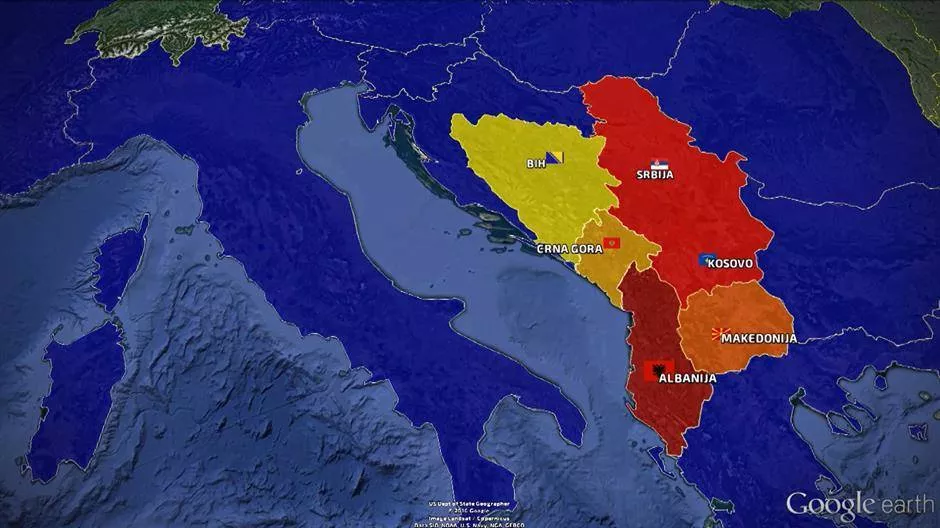
The International Institute for Middle Eastern and Balkan Studies (IFIMES) from Ljubljana, Slovenia, has prepared an analysis of the current political situation in the Western Balkans on the occasion of the EU summit in Brussels on October 17 and 18, 2019, which will decide on setting a date for the start of negotiations for membership in the EU for the Republic of North Macedonia and the Republic of Albania.
From the extensive analysis "Western Balkans 2019: Is the EU Pushing the Western Balkan Countries into Russia's 'Embrace'?" we highlight the most important and interesting parts.
Western Balkans 2019: Is the EU Pushing the Western Balkan Countries into Russia's "Embrace"?
The regular autumn EU summit will be held on October 17 and 18, 2019, in Brussels. Although the importance of the meeting of EU leaders is focused on the United Kingdom's exit from the EU (Brexit) on October 31, 2019, the Western Balkans are eagerly awaiting the Republic of North Macedonia and the Republic of Albania to be granted a date to start negotiations with the EU.
The EU was founded as a peace project after the end of World War II and ensured lasting peace and long-term stability in Europe. In the recent past, several wars were fought in the Western Balkan region. Due to this, a fragile peace and temporary stability have been established.
Analysts believe that EU leaders must be aware of the fact that if they want the EU peace project to continue in Europe, it must be implemented in the Western Balkan countries, as EU membership would ensure lasting peace and long-term stability for the countries in that region. As long as the EU has an unstable Western Balkan region, it will not be able to address key issues and its long-term strategic positioning in international frameworks.
Western Balkans Closest to Russia's "Embrace"
European leaders often express support for the Western Balkans and its Euro-Atlantic path, expressing concern about the influence of certain countries in the region, primarily Russia, China, and Turkey. Through its policy of (non)enlargement, the EU is effectively pushing the Western Balkan countries into Russia's "embrace," only to later accuse those same countries of close ties and cooperation with Russia. However, the concern of EU leaders for the Western Balkans is actually quite different. Namely, certain EU member states are constantly setting new conditions or criteria for membership for the Western Balkan countries. Although experts warn that as many as 15 EU member states would not be able to fully meet the membership conditions required of the Western Balkan countries. It is noted that Bulgaria and Romania were admitted to membership, and recently Croatia as well, for whom the rules were bent during their full accession. In 2004, 9.5 countries were admitted to full membership, as only half of Cyprus was admitted. The French province of Corsica and the Italian province of Sicily are also mentioned, where EU regulations do not function anywhere near the standards, rules, and directives required by the EU.
The (in)action of the EU is most illustratively shown in the example of the dialogue between official Belgrade and Pristina on normalizing relations, in which the EU is the mediator. Although the so-called Brussels Agreement on conducting dialogue was signed on April 19, 2013, the dialogue has stalled and its fate is uncertain. The dialogue was conducted non-transparently, while on the other hand, the EU often calls on the Western Balkan countries to be transparent, yet it is often non-transparent itself. This was also evident in cases of tax evasion by certain transnational companies, which occurred in Luxembourg at a time when the prime minister of that country was the current President of the European Commission, Jean-Claude Juncker (EPP). There are numerous examples of non-transparency and the unacceptable role of the EU.
Unacceptable Role of the EU – The Case of Ursula von der Leyen
The latest example of the EU's unacceptable role is the controversial visit of the newly elected President of the European Commission (EC), Ursula von der Leyen (CDU/EPP), to the Republic of Croatia, which will have to be more careful in the future regarding the Western Balkans and the actions of the European Commission. During her visit, von der Leyen stated that she would work on bringing the Western Balkan countries closer to the EU. The Western Balkans are part of Europe, and if the EU wants the Western Balkan countries to become EU members, it must specify the year of enlargement, not send statements in the form of platitudes about bringing the region closer to the EU, otherwise, those countries will be forced to find another path.
Croatia is a typical example of non-European behavior. Namely, Croatia does not respect the decisions of the international arbitration court regarding the border dispute with Slovenia. Furthermore, the Republic of Croatia does not respect the decision of the International Residual Mechanism for Criminal Tribunals for crimes committed in the territory of the former Yugoslavia (MICT), by which certain high officials of Croatia and the Croatian Democratic Union (HDZ) were finally convicted for participation in a joint criminal enterprise against Bosnia and Herzegovina. HDZ is a political party being tried at the County Court in Zagreb. In addition, it should be noted that the position of the Serb community in Croatia has drastically worsened after Croatia's accession to full EU membership. The Serb community was cooperative and an important factor that contributed to Croatia becoming an EU member. A revision of events from World War II is taking place in Croatia, according to which fascist and collaborationist forces are being attempted to be rehabilitated and presented as anti-fascist. The position of the Jewish community is of extreme importance here, as they have not yet resolved the issue of the return of their confiscated property. It is precisely the revision of history that has led the Jewish community and other anti-fascist associations to independently or separately mark the anniversary of their liberation from the Ustaše camp in Jasenovac without the participation of the Croatian state leadership. Noteworthy are the (pro)fascist appearances and speeches of the current President of the Republic of Croatia, Kolinda Grabar-Kitarović (HDZ), and her open interference in the internal affairs of neighboring Bosnia and Herzegovina.
Croatia, as a member of the EU and NATO, has unresolved border issues with any of its neighbors except Hungary, as it inherited its state border with Hungary from the former SFRY.
On January 1, 2020, the Republic of Croatia will chair the Council of the European Union. The Western Balkans, with which it is in conflict with almost all countries, will be a focus of its presidency. Thus, Croatia does not recognize the legal and legitimate election of Željko Komšić (DF) as the Croatian member of the Presidency of Bosnia and Herzegovina, solely because its favored candidate, the president of HDZ BiH, the controversial Dragan Čović (HDZ BiH), was not elected. Komšić was elected based on the same election law under which Čović was previously elected. It has become a constant that Croatian officials abuse their country's membership in the EU and NATO when it comes to Bosnia and Herzegovina, as well as the Republic of Serbia, and it is expected that they will soon start doing so in the Council of Europe (CoE), as the Secretary General of the Council of Europe, Marija Pejčinović Burić (HDZ), is the former Minister of Foreign Affairs of Croatia.
Analysts believe that the fact that EU and NATO institutions have not reacted to Croatia's behavior regarding Bosnia and Herzegovina and Serbia is worrying, as it represents a blatant abuse of membership in the EU and NATO. Numerous war criminals, who have been finally convicted in Bosnia and Herzegovina, have found refuge in Croatia, while Croatian secret services harass citizens of Bosnia and Herzegovina when they are on its territory. Croatian police treat migrants inhumanely (beatings, torture) and carry out illegal readmission of migrants from their territory to BiH, which human rights organizations have already warned about. Croatia is strongly building its relations with Russia, despite the EU sanctions imposed on Russia. Croatia will need assistance to face and overcome the challenges and the situation it finds itself in. If it wants its presidency of the EU, at least concerning the Western Balkans, not to be doomed to failure from the outset, it will need the help of the EU and the countries of the region, as past experiences have shown that the most difficult "confrontations are with oneself."
Trilateral Serbia – North Macedonia – Albania
A trilateral meeting of the presidents of Serbia, Aleksandar Vučić (SNS), with the prime ministers of North Macedonia and Albania, Zoran Zaev (SDSM) and Edi Rama (PS), was held in Novi Sad on October 10, 2019. A Declaration of Intent was signed to establish a "mini-Schengen" between these three countries.
The Declaration should help the entire Western Balkan region to start functioning based on the EU's four key freedoms – freedom of movement of capital, goods, services, and people.
The joint declaration envisages the elimination of border controls and other barriers for easier movement in the region by 2021, while at the same time allowing citizens to travel in the region with only an ID card, as well as to be employed anywhere if they have proof of their qualifications.
The declaration also envisages the recognition of diplomas in the region, as well as better cooperation in the fight against organized crime and assistance in cases of natural disasters.
Serbian President Aleksandar Vučić invited all members of the so-called Balkan Six to accept the document on "mini-Schengen," despite all the differences that exist regarding the recognition of Kosovo's independence.
North Macedonian Prime Minister Zoran Zaev said that all six Western Balkan countries (Serbia, North Macedonia, Albania, Bosnia and Herzegovina, Montenegro, and Kosovo) should join the initiative for closer economic integration of the countries in the region.
Zaev said that North Macedonia supported the initiative because "much more needs to be done on economic convergence. We are sending a message that political relations in the region are becoming simpler, that the Balkans is no longer a powder keg but a region of stability, economic development, committed to European integration and improving the standards of its citizens."
Last week, Serbian President Vučić held a trilateral meeting between Serbia, Turkey, and Bosnia and Herzegovina in Belgrade, and the foundation stone was jointly laid for the construction of the Belgrade-Sarajevo highway, as one of the important regional infrastructure projects.
Analysts believe that these are new positive developments coming from Serbia and its president, Aleksandar Vučić, which should be welcomed and supported by the EU to continue and further intensify this trend of regional cooperation. A new, higher-quality era is expected to begin for the future of Serbia and the region.
Western Balkans as the Visegrad Group
At the initiative of Serbian President Aleksandar Vučić, with the support of the Prime Ministers of North Macedonia, Zoran Zaev, and Albania, Edi Rama, mutual cooperation in the Western Balkan region has been intensified. Leaders of the Western Balkans are aware of the need to take strong steps towards mutual cooperation, which will be aimed at creating better living conditions for citizens and, importantly, stopping the trend of mass emigration from the region.
Analysts believe that the Western Balkan countries must establish strong political, economic, cultural, and all other forms of cooperation and present a united front to the EU as a group of states with clearly defined demands. Regarding EU enlargement, it is necessary to specify when enlargement will occur, as it cannot be postponed indefinitely. It is important to emphasize that regional cooperation does not mean that the countries of the region have abandoned their European path and EU membership, which Montenegro expresses concern about.
In this regard, the cooperation within the so-called Visegrad Group of countries (Hungary, Poland, the Czech Republic, and Slovakia), which very often present a united front within the EU with clearly expressed demands and positions, can serve as an example. Moreover, the Visegrad Group was formed to help these countries join the EU and NATO more easily and quickly, which they achieved. Therefore, it is important for the countries of the region to present a united front to the EU and/or other foreign policy initiatives, as an individual approach is insufficient and does not guarantee success.
Date for the Start of Negotiations with the EU for North Macedonia and Albania
At the EU summit on October 17 and 18, 2019, in Brussels, a decision will also be made on setting a date for the start of negotiations. Although some countries have expressed skepticism regarding the setting of a date, in the end, only France remains to approve the start of EU negotiations with North Macedonia and Albania.
Analysts believe that EU member states, including France, must show vision when it comes to enlargement, because if enlargements had not occurred in the past, the EU would never have developed into such a respectable regional integration. Given that the EU has 27 members (excluding the United Kingdom), there is always the possibility of various conditions and blockades, which member states should avoid or not allow themselves. This is particularly important in circumstances where other countries are trying to exert strong influence in the Balkans, primarily Russia, China, and Turkey. The EU's indecisiveness could have strategic consequences for the Western Balkans, meaning that some countries, due to uncertainty about EU membership and pressure from their domestic public, might change their geopolitical orientation.
Analysts believe that the reservation of France and its president, Emmanuel Macron (ALDE), regarding the granting of a date for the start of negotiations with the EU for North Macedonia and Albania demonstrates another absurdity of European policy. Namely, Macron's party, La République En Marche, is a member of the Alliance of Liberals and Democrats for Europe (ALDE), which are strong proponents of enlargement, yet its member La République En Marche is blocking enlargement. Therefore, ALDE bears historical responsibility, as President Macron belongs to ALDE. French President Macron, who was seen as a new leader of Europe upon coming to power two years ago, is surprising. With the announcement of blocking the granting of a date for the start of negotiations for North Macedonia and Albania, Macron shows that he lacks vision and is diverging from his political group ALDE within the EU, which is a strong advocate for enlargement, thereby taking enormous responsibility for the fate of the EU and the enlargement process.
In addition to the issue of the stability of the Western Balkan region, this is also a matter of the credibility of European leaders. They decided at the EU summit in June 2018 that in 2019 they would grant a date for the start of negotiations to North Macedonia and Albania if they met the conditions for starting negotiations. For both countries, and especially for North Macedonia, this has clearly been achieved. If a date for the start of negotiations is not granted (the start of negotiations does not mean EU membership), European leaders will break their word and lose their credibility. This would also call into question Schuman's vision of a united Europe. In that case, it could even be said that President Macron worked against the idea of his great compatriot who launched the project of today's EU.
The EU Has Also Endangered American Interests
The dialogue between official Belgrade and Pristina was led by the EU as a mediator. The dialogue has been a fiasco. In the last decade, since the Western Balkan region has been left to the EU's care, no significant progress has been made. Other countries, especially Russia, China, and Turkey, have strengthened their presence and influence in the region. Due to such actions by the EU, the return of the USA to the Balkans was necessary. Questions arise as to whether the EU is a reliable partner and can the EU overcome its internal crisis without strong support from the USA?
Analysts believe that it is of particular symbolic importance and for the credibility of the EU in the Western Balkans, perhaps the last chance to save the Western Balkan countries from the "embrace" of Russia, China, and Turkey by granting a date for the start of negotiations with the EU to North Macedonia and Albania at the EU summit in Brussels, and by rapidly working to conclude the dialogue between official Belgrade and Pristina by signing a legally binding agreement, while the countries of the region intensively work on the initiated regional cooperation.
Komentari (0)
Prijavite se za komentiranje
PrijavaJos nema komentara. Budite prvi!
Minuta
Sve →Iz drugih kategorija

High Representative Not Elected: Germans, French and British Sabotaged Americans, New Attempt at End of June

ČOVIĆ WITHOUT MERCY: How Those Who Brought Ademović to Office Created a Political Hell for Him



Sunny Saturday, quite warm



Tragedy in Albanian resort: Two minors drown












