
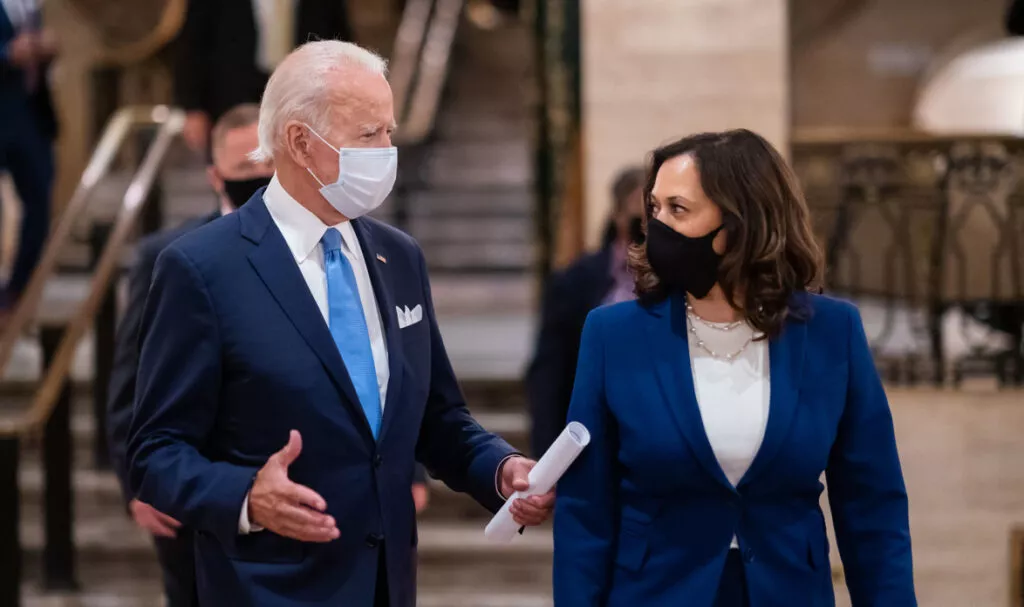
President Joe Biden presented the foundations of the United States' foreign policy for the next four years during his first official visit to the State Department on February 4. He then spoke about climate change and the pandemic as global challenges, and announced the strengthening of the American role in international organizations, greater diplomatic engagement, and cooperation with traditional allies. With a few exceptions like China, Russia, and Myanmar, he did not mention specific countries or regions, including the Western Balkans.
On how the new US administration might be engaged in Bosnia and Herzegovina and its surroundings, analysts from the United States who are well-acquainted with the situation in the Western Balkans spoke to Voice of America. All agree that it is still too early to talk about concrete steps, considering that Biden took office less than a month ago, but also that greater cooperation with Europe is certain.
Paul McCarthy, Regional Director for Europe at the International Republican Institute, which is also active in BiH, says it is positive that Biden, since his time in the Senate and as Chairman of the Foreign Relations Committee, as well as some of his associates, are well-acquainted with developments in the Western Balkans.
“We also know that Joe Biden and Angela Merkel, the German Chancellor, have discussed the Western Balkans. That is interesting,” says McCarthy. “I think we can expect the new administration to coordinate policies for the Western Balkans more closely with Brussels.”
David L. Phillips, Director of the Peacebuilding and Human Rights Program at Columbia University, has a similar opinion: “Biden will commit to transatlantic cooperation. His approach to the Balkans will have a strong foundation in the joint work of the United States and the European Union (EU).”
Phillips served as an advisor to the BiH Presidency between 1992 and 1994, and worked as an international relations expert with the administrations of Bill Clinton, George W. Bush, and Barack Obama. He says the relationship between the countries in the region will be very important:
“If Bosnia is slow and causes problems, if it allows Russia to hinder integration into Euro-Atlantic institutions, the West will not have much patience for Bosnia, and for that matter, neither for Kosovo.”
McCarthy says it will be interesting to observe Europe's behavior, which in the past four years has begun to act more independently from the United States, such as the proposal of German politician Christian Schmidt as the new High Representative in BiH. He also lists the negotiations between Serbia and Kosovo as an important issue, adding that the new administration will want to retain elements of the agreement signed by the two parties in Washington in September 2020.
Considering America's internal problems and developments in other parts of the world, Voice of America's interlocutors say they are not sure how much the Western Balkans will actually be in the focus of Joe Biden's administration. They also cite disagreements with European partners on various issues as a challenge. For example, Germany and Russia are cooperating on the construction of the Nord Stream 2 gas pipeline, which the United States opposes.
“We cannot expect the Western Balkans to be a top priority for the administration,” says McCarthy. “We must consider not only the international scene but also the domestic issues that the new administration must address, such as responding to the pandemic and political polarization, which is unfortunately growing in our country. So, it will have to focus on that, because voters expect it.”
McCarthy explains that Biden's administration will view the Balkans as an opportunity to be involved in developments, as Donald Trump's administration did, but with a different approach and acting independently:
“Biden's administration will likely place a higher priority on cooperation with Europeans. But I think we will see differences in policies that were not so noticeable during the past four years due to such an independent (American) approach. I don't think Brussels and Washington will agree on all issues, but they will be much more open to discussions.”
BiH: Small but concrete steps
A hearing on recommendations for new administration policies towards the Western Balkans was held before the House Foreign Affairs Committee of the United States Congress in December 2020. Most attention was paid to BiH and the relations between Serbia and Kosovo.
Participants, including former US Secretary of State Madeleine Albright, repeatedly emphasized the importance of joint action by the United States and the EU, and spoke about the necessity of more extensive changes in BiH, including an upgrade to the Dayton Agreement.
“To resolve the stalemate in Bosnia, American and European representatives must create an action plan for constitutional, administrative, and electoral reforms,” said Western Balkans expert Janusz Bugajski at the time, adding that it is necessary to strengthen the central government and reduce funding for entities and cantons.
Daniel Serwer, a long-time observer of events in the region, said that the United States should pressure Europe to also sanction officials who undermine BiH's integrity: “Cantons and entities, as well as national restrictions and the possibility of veto, will have to disappear. Americans and Europeans should welcome the prospect of a new civic constitution.”
Voice of America's interlocutors state that it is uncertain whether America and Europe are ready for such a significant engagement, and that a gradual approach is more realistic.
Komentari (0)
Prijavite se za komentiranje
PrijavaJos nema komentara. Budite prvi!
Minuta
Sve →Iz drugih kategorija

High Representative Not Elected: Germans, French and British Sabotaged Americans, New Attempt at End of June

ČOVIĆ WITHOUT MERCY: How Those Who Brought Ademović to Office Created a Political Hell for Him



Sunny Saturday, quite warm



Tragedy in Albanian resort: Two minors drown












