
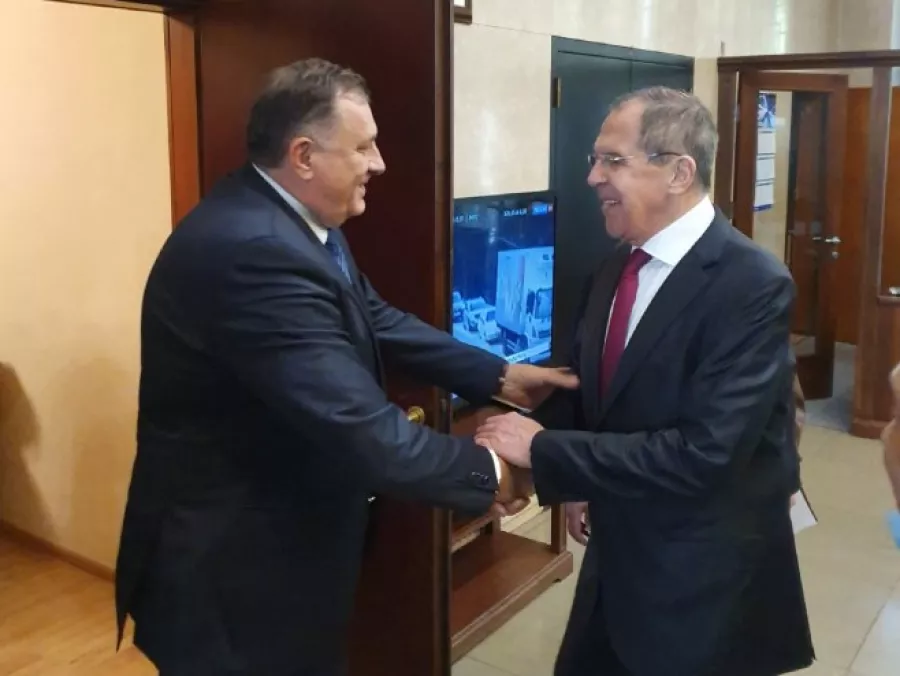
SARAJEVO, (Patria) - The stay of Russian Foreign Minister Sergey Lavrov in the Balkans can be understood as an effort to secure stronger support for Russia, considering the upcoming handover of power of the new American administration, Paul McCarthy, Regional Director for Europe of the International Republican Institute (IRI), told Voice of America.
"Serbia's inconsistent foreign policy creates the impression that Serbia does not share the interests or values on which the EU is based, is one of the most significant conclusions of the publication 'Seven Years of Serbia's Alignment with the EU's Common Foreign and Security Policy'," reports the European Western Balkans (EWB) portal.
As stated in the publication, Serbia opened negotiations with the EU in 2013, and in June and September 2014, it completed the analytical review for Chapter 31 - EU's Common Foreign, Security and Defense Policy, but has not yet opened this chapter, nor has it received a screening report.
It is emphasized, however, that issues related to the content of the chapter came into public focus with the opening of negotiations, primarily due to the outbreak of armed conflict in Ukraine, Russia's annexation of Crimea, and the conflict in the east of that country.
The European Union, as emphasized, has defined a unified approach and begun to implement restrictive measures against the Russian Federation, but Serbia has refused to align itself with EU declarations aimed at Russia, as well as with the consistent restrictive measures with which the EU calls on partner countries to align through foreign policy declarations.
"As early as 2008, a pattern was established that Serbia follows to this day, which involves taking into account the approach, primarily, of two permanent members of the Security Council - the Russian Federation and China, and then other countries that have not recognized Kosovo as an independent state," the publication states.
McCarthy, an expert on the Balkans among other things, believes that Russia, as he points out, wants to show that it is a player that can be counted on.
"It is possible that it is concerned that the new administration, in agreement with its European allies, could strengthen its engagement in the region," notes Paul McCarthy in a written response to Voice of America.
Frederick Ben Hodges, former commander of the US Army in Europe, saw his visit to Serbia as a possible opportunity to convey some messages to the Serbian authorities that they might not be ready to hear.
Hodges, a fellow at the Washington-based Center for European Policy Analysis (CEPA), says that the fact is that Russian officials have publicly rejected claims that the newly elected Serbian government, as he pointed out, is less oriented towards Russia than before.
"However, it seems to me that the Serbian government is becoming less committed to its traditional relations with the Kremlin. This is shown, for example, by the attitude of the new Minister of Energy towards the director of the Serbian gas company - which cooperates with Gazprom. This could also be the reason for Lavrov's visit. I think the pressure in these relations is growing, and I hope the Biden administration will be ready to extend a hand to President Vučić," General Hodges told Voice of America.
Komentari (0)
Prijavite se za komentiranje
PrijavaJos nema komentara. Budite prvi!
Minuta
Sve →Iz drugih kategorija

High Representative Not Elected: Germans, French and British Sabotaged Americans, New Attempt at End of June

ČOVIĆ WITHOUT MERCY: How Those Who Brought Ademović to Office Created a Political Hell for Him



Sunny Saturday, quite warm



Tragedy in Albanian resort: Two minors drown












