
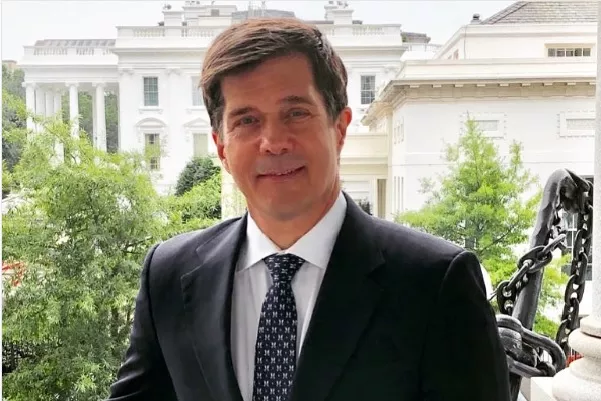
The peace conference on Bosnia and Herzegovina, exactly 25 years ago, was led by Americans Warren Christopher and Richard Holbrooke and ended with the Dayton Peace Agreement. In a conversation with the Ambassador of the United States of America to Bosnia and Herzegovina, Eric Nelson, Inda Swanke from Voice of America asked whether Dayton is outdated, whether it needs to be changed, and whether Bosnia and Herzegovina is still an American project?
"The Dayton Agreement ended the terrible war of the 1990s in Bosnia and Herzegovina and proved very effective in terms of ending the conflict and in terms of post-war reconstruction," says the Ambassador of the United States of America to BiH, Eric Nelson, for Voice of America.
"Dayton also gave Bosnia and Herzegovina a Constitution; it can be considered an initial constitution. Every constitution should be a living document that is supplemented and must define the process for making amendments. So sooner or later, every country realizes that it needs some reforms, and it is obvious that the constitution of Bosnia and Herzegovina needs reforms, and both Dayton and the constitution of Bosnia and Herzegovina need to be reformed. Why? Because the citizens of Bosnia and Herzegovina want to be part of the transatlantic community," explains Ambassador Nelson.
"There is a whole series of constitutional issues that need to be addressed in this regard for the country to meet transatlantic standards. Many of these issues are difficult to resolve, but none are impossible to resolve. The disagreement over the elections in Mostar dragged on for more than a decade and was not impossible to resolve. Of course, it required strong will and time to say that we are finally moving forward," says Ambassador Nelson in the interview.
"And I think that 25 years is precisely a turning point where people start to think that it is high time to move forward. And this country can move forward." Eric Nelson, US Ambassador to BiH
And precisely in response to the COVID-19 pandemic, we saw a certain unity, points out the American ambassador, and continues: "We know that it is possible when there is a sense of urgency, and I hope that this sense will remain, especially now that the country must recover economically and establish the necessary reforms for economic recovery to be possible at all. So, Bosnia and Herzegovina is a project, but it is a project of Bosnia and Herzegovina."
Voice of America: Many things have come to light during this pandemic, both good and bad. What would you highlight as a positive development, when we are talking within the framework of Dayton?
Nelson: When I look back at the significance of this anniversary, I look from the perspective of the progress this country has made in that period. Most citizens are not satisfied with its progress. If they were, we wouldn't have so many people leaving the country. However, there have been significant successes, for example, the creation of joint Armed Forces, which was a unification of previously warring parties, which, in accordance with the constitution, strive for all international standards and have become reliable peacekeeping forces on the international stage, an equal partner in the fight against terrorism, side by side with American forces in Afghanistan and elsewhere. This is an excellent example, and we need more such examples, because it is obvious that when a decision is made, things are possible to implement.
Voice of America: One of the big problems you talked about, which does not only concern Bosnia and Herzegovina but also its neighbors, is the brain drain. Is better regional communication and cooperation, and the possible expansion of markets, one of the links that could help stimulate international investments, American investments, which would lead to new jobs and thus eliminate this problem, as the Atlantic Council recently concluded? Do you agree with that?
"Very much so, and I am glad that the Atlantic Council brought together regional leaders to discuss economic cooperation, starting with the importance of a joint response to the COVID-19 pandemic, because, as we have seen, the virus has no borders, and only a joint response is effective."
Nelson: For this reason, so-called green corridors were opened, through which the transport of equipment, food, and other goods necessary to fight the virus proceeded quickly and efficiently. We saw the possibility here to standardize this type of communication and thus help standardize trade and all regulations and processes in the entire region, thereby improving the business environment. This gives all businesses in the region the opportunity to simply expand their markets, but at the same time, it creates a much more attractive market for direct foreign investment, both from the United States and from other credible investors who want to bring new jobs and positive changes. But they, as a rule, will also want guarantees that their investments will be in a fair process and protected, so we return again to the fight against corruption and for the rule of law, as the highest priority for doing business in the right way.
Komentari (0)
Prijavite se za komentiranje
PrijavaJos nema komentara. Budite prvi!
Minuta
Sve →Iz drugih kategorija

High Representative Not Elected: Germans, French and British Against Americans, New Attempt at End of June

ČOVIĆ WITHOUT MERCY: How Those Who Brought Ademović to Office Created a Political Hell for Him



Sunny Saturday, quite warm



Tragedy in Albanian resort: Two minors drown












