
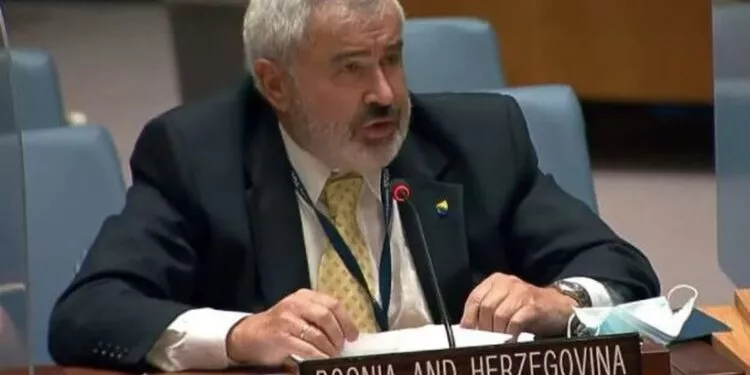
SARAJEVO, (Patria) - BiH Ambassador to the UN Sven Alkalaj addressed the UN Security Council today as part of the discussion on BiH, stating that High Representative Christian Schmidt violated the BiH Constitution, as well as a number of international agreements and BiH laws.
We are transmitting his address in full:
"Congratulations to the President and satisfaction with the extension of the mandate of the EUFOR Althea mission.
The reason for today's address on behalf of Bosnia and Herzegovina, a sovereign and independent state, largely relates to the past six-month period in the country, with a special emphasis on the recently held General Elections on October 2, 2022. The previous period was relatively peaceful and largely dedicated to holding the General Elections in Bosnia and Herzegovina. We can even say that the election campaign was calmer than previous ones, although there were sporadic instances of secessionist and nationalist rhetoric.
Before I offer you a review of the mentioned six-month period in Bosnia and Herzegovina, please allow me to emphasize at this point that the state of Bosnia and Herzegovina is one of the signatories to the General Framework Agreement for Peace in Bosnia and Herzegovina, better known as the Dayton Peace Agreement, along with two other neighboring countries and six witnesses, including 5 countries plus the European Union. It is known that peace agreements are usually signed by participants in a war, so from that international legal standpoint, the signing of the Dayton Peace Agreement ended the interstate armed conflict, as determined in its judgments by the International Criminal Tribunal for the former Yugoslavia in The Hague. I state this because, occasionally, we hear claims in the public sphere from neighboring countries that they are guarantors of the Dayton Peace Agreement, which is incorrect and ill-intentioned, because the Dayton Agreement does not establish anyone as a guarantor of the agreement. With that incorrect claim that they are guarantors of the Dayton Peace Agreement, neighboring countries are trying to create a false environment in which they have the right to intervene in the political, economic, and social system of Bosnia and Herzegovina, which, simply put, represents an attack on the sovereignty of Bosnia and Herzegovina and is one of the more significant factors destabilizing the entire region.
According to the Dayton Peace Agreement, the supervision of the implementation of the military aspect is assigned to NATO and EUROFOR as equal legal successors to the former Stabilization Forces or SFOR, while the supervision of the implementation of the civilian aspect is carried out by the Office of the High Representative or OHR with the assistance of the Peace Implementation Council (PIC). This is very important to emphasize, because in the previous period, we see significant violations of these provisions of the Dayton Peace Agreement by neighboring countries, but unfortunately also by the OHR itself.
Because the six-month report of the High Representative is the topic today, I take this opportunity to remind you that his jurisdiction is established by Annex 10 of the Dayton Peace Agreement in a way that he supervises the implementation of the civilian aspect, which, among other things, includes holding fair and free elections in Bosnia and Herzegovina.
Based on this premise, the Office of the High Representative (OHR) has imposed two decisions in the previous period concerning the Election Law of Bosnia and Herzegovina, as well as amendments to the constitution of one of the BiH entities.
The first intervention was at the end of July 2022, where by amending certain paragraphs of the Election Law of Bosnia and Herzegovina, the OHR attempted to improve the integrity and transparency of the election process, although it was already known at the time that the competent body – the Central Election Commission – had announced the holding of elections for October 2, 2022, at the beginning of May 2022. Thus, the High Representative, knowing that the elections were announced under certain rules, made the first change to those rules, trying, as he claims, to improve the integrity of the election process. However, the body responsible for conducting the elections – the Central Election Commission – had only two months to organize that part of the election process according to the new rules, which was insufficient time. The result of this is what we have today. The counting of election results has been made difficult, a number of irregularities have been identified, and even instances of falsified ballots. The cause of this is certainly that the election rules were changed only two months before the elections were held, which prevented the Central Election Commission from organizing everything adequately and on time, and the cause of this is none other than the OHR.
The second intervention regarding the Election Law of Bosnia and Herzegovina was made on the day of the elections, October 2, 2022, and after the citizens of Bosnia and Herzegovina had already voted. In this second intervention, the OHR imposed completely new rules for the allocation of delegates to the upper house of the legislative body of the BiH entity Federation of Bosnia and Herzegovina. At the same time, the High Representative amended the constitution of the BiH entity Federation of Bosnia and Herzegovina, even though this is not part of the civilian aspect of the Dayton Peace Agreement and does not fall under his competencies from Annex 10. To make all of this as clear as possible, I will offer you several elements that show that the High Representative has taken actions contrary to Annex 10 of the Dayton Peace Agreement and the Constitution of Bosnia and Herzegovina, thereby bringing Bosnia and Herzegovina into a state of destabilization and beyond any further possibility of continuing its path towards the European Union and NATO.
The first problematic element is as follows. Bosnia and Herzegovina is constitutionally organized as a democratic country that functions in accordance with the rule of law and free and democratic elections. The High Representative violated this constitutional principle by imposing changes to the election rules after the elections were concluded. By doing so, the High Representative deceived all voters in Bosnia and Herzegovina, as they would undoubtedly have voted differently had they been aware of the new election rules. At the same time, the High Representative also deceived all election stakeholders, namely all political parties and independent candidates, who would undoubtedly have offered different election lists and election programs that would have been in line with those new election rules. How can Bosnia and Herzegovina realize its constitutional principle of being a democratic country if election rules are changed after elections are held? It cannot, and it has been prevented from doing so precisely by the High Representative, who has no right to do anything contrary to the Constitution of Bosnia and Herzegovina in his work. Does anyone believe that Bosnia and Herzegovina and its citizens are not good enough for full democracy? I remind you that the Constitution of Bosnia and Herzegovina is not part of the civilian aspect of the Dayton Agreement, which means it cannot be interpreted by the High Representative, as this is the exclusive responsibility of the Constitutional Court of Bosnia and Herzegovina.
I take this opportunity to remind you that in some European countries (Bulgaria, Romania, and Greece), domestic or international courts have annulled all changes to election rules shortly before or after elections were held, which judicial instances saw as a direct attack on democracy. Similarly, in the United States, Supreme Courts have annulled changes to election rules shortly before elections were held or when those election rules prevented certain ethnic groups defined by skin color from exercising their civil rights. This was the case in Purcell vs. Gonzales and Merrill vs. Milligan. All of this means that any change to election rules shortly before or after the conclusion of elections is considered a direct attack on democracy in any country. The High Representative clearly did not take this into account.
In a similar vein, we have the opinion of the Venice Commission, the highest legal authority in Europe, which clearly states that election rules cannot be changed too often and certainly not one year before elections are held, so that all citizens and all election stakeholders are informed of the new election rules in a timely manner. This opinion was also not respected by the High Representative.
The second problematic element is as follows. The High Representative imposed changes to the Election Law of Bosnia and Herzegovina in which, through a mathematical formula, living people are valued and their coefficient for participation in the election process is determined according to their ethnic affiliation. This means that you have citizens of Bosnia and Herzegovina who are an ethnic minority in certain parts of the country and who have a coefficient of, for example, 0.5, while citizens of the same ethnic affiliation in the southern part of Bosnia and Herzegovina have a coefficient of 1.5, which gives them greater rights and chances in the election process. This is the ultimate form of ethnic discrimination, which is prohibited by United Nations acts such as the UN Covenant on Civil and Political Rights and the European Convention on Human Rights and Fundamental Freedoms. I remind you that these international instruments are an integral part of the Constitution of Bosnia and Herzegovina, which have direct application. How can any country value people, living human beings, give them a higher or lower personal coefficient, based on which they should have a higher or lower degree of human rights? The answer is very simple, no country can. It is particularly worrying that the High Representative has completely undermined the principle of the rule of law, which implies equality of all before the law without exception. On the contrary, he has created a system in which not everyone is equal before the Election Law of Bosnia and Herzegovina. Furthermore, the High Representative has not respected any ruling of the European Court of Human Rights which has established the existence of systemic discrimination, and this is a constitutional obligation in Bosnia and Herzegovina.
This is the second indicator of the violation of the Constitution of Bosnia and Herzegovina and international acts by the High Representative.
As an example, I will offer the fact that I, as an ethnic Jew from Bosnia and Herzegovina, in this new election system imposed by the High Representative, no longer have any rights, opportunities, or chances to participate adequately in the election process. In Bosnia and Herzegovina, it is evident that someone is trying to create an environment based on the premise of "Equal but Separate," which is based on racial and ethnic discrimination and was rejected decades ago, just as all elements of apartheid, which are unfortunately being attempted to be introduced into Bosnia and Herzegovina through the interventions of the High Representative, have been rejected. This is absolutely unacceptable.
The third problematic element. The High Representative imposed amendments to the Constitution of the BiH entity Federation of Bosnia and Herzegovina in which he uses two different population censuses, one from 1991 and the other from 2013. From this decision, it is clear that his intention, in cooperation with neighboring Croatia, is to ensure unlimited participation in power for one political party – HDZ – which is a branch of that political party from neighboring Croatia. According to the 1991 census, there would be 5 ministers from ethnic Croats controlled by HDZ in the government of the BiH entity Federation of Bosnia and Herzegovina, while according to the 2013 census, there would be 3 or two fewer. Thus, the High Representative has consciously retained the ethnic quota from 1991 because it suits neighboring Croatia. On the other hand, by using the 2013 census to fill the upper house of the legislative body called the House of Peoples, he increased the quotas required for decision-making in favor of those same ethnic Croats controlled by HDZ. This has made Bosnia and Herzegovina the only country in the world that uses one census for forming legislative bodies and another for forming executive bodies. By doing so, the High Representative has brought all citizens of Bosnia and Herzegovina into a state of complete legal uncertainty. Furthermore, Annex 7 of the Dayton Peace Agreement mandates the return of all displaced persons to their pre-war homes, and until this process is completed, the 1991 census must be applied. The reason is very simple. This will never allow the results of ethnic cleansing in Bosnia and Herzegovina to be legalized in accordance with the judgments of the International Criminal Tribunal in The Hague. However, with his decisions, the High Representative has informally declared Annex 7 completed and thus formally accepted the results of ethnic cleansing, genocide, and other most horrific war crimes. This is not the job of the High Representative, and it is very detrimental to the Dayton Peace Agreement.
The fourth problematic element relates to the fact that the High Representative planned and carried out all of this in cooperation with neighboring Croatia, which the Government of the Republic of Croatia itself publicly announced, probably considering itself a guarantor of the Dayton Agreement, which it certainly is not. By doing so, the High Representative, among other things, committed a criminal offense prescribed by the Criminal Code of Bosnia and Herzegovina. In addition, the High Representative selectively implemented the rulings of the Constitutional Court of Bosnia and Herzegovina, i.e., he did not implement the only one related to combating discrimination, which is the one in the "Komšić" case, thereby committing another criminal offense of non-compliance with the decisions of the Constitutional Court of Bosnia and Herzegovina.
Finally, in my conclusion, I want to share some important observations with you. The High Representative's intention to enable fairer elections through his decisions has not been realized. On the contrary, it has introduced a series of confusing elements and complicated the election process. His other intention, through interventions in the Constitution of the BiH entity Federation of Bosnia and Herzegovina and the Election Law of Bosnia and Herzegovina, allegedly to enable the unblocking of the government formation process, is simply untrue, because the blockades have not been removed, and at the same time, he has introduced significant asymmetry in government formation in the two BiH entities. By changing election rules shortly before and after the elections were held, the High Representative has violated the Constitution of Bosnia and Herzegovina and a number of international acts that are integrated into the legal system of Bosnia and Herzegovina. This is certainly not and cannot be his role. Deceiving voters by changing election rules after elections have been held is an act by the High Representative that has caused such destabilization of the situation in Bosnia and Herzegovina, which is manifested by mass protests by citizens in front of the OHR building in Sarajevo, who are dissatisfied and believe that apartheid has been introduced. In addition, an appeal has been filed with the Constitutional Court of Bosnia and Herzegovina, because the High Representative's decisions are clearly unconstitutional. Instead of waiting for the outcome of that court process, the High Representative is pressuring political actors, and even judicial instances, to implement his decisions as soon as possible. This is absolutely unacceptable.
For all these reasons, it has become more than obvious that the role of the current High Representative has become destabilizing and in favor of one of the neighboring countries, as well as some of his international mentors, but to the detriment of the state of Bosnia and Herzegovina and its citizens. I take this opportunity to emphasize that Bosnia and Herzegovina still supports the institution of the High Representative, in accordance with the powers granted by the Dayton Peace Agreement, but that the activities of the current acting High Representative have become a problem that needs to be resolved as soon as possible. Therefore, it is important to reiterate that anyone performing the duties of the High Representative cannot do anything unconstitutional nor can they act outside of their authority, which is unfortunately the case at present. Therefore, I call on you through this means to resolve this issue together in the coming period."
Komentari (0)
Prijavite se za komentiranje
PrijavaJos nema komentara. Budite prvi!
Minuta
Sve →Iz drugih kategorija

High Representative Not Elected: Germans, French and British Sabotaged Americans, New Attempt at End of June

ČOVIĆ WITHOUT MERCY: How Those Who Brought Ademović to Office Created a Political Hell for Him



Sunny Saturday, quite warm



Tragedy in Albanian resort: Two minors drown












