
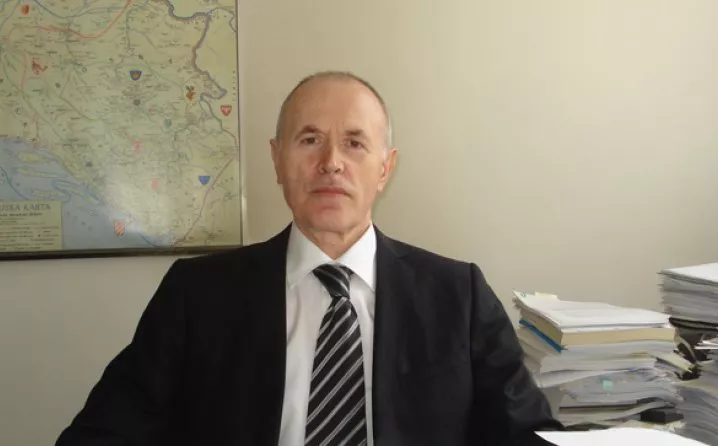
- Mr. Ivanić and like-minded individuals, contrary to the capacity and manner of experienced and wise politicians, instead of bowing to the victims of genocide and moving towards building a better, common future, are demonstrating political behavior based on ideological and political reasons, and continue to stubbornly and brazenly claim that there is no new evidence, even though, completely contrary to this, they are aware of the fact that relevant evidence absolutely exists - writes academic Smail Čekić in an author's text that the Patria News Agency is transmitting in its entirety:
Recently, in the public sphere in Bosnia and Herzegovina and beyond, through electronic and print media, numerous statements have appeared, primarily from politicians, as well as some university professors and pseudo-researchers, and representatives of some international organizations, regarding the potential reopening of the case in the matter of BOSNIA AND HERZEGOVINA v. SERBIA AND MONTENEGRO before the International Court of Justice in The Hague for violating the Convention on the Prevention and Punishment of the Crime of Genocide. These statements are mostly dominated by aggressive stances and ultimatums from Serbian politicians (from Bosnia and Herzegovina and the Republic of Serbia), who, when this issue is mentioned, experience anaphylactic shock.
The history of the aforementioned process, especially its outcome - the VERDICT, which initiated and produced sharp polemics and divisions in the academic community and judicial practice, is known to the public, especially the scientific community. According to this verdict, among other things, the Republic of Serbia, the only country in the world, violated (on three grounds of responsibility) the Convention on the Prevention and Punishment of the Crime of Genocide. Although there was sufficient relevant, valid, and reliable evidence in the previous phase of the aforementioned criminal proceedings to establish the international criminal responsibility of Serbia and Montenegro/Federal Republic of Yugoslavia for all punishable acts (forms of participation in genocide) of the crime of genocide, as defined by the Convention on the Prevention and Punishment of the Crime of Genocide, which, among other things, is confirmed by the very explicit and well-argued Dissenting Opinion of the Vice-President of the International Court of Justice, the Republic of Serbia, according to the Verdict, "did not commit genocide, through its organs or persons whose acts engage its responsibility under international customary law..."; "did not engage in a conspiracy to commit genocide, nor did it incite the commission of genocide..."; and "was not an accomplice to genocide...".
Thus, the Court effectively acquitted Serbia of direct international responsibility for the genocide in the Republic of Bosnia and Herzegovina (except for responsibility for the failure to prevent genocide in Srebrenica in July 1995 - "Serbia violated its obligation to prevent genocide, under the Convention on the Prevention and Punishment of the Crime of Genocide, which was committed in Srebrenica in July 1995." - which is contrary to adequate, valid, reliable, and usable relevant evidence. The International Court of Justice shifted the responsibility for the crime of genocide against Bosniaks "in Srebrenica in July 1995" from the state of Serbia and Montenegro/Federal Republic of Yugoslavia "to the Bosnian Serbs who conceived and carried out the genocide in Srebrenica," more precisely to the political, military, and police leadership of the para-state entity of Republika Srpska.
The verdict of the International Court of Justice is predominantly based on the evidence (legal qualification of facts) of the ICTY, and exclusively on the verdicts in the Krstić and Blagojević cases, when it comes to the reconstruction and nature of the crime (genocide) in Srebrenica, whose jurisdiction is to determine individual criminal responsibility. This limits and directs the relevant evidence only to the actions of the accused individual (the Court did not recognize the substantive difference between a criminal proceeding against one person - an individual and the international criminal responsibility of a state for genocide, nor did it accept the full complexity and gravity of the crime of genocide, nor a comprehensive approach when considering interconnected essential facts). It is evident that this is not original research, but rather the adoption of the research results of others (ICTY).
The International Court of Justice, in addition to disputing, ignoring, and rejecting relevant facts and crucial and convincing evidence, as well as unfounded, invalid, unreliable, unconvincing, hypothetical, controversial, contradictory, and erroneous assessments and conclusions, and under the significant (great) influence of the ICTY's conclusions, selectively chose from the ICTY's research, adopting only those legal qualifications that suited the author(s) of the Verdict. This was evident, for example, in the application of high standards in proving genocidal intent and establishing state control (specific) and its responsibility, especially in proving the attribution of acts to a specific state through the test of its control (effective control and overall control), which is not in line with the facts of the dispute nor with the relevant practice of the ICTY. Such an approach and attitude will undoubtedly have a significant impact on the potential reopening of the proceedings, which the subject of the reopening is likely aware of.
The state, political, and military leadership of the Federal Republic of Yugoslavia / Serbia and Montenegro obstructed the aforementioned process (the most complex and difficult case) for 14 years, to put it mildly, disputing the jurisdiction of the International Court of Justice (hearings on the merits were constantly postponed by an "unprecedented procedural battle") and, in accordance with the agreement between the chief prosecutor of the ICTY, Carla Del Ponte, and the Minister of Foreign Affairs of the Federal Republic of Yugoslavia, Goran Svilanović, as well as the decisions of certain ICTY judges, secretly concealed evidence by applying protective measures for key documents.
In this way, the most responsible UN lawyers (in the field of international law), with intent and a well-established goal, made and continue to make secret agreements (a criminal offense) with the state of the Federal Republic of Yugoslavia / Serbia and Montenegro, which committed genocide, in order to prevent the Republic of Bosnia and Herzegovina from obtaining justice, humanity from obtaining justice, victims of genocide from obtaining some form of satisfaction, and to help Serbia avoid billions in war reparations - compensation for the committed genocide (inflicted on individuals and the property of individuals and legal entities). The International Court of Justice, among other things, did not accept any request from the Applicant for unredacted, complete documents of the Supreme Defense Council of the Federal Republic of Yugoslavia to be provided. These coordinated and synchronized activities were solely in the interest and for the account of the aggressor state, to the detriment of the victims of genocide, meaning it is a crime with unforeseeable consequences, primarily for the victims of genocide, but also for all of humanity, which, among other things, confirms that a dominant part of the United Nations and the leading states of the so-called international community protected and, unfortunately, still protect the state that committed genocide.
The question arises whether the world powers would have acted this way if the victims of genocide had been Christians? In this case, we are talking about the victims of genocide, Bosniaks-Muslims, an indigenous peaceful European people, who in their history have never had nor have their own fascist ideology or their own fascist movement, which is a great civilizational achievement that Bosniaks cherish.
Why, unlike the anti-fascist Serbian intellectual and political elite, has the nationalist Serbian political and intellectual elite, which, among other things, is fully in agreement and united in its common stance towards the state of Bosnia and Herzegovina and Bosniaks, so aggressively and in unison stood against the reopening of the aforementioned proceedings? The answer is very clear: it is aware of the fact that the Republic of Serbia, i.e., Serbia and Montenegro / Federal Republic of Yugoslavia, is internationally responsible, on various grounds and in various ways, for the (committed) genocide, and for (all) punishable acts of the crime of genocide (all acts of genocide), as defined by the Convention on the Prevention and Punishment of the Crime of Genocide. That elite is well aware of the evidence and its existence, evidence that is held and possessed, primarily by the most important institutions of the Republic of Serbia and empirical sources - people: planners, organizers, participants, abettors, inciters, accomplices, and perpetrators of the crime of genocide. The Republic of Serbia continues to systematically, organizedly, intentionally, and purposefully protect and hide key evidence of the committed genocide, especially regarding the participation of the Federal Republic of Yugoslavia / Serbia and Montenegro, legal and natural persons who had the status of de jure and de facto organs of the Federal Republic of Yugoslavia in the commission of genocide, from the public, fearing the (proof of) truth and the establishment of its own criminal responsibility, and thereby simultaneously denies the genocide against Bosniaks, minimizes the scale of crimes against humanity and international law, equates victims of genocide with perpetrators of genocide, and declares criminals national heroes. The nationalist Serbian political and intellectual elite in Bosnia and Herzegovina (in the Republika Srpska entity) also actively participates in this project to a significant extent.
Numerous relevant documents based on which the existing knowledge about the scale of the genocide can be supplemented and Serbia's international responsibility for the genocide in the Republic of Bosnia and Herzegovina can be reliably established are still not available to the public. Unfortunately, the ICTY, as claimed by Geoffrey Nice, a renowned and respected lawyer and university professor (former ICTY prosecutor), "has protected and still protects a large amount of documents since April 2007." Victims of genocide, nor researchers of genocide, are unable to access these relevant documents. These and similar documents can only be accessed through formal legal channels, through specific activities of the legal representative, via the International Court of Justice, before which the case is pending.
The reopening of the proceedings is a legal and moral, not a political issue, as persistently claimed and repeated by the Chairman of the Presidency of Bosnia and Herzegovina, Mr. Mladen Ivanić, and other participants in this joint project. In order to conceal the facts about the truth of the events in the Republic of Bosnia and Herzegovina at the end of the 20th century, to deceive domestic and international public opinion, various methods and means, qualifications, and assessments are used, in accordance with Ćosić's statements about the role of lies and their functionality in the history of Serbian society ("...we lie creatively, imaginatively, inventively... In this country, every lie becomes the truth"), illustrated by the following statements: "a new lawsuit would disrupt the stability of Bosnia and Herzegovina"; "it would cause an irreparable crisis within BiH, but also a serious regional crisis"; "initiating the revision of the lawsuit would be illegal and violent and would cause the biggest crisis in BiH since Dayton"; "it is a path to the disappearance of Bosnia and Herzegovina"; "it will contribute to the deterioration of relations in Bosnia and Herzegovina"; "the revision of the lawsuit would lead to the freezing of political relations between the two countries" and numerous other provocative, aggressive, and threatening statements. In this way, in an extremely brazen and inappropriate manner, without moral and/or political responsibility, victims of genocide are insulted, harassed, and killed again, unprecedented pressure is exerted on researchers, and especially on the representative (agent) of Bosnia and Herzegovina, Prof. Dr. Sakib Softić, as well as on the International Court of Justice, fear is instilled among citizens, and a war of conquest is provoked, incited, and prepared again, and a new genocide is threatened.
The applicant (Bosnia and Herzegovina) has the right, according to the Statute of the International Court of Justice, to submit a request for reopening the proceedings if it discovers "some facts of decisive importance," which the Court will decide upon, and which will also have the final say (or has already had it) regarding the legality and legitimacy of the legal representative. Therefore, the hysterical behavior of Serbian politicians towards the (potential) request for reopening the proceedings is incomprehensible.
Mr. Ivanić and like-minded individuals, contrary to the capacity and manner of experienced and wise politicians, instead of bowing to the victims of genocide and moving towards building a better, common future, are demonstrating political behavior based on ideological and political reasons, and continue to stubbornly and brazenly claim that there is no new evidence, even though, completely contrary to this, they are aware of the fact that relevant evidence absolutely exists. They consciously ignore, overlook, violate, "forget," and refuse to accept the moral creed that human beings (homo sapiens) must not conceal facts about evidence of genocide, must not be neutral, must not be indifferent, must not remain silent, must not lie, manipulate, or invent.
Without delving into the merits of the (potential) reopening of the proceedings, the victims of genocide and researchers of genocide are aware of the truth and scientific facts about the events in the Republic of Bosnia and Herzegovina at the end of the 20th century, of which we remind the public of only some of the essential ones:
- The Federal Republic of Yugoslavia / Serbia and Montenegro waged a war of conquest against the Republic of Bosnia and Herzegovina - carrying out armed actions with the aim of realizing the Nazi political project - the formation of a unified Serbian state in the Balkans;
- The Federal Republic of Yugoslavia / Serbia and Montenegro) planned, prepared, organized, and participated in the (commission of) genocide in the Republic of Bosnia and Herzegovina - in all occupied places, besieged cities, and United Nations safe areas - with INTENT (mens rea) and a clearly expressed plan and project, with well-designed and established goals and tasks, in accordance with Serbian nationalist ideology and policy of a fascist and genocidal character, which, among other things, is confirmed and proven by mass graves, concentration camps, mass and individual rapes, destruction of civilian objects, especially religious and residential ones, and other forms of crimes against humanity and international law;
- acts of genocide (actus reus) in the Republic of Bosnia and Herzegovina were committed by the state of the Federal Republic of Yugoslavia / Serbia and Montenegro, legal and natural persons who had the status of de jure and de facto organs of the Federal Republic of Yugoslavia;
- The Federal Republic of Yugoslavia, by participating in wars of conquest in the Republic of Croatia and the Republic of Bosnia and Herzegovina and genocide against Bosniaks, according to the statement of the President of the Federal Republic of Yugoslavia, academician Dobrica Ćosić, of May 27, 1993, MAINTAINED "70,000 SOLDIERS IN THE ARMY OF THE REPUBLIC OF SERBSKA KRAJINA, ABOUT 200,000 SOLDIERS IN THE ARMY OF THE REPUBLIC OF SERBSKA AND THE ARMY OF YUGOSLAVIA, WHICH IS ALMOST HALF A MILLION SOLDIERS";
- The Federal Republic of Yugoslavia by August 30, 1994, "SPENT TWO BILLION /US/ DOLLARS IN BOSNIA AND HERZEGOVINA" - for waging an aggressive war of conquest against the Republic of Bosnia and Herzegovina and the destruction of Bosniaks, whereby by July 8, 1994, it had only "SPENT ABOUT ONE BILLION US DOLLARS ON AMMUNITION AND MILITARY EQUIPMENT FOR THE WAR IN RS AND RSK ("... ABOUT $1,000,000,000");
- Serbia and Montenegro / Federal Republic of Yugoslavia formed the para-state entity of Srpska Republika Bosna i Hercegovina / Republika Srpska in the Republic of Bosnia and Herzegovina;
- The para-state entity Srpska Republika Bosna i Hercegovina / Republika Srpska acted on behalf of Serbia and Montenegro / Federal Republic of Yugoslavia - as a de jure and de facto organ and/or agent of the Federal Republic of Yugoslavia, i.e., in its capacity and for the account and benefit of the Federal Republic of Yugoslavia;
- The para-state entity Srpska Republika Bosna i Hercegovina / Republika Srpska was merely a tool of the Federal Republic of Yugoslavia, without any real political and/or military independence, through which, among other state organs, the Federal Republic of Yugoslavia acted, which had overall (general) and effective control over the political and military leadership of the said para-state entity;
- The para-state entity Srpska Republika Bosna i Hercegovina / Republika Srpska is equated with the organs of the Federal Republic of Yugoslavia and was entirely dependent on the Federal Republic of Yugoslavia, whose acts are attributed to the Federal Republic of Yugoslavia;
- The political, military, and financial assistance, support, and resources provided by the Federal Republic of Yugoslavia / Serbia and Montenegro to the para-state entity Srpska Republika Bosna i Hercegovina / Republika Srpska prove that the crime of genocide in the Republic of Bosnia and Herzegovina, including the crime of genocide in the United Nations safe zone of Srebrenica and its surroundings - in July 1995, was committed through the use of armed forces - direct participation of personnel (JNA/Army of Yugoslavia/, "Army of the Serbian Republic of Bosnia and Herzegovina"/"Army of Republika Srpska"/, "Serbian Krajina Army", "People's Defense of the Autonomous Province of West Bosnia", special units of the State Security of the Ministry of Internal Affairs of the Republic of Serbia, and other armed units and groups) and resources (weapons, ammunition, fuel, equipment...) of the Federal Republic of Yugoslavia;
- Officers of the Army of Yugoslavia, members of the 30th Personnel Center of the General Staff of the Army of Yugoslavia, constituted the highest command structure of the "Army of Republika Srpska";
- The Federal Republic of Yugoslavia sent, assigned, transferred, appointed, and seconded leading officers of the Army of Yugoslavia, members of the 30th Personnel Center of the General Staff of the Army of Yugoslavia, to the "Army of Republika Srpska," where they performed "tasks of control and defense of the territory of the Federal Republic of Yugoslavia and, in connection therewith, participated "in armed actions" against the Republic of Bosnia and Herzegovina, and were responsible for the crime of genocide against Bosniaks, in addition to crimes against peace (aggression);
- General Ratko Mladić, the de facto and substantive commander of the General Staff of the 30th Personnel Center of the General Staff of the Army of Yugoslavia, and the formal commander of the General Staff of the "Army of Republika Srpska," who carried out orders from the Army of Yugoslavia, i.e., the Federal Republic of Yugoslavia, and all officers and members of the 30th Personnel Center of the General Staff of the Army of Yugoslavia, as well as from other commands, units, and institutions of the Army of Yugoslavia, were, according to the internal legislation of the Federal Republic of Yugoslavia, officers - members of the Army of Yugoslavia, de jure and de facto organs of the Federal Republic of Yugoslavia;
- All members of the General Staff of the "Army of Republika Srpska" and many other officers, non-commissioned officers, and civilian personnel in the "Army of Republika Srpska" (in key positions in corps, brigades, battalions, and companies, at various command levels of the "Army of Republika Srpska") were de jure and de facto members of the Army of Yugoslavia, i.e., they were organs of the state of the Federal Republic of Yugoslavia, who, in accordance with the Decision on determining tasks and the territory on which service is performed under difficult (special) conditions, performed tasks on the territory of the Republic of Bosnia and Herzegovina, which was defined as an integral part of the territory of the Federal Republic of Yugoslavia;
- In order to conceal the political, military, economic, and other participation of the Federal Republic of Yugoslavia in the aggression against the Republic of Bosnia and Herzegovina and the genocide against Bosniaks, officers and other professional soldiers of the Federal Republic of Yugoslavia were simultaneously, in a highly formal sense, officers of the "Army of Republika Srpska," and de jure and de facto officers of the Federal Republic of Yugoslavia;
- Officers of the "Army of Republika Srpska" were under the command of the Army of Yugoslavia, the President of the Federal Republic of Yugoslavia, and subordinate to the state, political, and military leadership of the Federal Republic of Yugoslavia. They factually received orders from the Federal Republic of Yugoslavia, the General Staff of the Army of Yugoslavia, and formally from the para-state entity of Republika Srpska;
- Officers of the "Army of Republika Srpska," i.e., officers of the Army of Yugoslavia, performed tasks on behalf of the Federal Republic of Yugoslavia, and thus represented the organs of power of the state of the Federal Republic of Yugoslavia.
Komentari (0)
Prijavite se za komentiranje
PrijavaJos nema komentara. Budite prvi!
Minuta
Sve →Iz drugih kategorija

High Representative Not Elected: Germans, French and British Sabotaged Americans, New Attempt at End of June

ČOVIĆ WITHOUT MERCY: How Those Who Brought Ademović to Office Created a Political Hell for Him



Sunny Saturday, quite warm



Tragedy in Albanian resort: Two minors drown












