
By A. Čorbo-Zećo
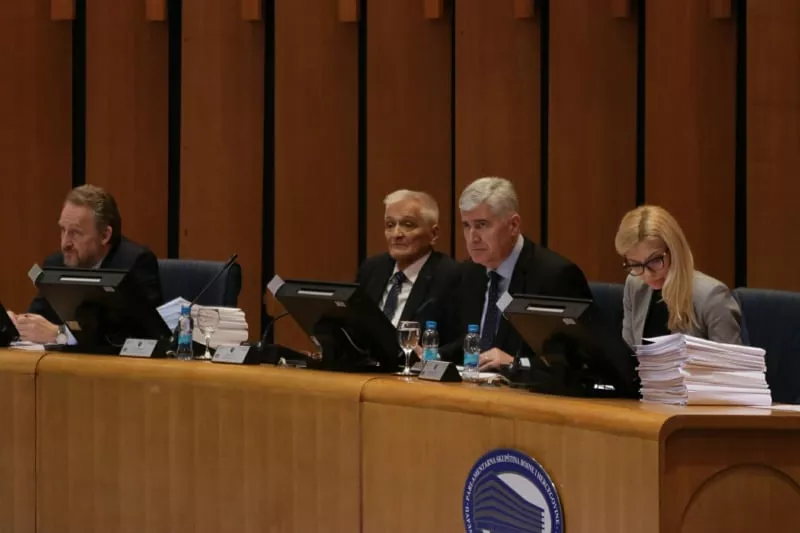
The House of Peoples of the Parliamentary Assembly of Bosnia and Herzegovina (PSBiH) will consider the proposal for amendments to the BiH Election Law on an urgent procedure tomorrow.
It is absolutely clear that this proposal, which deviates from any civilized concept, cannot pass the House of Representatives of the PSBiH, but convinced that it will receive support in the House of Peoples (4 HDZ delegates, plus the Serb Caucus), Dragan Čović has reversed the order of procedure. It is usual for adoption to start in the House of Representatives, but this procedure is also permitted by the rules of procedure.
Well-informed sources warn that this is a matter of buying time, before the Central Election Commission (CEC) calls the General Elections in early May.
The story about the amendments to the BiH Election Law has diverted attention from the fact that today is April 25th, and the BiH Ministry of Finance, headed by HDZ's Vjekoslav Bevanda, has not yet submitted the Framework Budget Document and the Draft Budget for 2022 to the Council of Ministers of BiH!
Earlier, the BiH Minister of Foreign Affairs, Bisera Turković, confirmed that the Collegium of the Council of Ministers of Bosnia and Herzegovina, consisting of Chairman Zoran Tegeltija (SNSD) and Ministers of Foreign Affairs and Finance and Treasury Bisera Turković (SDA) and Vjekoslav Bevanda (HDZ), had reached an agreement to prepare the state budget by April 25th.
She emphasized at the time that this was positive and that if it happened, the issue of financing the upcoming elections in BiH would also be resolved.
Otherwise, the request for consideration of the Proposal for Amendments to the Election Law of BiH on an urgent procedure was submitted by delegates of the Croat People's Caucus in the House of Peoples: Dragan Čović, Lidija Bradara, Marina Pendeš, and Bariša Čolak.
In political circles, there is much talk that after the adoption of these amendments in the House of Peoples of the PSBiH, pressure could be exerted on the High Representative in BiH, Christian Schmidt, to impose a law in line with the HDZ's wishes.
In the House of Peoples, this HDZ proposal could be adopted without the votes of Bosniaks, but Bosniaks in the House of Peoples can initiate the vital national interest procedure.
All of this could serve as an alibi for the HDZ to continue to delay sending the Budget into procedure, which could ultimately jeopardize the holding of elections, and that is the HDZ's goal, as they do not want to participate in them without changes that suit them.
Along with this proposal, the House of Representatives will consider the technical part of the amendments on April 27th, on which all parties have reached a consensus, but the adoption of these is also highly questionable. Mostly due to the HDZ, which wants to impose political decisions along with them.
The HDZ's proposal provides for the election of members of the Presidency of BiH according to the so-called electoral college model.
"All Croat candidates form a list of Croat candidates from which a candidate is elected if: they receive the highest total number of votes among Croat candidates in the Federation of BiH, provided that the candidate won the highest number of votes among Croat candidates in at least three out of five cantons, namely: Herzegovina-Neretva, Central Bosnia, West Herzegovina, Canton 10, and Posavina. If the candidate who received the highest number of votes in the Federation of BiH does not meet the specified condition, the next candidate from the list of Croat candidates by number of votes is taken, and so on until the end of the list until a candidate who meets the specified condition is found," the proposal states.
Regarding the election of delegates to the House of Peoples of the Parliament of the Federation of BiH, the proposal is as follows:
"Of the 17 delegates from the Croat people, 16 are elected from the cantonal legislative bodies in such a way that: Herzegovina-Neretva elects four delegates, Central Bosnia elects three delegates, West Herzegovina elects three delegates, Herzegovina-Bosnia elects two delegates, Zenica-Doboj elects two delegates, and Posavina elects two delegates. Representatives of the Croat people from the Tuzla, Sarajevo, Una-Sana, and Bosanska-Podrinje cantons jointly elect one Croat delegate to the House of Peoples of the Parliament of the Federation of Bosnia and Herzegovina," it states.
In their proposal, they also request that members of the Central Election Commission of BiH be elected differently, i.e., that members be confirmed by the Parliamentary Assembly of BiH, which has not been the case so far; according to the Election Law of BiH, members of the CEC were appointed by the House of Representatives of the PSBiH.
The reasons for adopting this Law are reflected in the implementation of the decision of the Constitutional Court of BiH No. 23114 of December 1, 2016 (Božo Ljubić ruling), as well as "satisfying the general principle of democracy that one people does not elect representatives for another people," the explanation states.
This HDZ proposal does not comply with any of the five rulings of the European Court of Human Rights in Strasbourg.
Komentari (0)
Prijavite se za komentiranje
PrijavaJos nema komentara. Budite prvi!
Minuta
Sve →Iz drugih kategorija

High Representative Not Elected: Germans, French and British Against Americans, New Attempt at End of June

ČOVIĆ WITHOUT MERCY: How Those Who Brought Ademović to Office Created a Political Hell for Him



Sunny Saturday, quite warm



Tragedy in Albanian resort: Two minors drown












