
By: Armin Sijamić
Yesterday marked another anniversary of the genocide in Srebrenica. While Bosnia and Herzegovina mourned the victims, Serbia had a completely ordinary day - denying the genocide and shifting blame onto the victims. One television channel dedicated its program to denying the genocide, and social media did not rest.
The speech by the Vice President of the World Jewish Congress, Menachem Z. Rosensaft, at the commemoration in Potočari, drew significant attention from the Bosnian public. Rosensaft said nothing that our public does not already know, making the interest in his speech all the more indicative. Naming the deniers of genocide, calling the perpetrators "scum," and the message that it will not be forgotten or forgiven, was met with approval by a large part of the Bosnian public, accompanied by the question of why domestic officials do not use the same language.
With this act, Rosensaft opened broader questions about our past, present, and future. The first and foremost is how we arrived where we are, or how we allowed it. Perhaps the most important question is how to move forward and how to correct mistakes. Rosensaft did not give us an answer, but the Jewish community to which he belongs did. The decision to prosecute Nazis and their accomplices was made long ago by Jewish officials, and the Jewish people decided that criminals and deniers of their suffering would not lecture them. For this justified act, they received support worldwide.
The Power of Social Media
Dozens of prominent figures from Serbia, several representatives of parliamentary and non-parliamentary opposition, non-governmental organizations, and a smaller number of media outlets stood with the victims of the genocide, showing that even in that country there are people different from those who prepared and carried out the aggression and genocide, as well as from those who continue such a policy by denying the genocide.
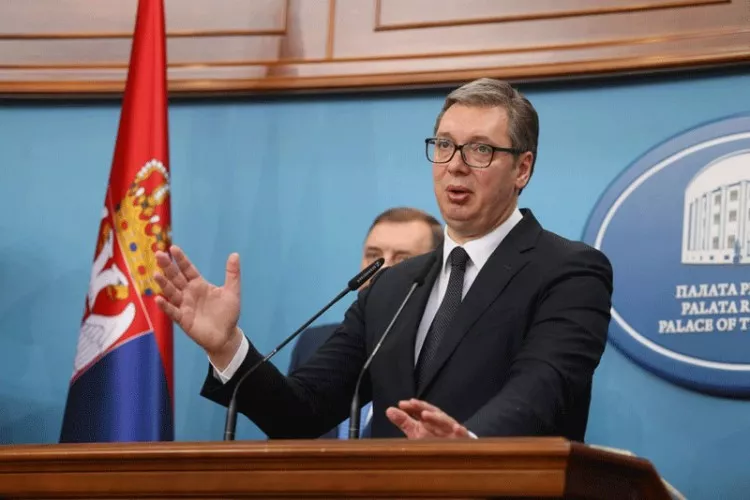
The authorities in Serbia did not comment on the genocide yesterday, and the ever-present Aleksandar Vučić in the media found no time for this topic. On Sunday and Monday, he hosted Montenegrin President Jakov Milatović, who recently expressed sympathy for Momir Bulatović, one of Slobodan Milošević's closest associates. The night before, together with Foreign Minister Ivica Dačić, Vučić and Milatović dined with song and informed the public via social media.
State television RTS reported on the genocide as an "event in Srebrenica." Social media was flooded with content denying the genocide, with almost every post about the crime being "tagged" with manipulated video material, photos, or text. There is no evidence that the authorities in Serbia are behind these posts, but there is evidence that the authorities there could create a completely different atmosphere in the media (which they control) and on social media, which they use to shape public opinion.
Bots in the Service of the Government
Almost unnoticed in Bosnian media was the news that a list of 14,000 bots appeared in Serbia, who wrote comments on social media praising the "successes" of Vučić's government. Among them are those working in the public sector. No one from Vučić's Serbian Progressive Party confirmed or denied the authenticity of the list.
Let us recall, bots are robots that automatically perform actions in the computer world. Practically, they imitate people on the internet, making posts, giving responses, collecting information, i.e., they are part of the software of a site or program. In political parties, bots are, in fact, people who write positive comments in favor of their leader, attack opponents, "destroy" internet user debates with their comments, and generate results for polls and votes on certain websites. On social media, they spread and positively rate certain posts, while trying to remove opponents' content from the network or make it less visible by reporting it to administrators as inappropriate and offensive.
Former SNS official and former media advisor to the President of Serbia, Stanislava Pak, commenting on the appearance of the list, said that "on one hand, we have price increases for energy and basic food items, securing funds for children's treatment via SMS, and bringing Serbia to the brink of poverty, while on the other hand, there is a golden age, virtual stadiums, multiple-paid roads, and millions of square meters that no one can buy in that other imaginary world. That virtual reality is served through the media, and through botting it is confirmed."
"Bots are financed from the budget and are paid equally by those who are attacked and those who are deceived. We can no longer talk about wrong policy or government incompetence. All citizens of Serbia, as well as the international community, especially its Western part, are part of the deception and brokerage of a group led by Aleksandar Vučić, whose goal is to stay in power as long as possible at the cost of destroying all of us. We must not allow that," said Pak.
Jovana Brajović from Surdulica told the media that as a public administration employee, she was ordered by her boss to bot, i.e., to write comments supporting the ruling SNS.
Parallel Reality
The story about SNS bots is not new. In April 2020, Twitter announced that it had deleted 8,558 profiles working on "promoting the Serbian ruling party and its leader." Twitter cited the stifling of public debate as the reason for the deletion.
Stanislava Pak's statement is a valuable insider testimony, not only for Serbia. She claims that the West, i.e., the international community, is "part of the deception" to keep Vučić in power, who is promoted as a man focused on the future and a man who will bring peace to the region.
Kosovo President Vjosa Osmani, speaking about Srebrenica, said yesterday that "deniers of genocide cannot be a factor for peace." That she is right is also shown by the crises (BiH, Montenegro, Kosovo) that intensified as Vučić grew stronger in Serbia, gaining Western support. At the same time, the relativization of every truth uncomfortable for Serbia continued, aided by those who believed that Vučić had "changed" and that he disagreed with the leaders of Serbs in BiH or Montenegro.
Relativization has gone far, "turning a blind eye" to those who deny and celebrate genocide, protect criminals, and refuse to change the policy that led to over a hundred thousand deaths with the breakup of Yugoslavia. They are waiting for a new opportunity, and until then, they are part of the political and social spectrum with which one works. Rosensaft's words yesterday are a reminder of the state of the region that is said to be "in the heart of Europe" and into which the West has invested its money and credibility. Because of such a state, the thesis has been successfully peddled that such an official Serbia and such a Vučić are guarantors of peace, security, and the European path of the region, and that the problem is those who disagree with that thesis.
Komentari (0)
Prijavite se za komentiranje
PrijavaJos nema komentara. Budite prvi!
Minuta
Sve →Iz drugih kategorija

High Representative Not Elected: Germans, French and British Sabotaged Americans, New Attempt at End of June

ČOVIĆ WITHOUT MERCY: How Those Who Brought Ademović to Office Created a Political Hell for Him



Sunny Saturday, quite warm



Tragedy in Albanian resort: Two minors drown












