
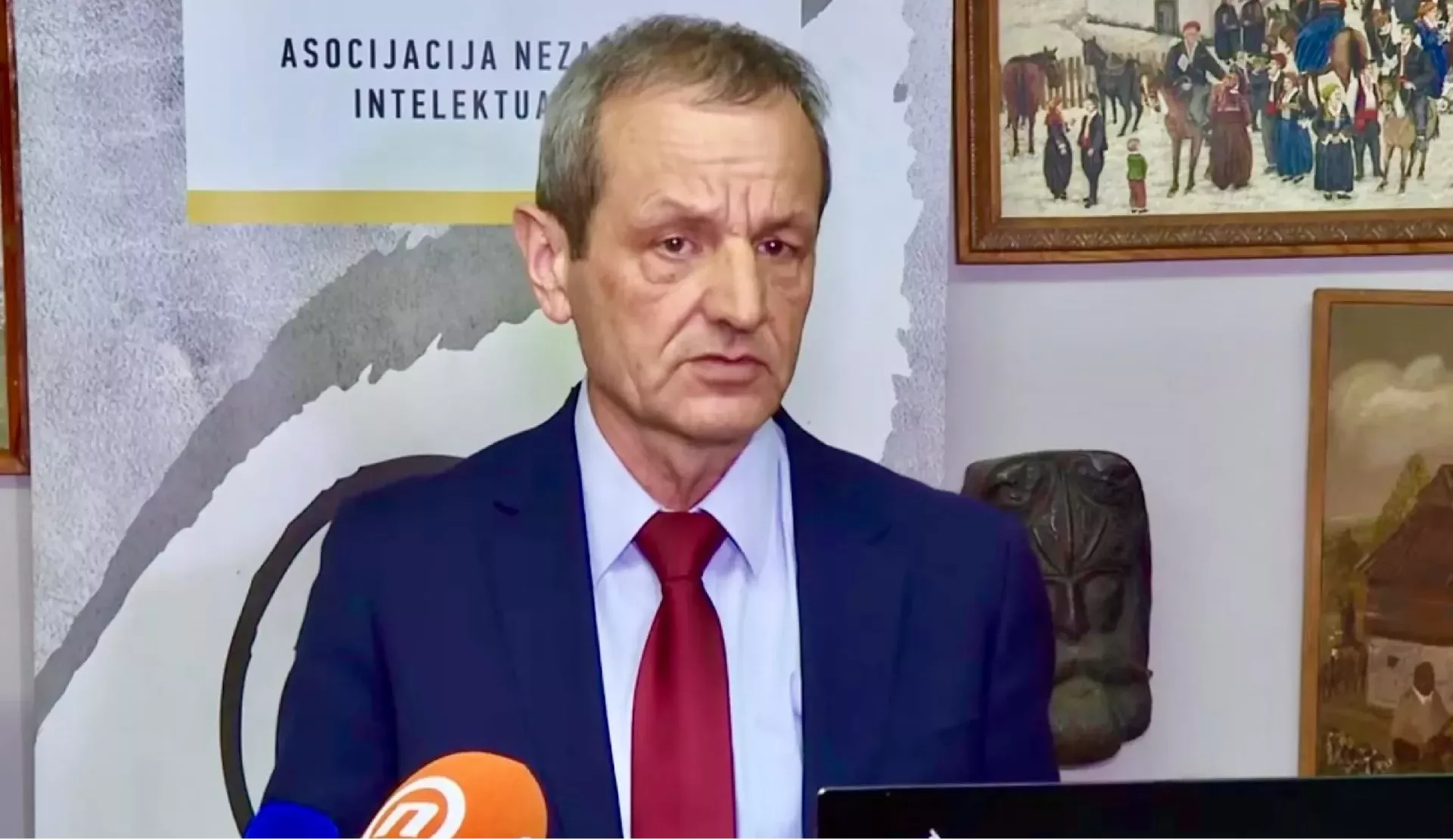
By: Prof. Dr. Hazim Bašić, member of the Presidency of Krug 99
Global security challenges, instability, and wars have resulted in the signing of military cooperation agreements between states in different parts of the world. Recently, agreements were concluded between Croatia, Kosovo, and Albania, later between Croatia and Slovenia, then Serbia and Hungary, and most recently between Saudi Arabia and Pakistan. The goals of such agreements are usually to strengthen defense capabilities, cooperation in the military industry, training and joint exercises, and countering hybrid threats. In this context, part of the motives for organizing a military parade in Serbia can be sought. However, the Serbian opposition believes that this is a regime spin about external danger and that the regime actually needs constant instability and an atmosphere of state endangerment.
Generally speaking, totalitarian and authoritarian regimes have more frequent and massive military parades (e.g., the former USSR, North Korea, China, Russia). Their goal is usually to demonstrate strength, legitimize power, mobilize the population, and create an image of unity and power. Given the nature of such regimes, these power rituals send a summary message like: "the state, the army, and the government are one and together they are invincible." Parades are often accompanied by mass choreographies, ideological slogans, and propaganda effects. Thus, this parade was named 'The Strength of Unity,' whereby the concept of unity can be interpreted and problematized in various ways.
On the other hand, liberal democratic countries organize military parades of this type less frequently, e.g., most Western countries (USA, UK, France, Germany). Military parades are organized only on special occasions (national holidays, anniversaries of war victories, independence celebrations). For example: July 14 (Bastille Day in France), Independence Day July 4 in the USA (with fewer military elements), Victory Day in the UK, etc. In liberal democratic societies, the purpose of parades is to commemorate historical events, pay tribute to soldiers, and recall tradition, and the summary message could be reduced to: "the army is at the service of citizens and the state," not at the service of ideology.
In the case of Vučić's military parade, analysts believe it has no clear historical justification, nor is it an anniversary of a great victory or a similar date. Military analysts believe that the format of the parade itself is oversized, which will affect its overall costs, which will likely be discussed in the coming days.
The nominal reason for the parade is Vučić's recently conceived holiday with a cumbersome name: "Day of Serbian Unity, Freedom, and the National Flag." The very name of this holiday and the attempt to impose it on Bosnian Serbs, who have nothing to do with this holiday, is the motive for writing this text. From the perspective of Bosnia and Herzegovina, both the holiday and the parade are viewed in the context of creating a '(Greater) Serbian World,' all based on the phantom Declaration from 2024.
The parade itself, whose duration with preparations has stretched to two full weeks, is held five days after the proclaimed holiday, at a time of deep social divisions and large anti-government protests. The protests were initiated by students blocking faculties and taking to the streets with the demand that they want a better, free, democratic state, free media, and free elections. However, the student protests have strayed into ideological imaginations, and their strength is continuously weakening by its nature. Therefore, it can be considered that the purpose of the parade is predominantly political, internal, aimed at boosting the president's rating, and even intimidating disobedient citizens.
Paradoxically, it is precisely the actions taken by Vučić's regime that contribute to the absence of both unity and freedom in Serbia, which are two key words from the name of the newly imposed holiday. Society is sharply polarized, disunited, and Vučić himself divides citizens daily into 'us' and 'them.' Similarly, the traditional division between original and trans-Drina Serbs has deepened in recent years, even with increasing antagonism, for which Vučić's regime is again responsible. Let's remember that a significant number of participants in the regime's rally in Sremska Mitrovica were brought from Bosnia. Likewise, there is less and less freedom, as long as police or masked thugs beat and detain students and citizens, as long as they raid faculties, thereby violating university autonomy.
Finally, a part of the Serbian public also problematizes the third element in the name of Vučić's holiday - the flag. Namely, they believe that the flag was compromised in the wars of the 1990s, but also by the president himself by wrapping himself in it at the UN Assembly during the adoption of the Resolution on the Genocide in Srebrenica. On that day, in the UN General Assembly hall, the word 'genocide' echoed countless times in the ears of the member state delegations, and during the vote, the Serbian flag wrapped around the president was in front of their eyes. Some citizens of Serbia believe that this flag should be replaced with the original flag from the time of the Sretenje Constitution.
The entire attitude of the Serbian regime towards Bosnia and Herzegovina is best illustrated by the recent behavior of the Minister of Defense, Bratislav Gašić, who, as a guest, refused to stand up when the national anthem was played in Banja Luka. Such behavior is a combination of domestic and regime, party upbringing.
Since Vučić's regime has been dealing with student protests quite successfully for a long time, this event will certainly find an important place in his book announced this spring titled 'How I Defeated the Color Revolution.' Winners write history.
It is interesting that there was more interest, analysis, and reaction regarding the military parade in Croatia than in Bosnia and Herzegovina. A smaller parade was held in Croatia on the same day as part of the commemoration of the Battle of Vukovar. Bosnians might show interest if the announced book is indeed published. That interest, of course, would not be related to the book.
Komentari (0)
Prijavite se za komentiranje
PrijavaJos nema komentara. Budite prvi!
Minuta
Sve →Iz drugih kategorija

High Representative Not Elected: Germans, French and British Against Americans, New Attempt at End of June

ČOVIĆ WITHOUT MERCY: How Those Who Brought Ademović to Office Created a Political Hell for Him



Sunny Saturday, quite warm



Tragedy in Albanian resort: Two minors drown












