
Written by: Amina Čorbo-Zećo
The government in Bosnia and Herzegovina is not functional even when it has money. And other countries have donated 20 million and 397 thousand to Bosnia and Herzegovina for the reconstruction of infrastructure, houses and commercial buildings in local communities that suffered the greatest damage during the floods. But there is still no reconstruction or accommodation.
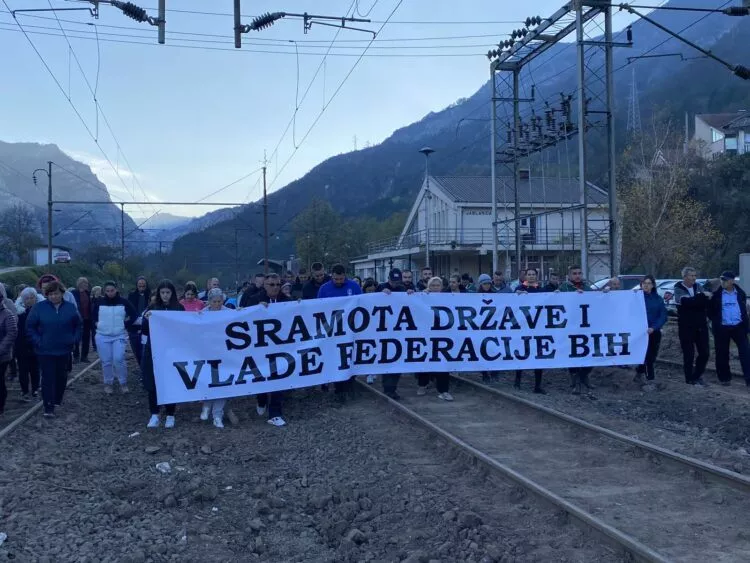
This is demonstrated by the example of Jablanica and the slowness of house reconstruction projects that were destroyed in floods and torrents three months ago. For the slowness in repairing the destroyed 80 meters of railway, they found a scapegoat in the former director of the FBiH Railways, Enis Džafić (whose hands were tied, the task was assigned to the Motorways, and then he was dismissed), but there is no accountability for the slowness because the citizens of Donja Jablanica are still staying in collective accommodation or with families and friends.
The Prime Minister of the Federation of BiH, Nermin Nikšić, said that such a matter could not be resolved in a short time, while Minister Nerin Dizdar resorted to a well-tested recipe – those before us are to blame (read: SDA).
“Unfortunately, the Federal Government in its previous term shut down the agency that could have channeled this very efficiently, so now we have to see the internal procedures, i.e., how the funds, not only from the Republic of Croatia but also from other donors, will be disbursed. We believe that the best course would be to immediately go through the Federal Government, which will be, so to speak, the operational support and backbone, of course, in cooperation with local communities and cantonal governments, but I believe that we will soon get answers and that we will receive the funds in a short time,” Minister Dizdar explained to Avaz.
And the money was collected. It sat in accounts while time mercilessly ticked away. A slap in the face for the federal authorities will come from the Minister of Finance of BiH, Srđan Amidžić, who, with astonishment, repeatedly noted that the authorities within the Federation cannot agree on the redistribution of money.
And this dragged on for some time, until they finally established the criteria for the distribution of money, which included the number of affected households, the degree of damage to buildings, the urgency of interventions, the length of damaged roads, and the affected areas of riverbeds and canals.
The total funds from this decision were distributed between the Government of the Federation of BiH, cantons, cities and municipalities, with the largest percentage share going to the Municipality of Jablanica with 23.41 percent. It is followed by the City of Konjic with 21.58 percent, and the Herzegovina-Neretva Canton will also receive a significant share of the funds with 13.53 percent.
Complete distribution
Government of the Federation of BiH – 1,063,617.36 KM (5.21%)
Herzegovina-Neretva Canton – 2,759,259.35 KM (13.53%)
Central Bosnia Canton – 1,031,159.53 KM (5.06%)
City of Mostar – 341,323.08 KM (1.67%)
City of Konjic – 4,400,726.24 KM (21.58%)
Municipality of Fojnica – 1,837,064.36 KM (9.01%)
Municipality of Kiseljak – 1,716,664.58 KM (8.42%)
Municipality of Kreševo – 2,296,208.86 KM (11.26%)
Municipality of Jablanica – 4,774,154.63 KM (23.41%)
Municipality of Vareš – 74,137.41 KM (0.36%)
Municipality of Drvar – 26,454.02 KM (0.13%)
Municipality of Visoko – 66,135.07 KM (0.32%)
Municipality of Breza – 10,112.89 KM (0.05%)
This was done only in mid-December, but again everything came to a halt.
No one is taking responsibility, and the snow has already largely covered the traces of the devastating floods that hit parts of Bosnia and Herzegovina on October 4. Catastrophic flash floods and landslides killed 27 people. The hardest hit was Donja Jablanica, a populated place in the municipality of Jablanica, where 19 people died and enormous material damage was caused. And not a single family has received accommodation there yet.
There is also no accountability for the shoddy work, which ultimately shows that the government in BiH is an end in itself, and by no means at the service of citizens.
Once again, we have seen the deep political and administrative incompetence of the authorities in Bosnia and Herzegovina, especially in the context of emergency situations such as floods. It is not just the slowness in the distribution of funds that is the problem, but also the complete uncertainty and distrust of citizens towards the institutions that are obliged to respond to disasters like this. And they are not!
The deeply rooted political, administrative and systemic problems that hinder the normal recovery of communities after natural disasters are simply the sad reality of BiH.
Komentari (0)
Prijavite se za komentiranje
PrijavaJos nema komentara. Budite prvi!
Minuta
Sve →Iz drugih kategorija

High Representative Not Elected: Germans, French and British Against Americans, New Attempt at End of June

ČOVIĆ WITHOUT MERCY: How Those Who Brought Ademović to Office Created a Political Hell for Him



Sunny Saturday, quite warm



Tragedy in Albanian resort: Two minors drown












