
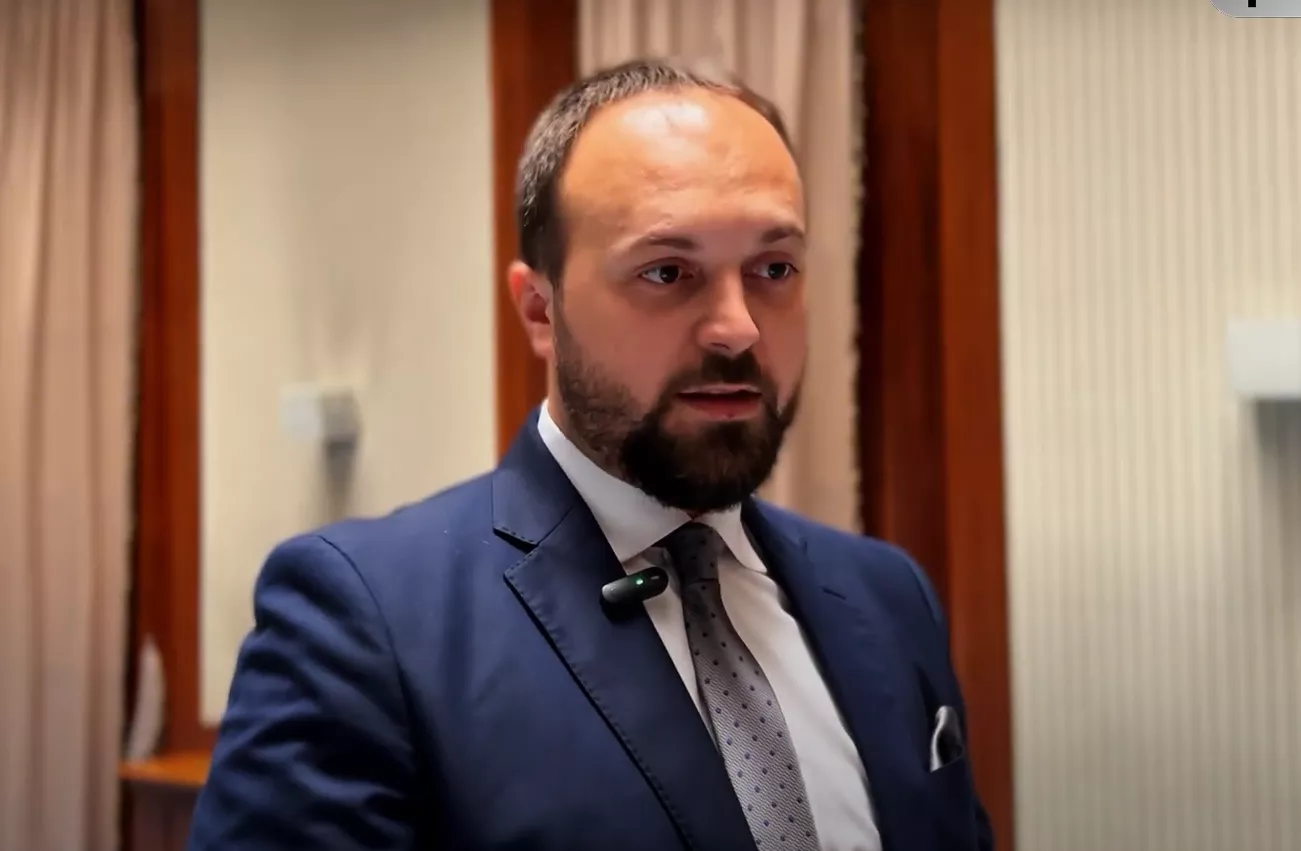
(Patria) - Sead Šahman, president of the Bosniak Democratic Movement (BDP) and long-time official of the Bosniak Party in Montenegro, visited Sarajevo. In an interview for the Patria News Agency, he spoke about his views on the situation of Bosniaks in Montenegro, as well as the political situation, and the goals of the newly formed political organization BDP.
Interview by: Amina Čorbo - Zećo
You are a new political organization, however, can we define from your previous statements that you would in no case enter into government with those who are currently in power and represent pro-Serbian politics?
Šahman: Let's be clear, Montenegro, by its constitution, should be a multi-ethnic and multicultural country. I am absolutely not against that because it would go against my political principles for a political party or parties to represent the interests of their community; that is completely normal for me. However, what is not normal is for a certain political party to want to achieve a type of hegemony, if it works for the interests of another state by implementing their agenda within your country, and if they want their policy to be dominant in a way that they mention changing the constitution of Montenegro, qualifying their language as one of the languages that should be official in Montenegro, etc. All these things resemble a certain hegemonic approach, and I am absolutely against it. It does not necessarily mean that a political party represents the interests of its community, but if it wants to achieve all of the above, then such an approach is unacceptable, and that is something we will not allow at any cost.
You recently stated that Bosniaks do not want to be servants of foreign interests, but rather seek partnership and alliance on equal terms. Does this mean that the current set of Bosniak representatives in the Government of Montenegro are “servants of someone’s interests”?
Šahman: Look, if you look at what Bosniak ministers currently cover within the Government of Montenegro, it will be clear to you that these are simply not the interests of the community. If you get the opportunity to negotiate a certain entry into the executive government, then you should, first and foremost, be guided by the interests of the community, in this case, the Bosniak community, and much less by the particular interests of individuals. Such an approach is not acceptable; I think that Bosniak interests in Montenegro are at a significantly higher level. What is written in the program of that political party that is currently participating in the government is the protection of the cultural heritage of Bosniaks, human and minority rights, greater principles of democracy, infrastructural and economic projects in less developed areas where Bosniaks predominantly live. If you look at what these Bosniak ministers cover today, you will see that this is not the case.
What specifically do the Bosniak ministers cover, what do they deal with?
Šahman: I will remind you that in July of this year, the Government of Montenegro underwent a reconstruction. It currently has 32 members. This is something unusual, something unseen in Europe. At this moment, it is the most cumbersome government functioning. The five ministers currently covered by Bosniaks are not a large number compared to 32. Therefore, all important decisions are made without the Bosniak ministers, and you recently had a situation where the Government decided to erect a monument to the former Montenegrin Metropolitan Amfilohije in Montenegro; thus, we have a situation where the Government, in which these Bosniak ministers sit, makes such a decision. They can leave sessions, it was demonstrative, but they hold onto their invented positions at all costs. The portfolios they cover today have never been at the ministry level; they were certain administrations, agencies, departments within ministries. Today, you have Bosniak ministers covering the gas and oil sectors, the sector for non-governmental organizations, etc. Everything that was minor has been converted into portfolios just so someone can be a minister. I think that is not the purpose, and I repeat that Bosniak interests in Montenegro are at a much higher level.
So, they cannot influence some important political arrangements in Montenegro?
Šahman: They cannot influence any important decision. Because that Government could be formed without them. They can also leave that Government; however, the biggest mistake is to be whitewashing the political biographies of those who belittle others, who do not respect your programmatic principles and tenets, those who deny the genocide in Srebrenica, those who do not recognize our neighboring independent state of Kosovo and who say that if their political structures become dominant, the majority in Montenegro, they will annul the 2008 decision and will not recognize Kosovo as our neighboring country with which we share a border.
An Albanian student from Sarajevo led the Government of Montenegro - Dritan Abazović and his government were perceived in Sarajevo as pro-Serbian. You are also a student from Sarajevo. What can we expect from you as a leader of a political party and perhaps in the future of some institutional body?
Šahman: Sarajevo is very important to me; part of my family lives here, I studied here, and in a way, I am still a student from Sarajevo as I am completing my doctoral studies here in Sarajevo. I am proud of the fact that I am a student at the University of Sarajevo; I graduated from the Faculty of Economics, earned my master's degree in Sarajevo, and am successfully completing my doctoral studies. Bosniaks from Montenegro, and speaking generally about Sandžak as well as the Serbian and Montenegrin parts living in BiH, of which there are a large number, are present in all spheres, including politics, culture, and diplomacy, and they should and must be a bridge strengthening ties between our two countries. Thus, between independent and sovereign Montenegro and independent and sovereign Bosnia and Herzegovina. Additional bridges, additional connections between two countries that currently have good bilateral relations. This was confirmed by the recent visit of the President of Montenegro, Jakov Milatović, to the three-member Presidency of BiH, during the presidency of the Bosniak member of the Presidency. This is a good message, and messages of friendship among friends were sent from that meeting, which is encouraging and optimistic for future cooperation. There is certainly room for additional cooperation, also in the economic sphere – strengthening economic activities, and more work needs to be done in that regard.
Bosniaks of the Balkans are generally, and also within the countries where they reside, divided along interest-political lines. In BiH, Bosniak politics has dissolved into several fronts. This is now also the case in Montenegro. How to find the connective tissue that will consolidate Bosniak political ideas, channel interests in one direction, because without this joint action, Bosniaks in all former Yugoslav countries are endangered?
Šahman: Unification and cooperation are absolutely important; finding a minimum of common cooperation, etc. However, when we talk about politics, I will remind you that there are other Bosniak parties in Montenegro. We left the Bosniak Party, which we built, strengthened, and developed over the years, precisely because of the wrong personnel and program implementations of such a policy. There are, I tell you, other institutions such as National Councils, cultural institutions, and if you will, the Islamic Community, which is heterogeneous in Montenegro because it includes Albanians, Bosniaks, and Montenegrins of the Islamic faith, but Bosniaks are dominant, and in that regard, these institutions should somehow unite us all.
However, political pluralism, at least at this moment, I think is good and will yield a certain quality. Because in the next period, we are newly established, but we aspire to be a superior political idea compared to the previous and current ones representing Bosniaks, and to be number one. That is our goal; for now, the situation is promising, and we are moving in that direction.
During the change, let's say, of the government system, the departure of Đukanović and the arrival of new policies, it could be heard in Sarajevo that Bosniaks turned their backs on Đukanović, and that cost him his election results. What is the potential for cooperation between BDP and DPS in future election cycles?
Šahman: At this moment, the Bosniak Democratic Movement is focused on itself. We want to strengthen our infrastructure; we want to bring our idea closer to the people. We talk daily from Rožaje, Plav, Gusinje, Bijelo Polje, Pljevlja, Podgorica, and all parts of Montenegro where our people live. This visit to Sarajevo is also a good opportunity to talk with our people who live and work here and have family or any other business ties with their homeland, and it is very important to present this idea. To somehow encourage people that there is another political option that primarily thinks about the interests of the community. At this moment, we are not thinking about any coalition arrangements; we will see when the time comes. Montenegro simply does not have a system where elections are held on a predetermined date like, for example, in BiH; we have extraordinary elections quite often, especially at the local level. Because, in our country, it simply happens that a coalition arrangement is made, then it ceases to exist, and extraordinary elections are held. By the end of this year, we have elections in Berane, at the beginning of next year in Nikšić, then Cetinje, etc. We are in some election cycle quite often. We will see if we will have extraordinary parliamentary elections. I will remind you that since 2020, we have gone to the polls three times for parliamentary elections. Presidential elections are separate, so there will be challenges in the coming period, and there will be opportunities to discuss these coalition battles in the coming months and years.
And finally, if there were an external dome over Montenegro, it would be called NATO, while the internal one is currently much closer to the “Serbian world”. The European Union, through the intermediate space, could be the deciding factor for Montenegro, along with the Atlantic institutions, to free itself from the already historical shackles of Belgrade's hegemonism. How realistic is Montenegro's relatively swift entry into the EU?
Šahman: The goal that Montenegro has set for itself is membership in the European Union by 2028. However, to achieve such a goal, it is very important to strengthen regional cooperation. At this moment, I am not sure that the Government of Montenegro is pursuing such a policy. Why? Because the Parliament of Montenegro recently, in the near past, adopted a resolution on Jasenovac, which was a very sharp message from official Zagreb. You know that Croatia is in the EU and is Montenegro's immediate neighbor, and as such, it was a great lobbyist for our interests on the path to the European Union.
These relations are currently not at a desirable level. You have a situation where one of the Deputy Prime Ministers of Montenegro, one of the seven we have, says that if his party were dominant in the government of Montenegro, they would annul Kosovo's independence, so I am not sure that in that context we can talk about good regional relations. And if you look at all that political elite in Montenegro, the executive power pulls in one direction, the president of the country in another, the legislative power in a third, etc. There is no common approach, no synergistic effect that would lead towards that goal. I think that if all this were classified and if relations were at a better level, it is realistic for Montenegro to become the next member of the European Union, and that would be achievable by 2028.
But, it is very important that we carry out certain reforms internally, it is very important for us to have the rule of law and the rule of law. To strengthen our democratic capacities and, what is very important, speaking from the perspective of the Bosniak people above all, for that part of Montenegro where Bosniaks predominantly live to be economically much more developed. That the state pays special attention to this, but also our diaspora living all over the world, which has achieved perfect businesses from the USA, Western European countries, and even countries in the region where they reside.
Komentari (0)
Prijavite se za komentiranje
PrijavaJos nema komentara. Budite prvi!
Minuta
Sve →Iz drugih kategorija

High Representative Not Elected: Germans, French and British Against Americans, New Attempt at End of June

ČOVIĆ WITHOUT MERCY: How Those Who Brought Ademović to Office Created a Political Hell for Him



Sunny Saturday, quite warm



Tragedy in Albanian resort: Two minors drown












