
Written by: Rasim Belko @rasimbelko
The announcement of major protests in Serbia, with an expected participation of around one million people, indicates an escalation of citizens' dissatisfaction.
The current wave of protests, which has been ongoing since November 2024 after the tragedy in Novi Sad (the collapse of a canopy with 15 victims), shows that students, with the support of a broader part of society, have become a key actor in challenging the rule of Aleksandar Vučić. Vučić's statement that he expects "great violence" can be interpreted as an attempt to prepare the public for a harsh reaction from the authorities or as a signal that he is preparing to suppress demonstrations by force, which is in line with previous patterns of behavior of his regime.
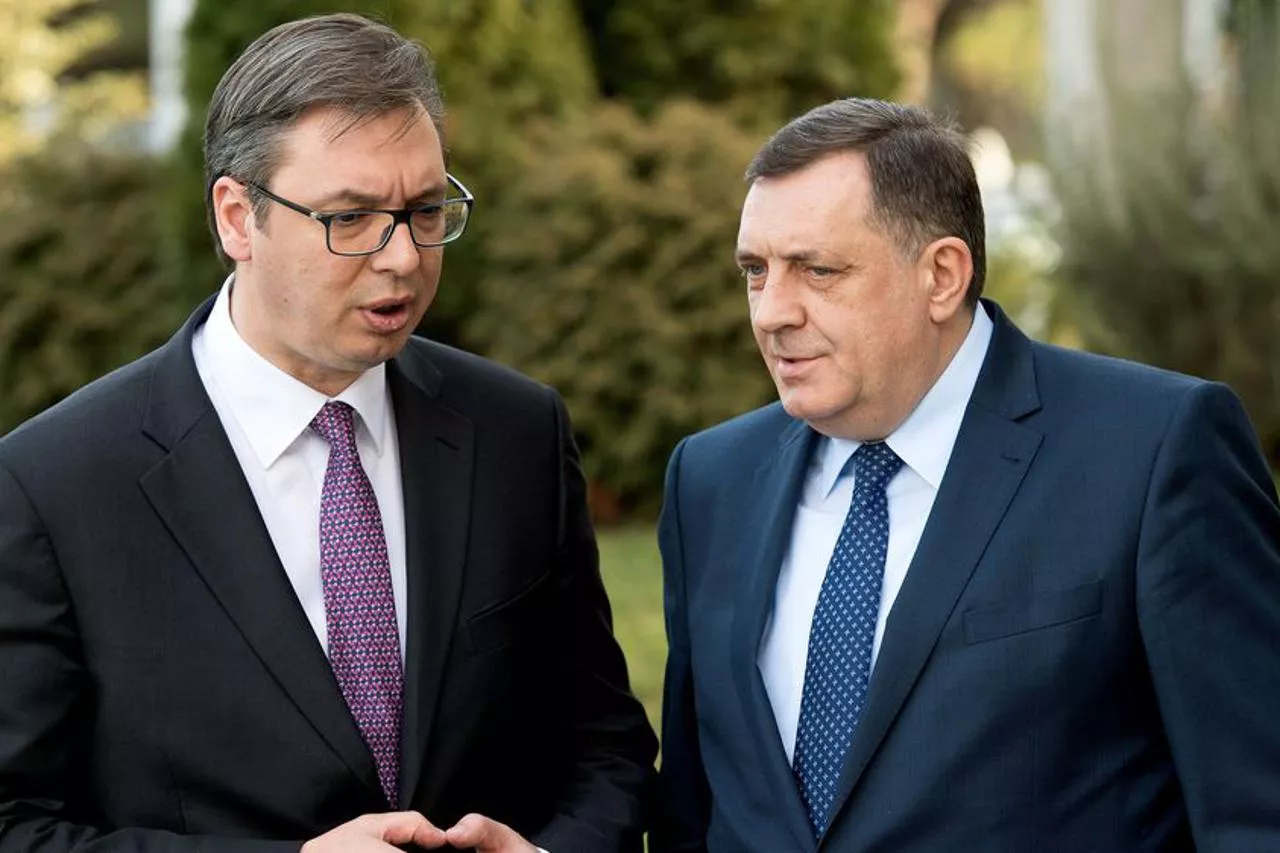
Parallel to the protests, Vučić's government has scheduled a three-day session of the Assembly on the Republika Srpska, at which Milorad Dodik, the President of RS, will speak. This is one of the few remaining strategic moves by Vučić to divert attention from the internal crisis in Serbia to regional issues and the strengthening of the Serbian national agenda. Vučić and Dodik have been continuously coordinating for a long time with the aim of preserving their political positions, and RS is often used as a training ground for mobilizing nationalist forces in Serbia.
Historically, crises in Serbia often have repercussions on Bosnia and Herzegovina and Kosovo. Vučić's policy often uses regional instability as a means to consolidate power at home, while Dodik uses the support of Belgrade to strengthen his position in RS, destabilizing Sarajevo and provoking the international community.
Several questions arise ahead of the, in many ways, important March 15.
Can Vučić and Dodik maintain control through a joint effort against students in Serbia and state institutions in Bosnia and Herzegovina?
Vučić's ability to maintain control over the situation in Serbia depends on several factors: the effectiveness of the repressive apparatus (police and security services), the support of his base, and the reaction of the international community. The student protests have shown a high level of organization and broad support, making them a serious threat to the Belgrade regime.
If the prediction of a million people on the streets materializes, it could exceed the authorities' capacity to suppress them without significant consequences (e.g., mass arrests or casualties), which would further erode Vučić's legitimacy. A joint effort with Dodik, such as mobilizing nationalist forces or diverting attention to RS, can temporarily help Vučić ease the pressure, but it will not solve the fundamental problem – internal dissatisfaction.
Dodik, on the other side of the Drina, has long been boycotting the state institutions of Bosnia and Herzegovina, and through secessionist acts, he undermines the constitutional and legal order. And all this while using secessionist rhetoric and the support of Belgrade. A joint appearance with Vučić at the session of the Serbian Assembly can temporarily strengthen his position in RS, but it does not guarantee the preservation of control. Vučić's support for Dodik can escalate tensions in Bosnia and Herzegovina, but it will not directly affect the student protests in Serbia unless it is used to spread the narrative of "external enemies."
However, judging by the mood in Serbia, the protests are too rooted in domestic issues (corruption, responsibility for the tragedy in Novi Sad…) for the regional agenda to neutralize them.
Will Vučić and Dodik stage incidents following the Kosovo model?
Information has appeared in the public space of Bosnia and Herzegovina that Dodik, with the help of the Russians, could stage incidents by March 15 in order to help Vučić on the one hand, and further threaten the international community on the other.
However, given the fact that spy planes of the USA and Great Britain have been flying over RS for days, that EUFOR continuously patrols the terrain, and that Dodik's strength among the Serbian population is diminishing, it is difficult to expect that he will succeed if he has imagined defending himself and Vučić with incidents like those Vučić carried out in Kosovo.
But this by no means means that all those tasked with ensuring security in Bosnia and Herzegovina should relax. Because Dodik and Vučić are seriously wounded, and a clouded mind is ready for anything.
Can the opposition in the Republika Srpska (PDP, For Justice and Order, SDS) make a more significant departure from the policy of official Belgrade and turn more towards Sarajevo, regardless of the government in Serbia?
This is a key question for the near and distant future of Bosnia and Herzegovina and its administrative units.
The opposition in RS (PDP, SDS, For Justice and Order) has traditionally been critical of Dodik, but has often maintained a nationalist tone similar to that of official Belgrade. PDP and SDS have shown a certain willingness to cooperate with Sarajevo in the past, but they have mostly remained in the orbit of Serbian national politics dictated by Vučić and implemented by Dodik. The movement "For Justice and Order" of Nebojša Vukanović shows greater radicalism in opposing Dodik, but without a clear orientation towards Sarajevo. Vukanović has publicly attended student protests against Vučić, but it is questionable how much of a departure he would make from his eventual successors.
A significant departure from Belgrade and a turn towards Sarajevo would require a fundamental change in strategy – abandoning nationalist rhetoric and Greater Serbian politics, and accepting Bosnia and Herzegovina as a functional state, which is contrary to the long-standing positions of these parties.
The current protests in Serbia and the potential weakness of Vučić could give the opposition space to profile itself as more independent, but this depends on their ability to articulate an alternative vision.
Belgrade, regardless of who is in power, has enormous cultural, economic, and political influence on RS. Even if Vučić weakens, any new government in Serbia will likely maintain an interest in RS, which limits the space for turning towards Sarajevo. Until the next elections in Bosnia and Herzegovina, the opposition in RS does not have enough strength to break the dominance of Dodik's SNSD and fully reveal its cards regarding relations with Belgrade.
However, the harmfulness of the Belgrade-Banja Luka connection could be at least controlled, if not significantly reduced, if the special and parallel ties were loosened and reset.
For now, it is quite clear that the strategy of the opposition in RS will mostly remain focused on opposing Dodik within the national framework, rather than on a radical paradigm shift towards Sarajevo.
In essence, no matter how much the entire region, Bosnia and Kosovo in particular, awaits the final end of Vučić and Dodik, it is almost certain that their followers will follow the paths of SANU under the banner of the 'Serbian world'.
Because change is more uncertain given the overall geopolitical crisis of relations and the realignment of forces, but it will be possible when a change occurs in the organization of Bosnia and Herzegovina, i.e., its adaptation to Atlantic and European integrations.
More precisely, on the day when options for the partition of Bosnia and Herzegovina die, the link between Banja Luka and Belgrade will weaken, and the link with Sarajevo will strengthen!
And in all this, it is not unimportant to avoid repeating the now standard mistakes, when policies in Banja Luka were appeased at any cost just so they would accept Bosnia and Herzegovina. Dodik has proven that this is fatalistic!
Komentari (0)
Prijavite se za komentiranje
PrijavaJos nema komentara. Budite prvi!
Minuta
Sve →Iz drugih kategorija

High Representative Not Elected: Germans, French and British Against Americans, New Attempt at End of June

ČOVIĆ WITHOUT MERCY: How Those Who Brought Ademović to Office Created a Political Hell for Him



Sunny Saturday, quite warm



Tragedy in Albanian resort: Two minors drown












