
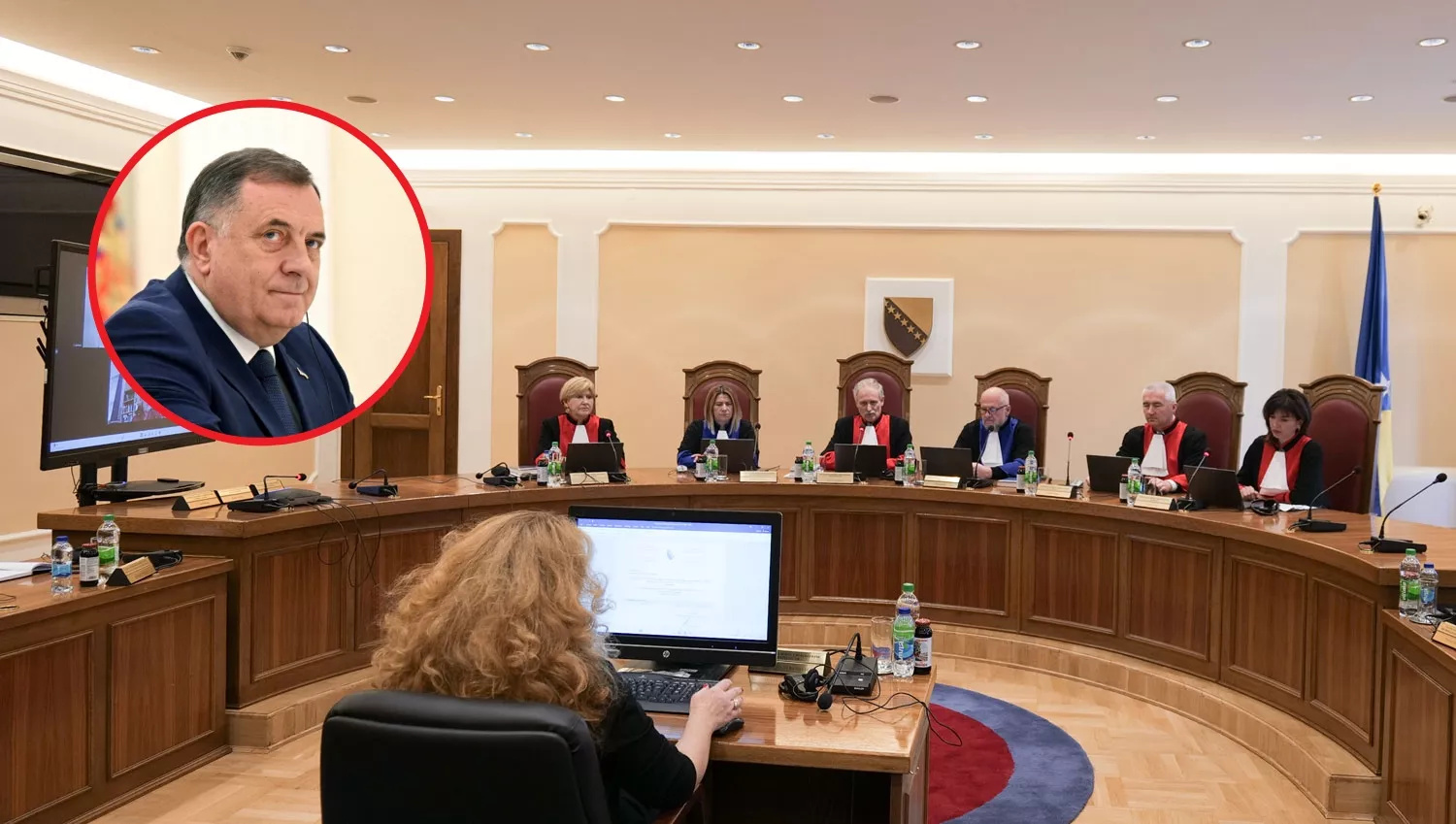
(Patria) - The Constitutional Court of BiH at today's 10th extraordinary plenary session rejected the appeal of former RS President Milorad Dodik, by which he challenged the final verdict of the Court of BiH, by which he was convicted for disrespecting the High Representative's decisions.
"By the Decision on Admissibility and Merits in case number AP-3722/25 (Milorad Dodik), the Constitutional Court rejected Milorad Dodik's appeal against the Verdict of the Court of Bosnia and Herzegovina number S1 2 K 046070 25 Kž 2 of June 12, 2025, as unfounded in relation to Article II/3.e) of the Constitution of Bosnia and Herzegovina and Article 6 paragraph 1 of the European Convention on Human Rights and Fundamental Freedoms (European Convention), Article 7 of the European Convention, and Article 18 of the European Convention in conjunction with Article 6 of the European Convention.
The Constitutional Court rejected Milorad Dodik's appeals filed in relation to Article II/3.e) of the Constitution of Bosnia and Herzegovina and Article 6 paragraph 2 of the European Convention in connection with statements by public officials made during the trial of the appellant as manifestly (prima facie) unfounded.
The Constitutional Court rejected Milorad Dodik's appeal against the Decision of the Court of Bosnia and Herzegovina number S1 3 Iž 052766 25 Iž of August 18, 2025, and the Decision of the Central Election Commission of Bosnia and Herzegovina (CEC) number 06-1-07-939/25 of August 6, 2025, in relation to Article II/3.e) of the Constitution of Bosnia and Herzegovina and Article 6 paragraph 1 of the European Convention, and Article 3 of Protocol No. 1 to the European Convention, as inadmissible because it is ratione materiae incompatible with the Constitution of Bosnia and Herzegovina," concluded the Constitutional Court of BiH.
In the explanation of the decision regarding the claim of violation of the right to a fair trial in relation to the procedure that followed the conviction by the Court of BiH (AP-4095/25), the Constitutional Court stated that in the specific case, the CEC, ex officio, conducted the procedure to determine the termination of the appellant's mandate as RS president.
This procedure was conducted in accordance with the relevant provisions of the Election Law of BiH after the contested appellate verdict of the Court of BiH from case number AP-3722/25 was rendered, i.e., after the conviction against the appellant became final.
From the explanation of the CEC and Court of BiH decisions, it follows that this procedure did not decide on the constitutionality and legality of the Court of BiH's actions in the criminal proceedings against the appellant. The declaratory nature of the contested CEC decision (stating the termination of the appellant's mandate) was also pointed out in the CEC's response to the appeal.
Based on this, the Constitutional Court concluded that the contested decisions from case number AP-4095/25 did not decide on the appellant's "civil rights and obligations," nor on a "criminal charge" within the meaning of Article 6 paragraph 1 of the European Convention, which is why the guarantees from Article II/3.e) of the Constitution of Bosnia and Herzegovina and Article 6 paragraph 1 of the European Convention are not applicable to the procedure conducted before the CEC and the Court of BiH.
Such a conclusion consequently excludes the merits-based examination of the appellant's claims regarding the alleged bias of CEC Council member V.B.P., who participated in the adoption of the contested CEC decision of August 6, 2025, given that the right to an independent and impartial tribunal in the conventional sense represents one segment of the right to a fair trial.
Given the above, the Constitutional Court determined that this part of the appeal claims is ratione materiae incompatible with the Constitution of Bosnia and Herzegovina and the European Convention.
Furthermore, regarding the appellant's claims concerning the violation of the principle of punishment only by law from Article 7 of the European Convention, the Constitutional Court pointed out that this is a new criminal offense incorporated into the criminal justice system by the action of the High Representative.
It was further emphasized that the case files indicate that the regular courts applied and interpreted Article 203a of the Criminal Code of Bosnia and Herzegovina (non-execution of High Representative's decisions; CCBiH) for the first time in the appellant's case, and therefore, there can be no talk of comparable situations/precedents.
The essence of the appellant's objections regarding the application of the law concerns the manner in which the legal provision applied to the appellant was adopted, and the legal status of Christian Schmidt as High Representative and his role in the legal system of Bosnia and Herzegovina, i.e., his right to enact laws.
In the circumstances of this specific case, this related to the High Representative's authority to issue two decisions on July 1, 2023, preventing the entry into force of the Law on the Publication of Laws and Other Regulations of Republika Srpska and the Law on Non-Application of Decisions of the Constitutional Court of Bosnia and Herzegovina, and then the decision of July 1, 2023, by which the Law on Amendments to the CCBiH was enacted, prescribing the criminal offense for which the appellant was prosecuted and convicted.
Regarding the High Representative's jurisdiction to enact laws, the Constitutional Court pointed out that it has previously expressed its position in several decisions that the High Representative's powers derive from Annex X, relevant UN Security Council resolutions, and the Bonn Declaration, and that these powers are not subject to the Constitutional Court's review, nor is the exercise of these powers (see, e.g., Decision on Admissibility and Merits number U-27/22 of March 23, 2023, points 72 and 73, with further references, available at www.ustavnisud.ba).
In this specific case, the Constitutional Court noted that on July 1, 2023, the High Representative intervened in the legal system of Bosnia and Herzegovina and, instead of the Parliamentary Assembly of Bosnia and Herzegovina, enacted the Law on Amendments to the CCBiH.
In this regard, according to the Constitutional Court's opinion, he acted as the legislative authority of Bosnia and Herzegovina, and the aforementioned amendment to the CCBiH undoubtedly has the legal nature of a domestic regulation whose constitutionality review is not the subject of this appeal.
Therefore, the Constitutional Court determined that the appellant's claims challenging the legal status of the High Representative and his powers in the context of prescribing the criminal offense under Article 203a of the CCBiH, for which the appellant was found guilty, are unfounded.
According to the Constitutional Court's opinion, the regular courts elaborated on this in detail, which was the backbone of the entire criminal proceedings. Therefore, the Constitutional Court considers that in this specific case, the basic condition from Article 7 of the European Convention that only the law can prescribe a criminal offense and a penalty, i.e., that the criminal offense is clearly defined by law, has been undeniably met.
Similarly, contrary to the appellant's claims, the Constitutional Court also considers that the criminal offense for which the appellant was convicted was in force at the time of the signing of the contested decrees.
Regarding the predictability and accessibility of the legal norm based on which the appellant was convicted and the contested security measure was imposed, it was pointed out that in a situation where, as in the specific case, a provision of the criminal code with a lawful legal basis and which is clearly formulated (Article 203a CCBiH) is interpreted for the first time, the Constitutional Court considers that the regular courts have adequately and sufficiently addressed all disputed issues regarding the qualitative requirements of Article 7 of the European Convention.
According to the Constitutional Court's opinion, such interpretations of the facts from the contested verdicts do not give an impression of arbitrariness.
Furthermore, the Constitutional Court reviewed the appellant's claims regarding the independence and impartiality of the two judges of the Court of BiH who acted in the criminal proceedings against the appellant.
In this regard, after reviewing these claims by the appellant, as well as the facts and circumstances of the case, the Constitutional Court determined that the impartiality of the judges in the case was not called into question, and therefore there was no obligation for their recusal. For this reason, the Constitutional Court determined that in this specific case, there was no violation of the appellant's right to an independent and impartial tribunal.
Regarding the public nature of the trial, the Constitutional Court notes that the trial was public throughout the entire criminal proceedings, and a large audience attended the main hearing. According to the Constitutional Court's opinion, the regular courts provided clear reasons why it was necessary to take certain measures to maintain order in the courtroom.
It was pointed out that the appellate panel determined that there was no interruption in the transmission of the trial on monitors in the area where the audience was seated. Therefore, according to the Constitutional Court's opinion, it is clear that the audience, i.e., the public, could follow the trial without hindrance.
Regarding the appellant's claims that the decision on delegation was not made by a functionally competent court, the Constitutional Court pointed out that the appellate panel examined the appellant's claims in this regard in the contested appellate verdict.
The explanation provided in this regard is sufficiently clear and not arbitrary, especially considering that it was an issue that had been previously finally decided. The Constitutional Court emphasized that the court before which the appellant was tried has all the competencies for judging, just like any other regular court.
This is a legally established court, presided over by professional judges, and within its actual jurisdiction is the determination of the appellant's criminal charge under Article 203a of the CCBiH. Therefore, the Constitutional Court determined that these claims by the appellant are also unfounded.
Furthermore, the Constitutional Court determined that in this specific case, the requirement of the "fairness" principle that all evidence be presented at the main hearing in the presence of the accused, in order to ensure the principle of adversarial proceedings, has been met.
The Constitutional Court could not conclude that the regular courts, by conducting the evidentiary proceedings in this criminal matter, exceeded the scope of their discretion in freely assessing the evidence presented in the proceedings, nor was the "equality of arms" called into question, which would result in a violation of Article 6 paragraph 1 of the European Convention.
The Constitutional Court considers that the regular courts, in explaining the contested decisions, did not fail to respond in detail to all of the appellant's arguments/objections of essential importance for the outcome of the proceedings in the specific case, and that they provided relevant and sufficient reasons for their decisions.
The Constitutional Court also reviewed numerous other claims in the appeal in the context of the right to a fair trial, but concluded that they do not raise issues that should be considered separately in detail. Therefore, the Constitutional Court considers that the circumstances of the specific case, in light of the previous considerations and conclusions, do not give the impression that the right to a fair trial was violated in the criminal proceedings against the appellant, viewed as a whole.
Given the Constitutional Court's decision in this case, it was decided that it is not necessary to specifically consider the appellant's request for a temporary measure, the Constitutional Court of BiH announced.
Let us remind you, Milorad Dodik was sentenced to one year in prison and a six-year ban from holding political office, after which the CEC BiH revoked his mandate as RS president. In this regard, he also challenged the CEC's decision to call early elections for the RS president.
The appeal was filed on August 20 this year, two weeks after his mandate was revoked.
Despite everything, Dodik remains the leader of SNSD, thereby retaining undeniable influence on political processes in Bosnia and Herzegovina.
Ana Trišić Babić is currently the acting president of the RS, appointed to that position by the National Assembly of RS, which happened as part of an agreement between Dodik and US representatives.
Komentari (0)
Prijavite se za komentiranje
PrijavaJos nema komentara. Budite prvi!
Minuta
Sve →Iz drugih kategorija

High Representative Not Elected: Germans, French and British Against Americans, New Attempt at End of June

ČOVIĆ WITHOUT MERCY: How Those Who Brought Ademović to Office Created a Political Hell for Him



Sunny Saturday, quite warm



Tragedy in Albanian resort: Two minors drown












