
The European Union is introducing a register of ultimate beneficial owners of companies to prevent tax evasion and money laundering through offshore zones. All of this will have consequences for Serbia in the future, where more than 1,100 companies currently operate, whose ownership is hidden in one of the tax havens around the world, writes the Center for Investigative Journalism of Serbia, reports NAP.
The same awaits Bosnia and Herzegovina.
CIN states that in 2007, Nikola Đivanović bought the oldest Serbian company for film production, distribution, and exhibition, Beograd film, for slightly more than nine million euros at the time. This company owned some of Belgrade's most famous cinemas: Kozara, Jadran, Zvezda, etc.
The media then presented him as a successful British businessman of Serbian origin, owner of a London real estate company, and a former advisor to the governor of the National Bank of Serbia, Mlađan Dinkić.
A few years later, it turned out that behind the buyer of the cinemas was actually a network of offshore companies – and behind them, Đivanović's company from the Bahamas and a group of former executives of Beograd film. Because of this, the Organized Crime Prosecutor's Office charged them with money laundering, tax evasion, and abuse of official position, through which they damaged the company, the state, and shareholders, and tried to gain at least 1.6 million euros for themselves.
Among other things, the indictment accused them of using the buildings of seven cinemas from 2007 to 2011 to establish separate companies and sell them to Cypriot companies controlled by Đivanović. In 2008, they paid only 10 percent of the price to Beograd film, and according to the Prosecutor's Office, to maintain the illusion of payment of the remaining money, Đivanović opened an account in Switzerland in 2010 and created fake payment confirmations. The cinemas were later resold, but none have been operating for years.
In 2012, Đivanović reached an agreement with the Prosecutor's Office, after which he was convicted of abuse of official position, while the charge of money laundering was dismissed. According to the verdict, he received a three-year prison sentence, with the obligation to return about 3.1 million euros to the budget and shareholders at the exchange rate at the time. He was conditionally released in 2014, after his sentence was reduced by one year.
EU Blacklisted Countries
In parentheses is the number of companies from these countries operating in Serbia:
Europe: Liechtenstein (33), Andorra (4), Monaco (4), Guernsey (3). Africa: Seychelles (19), Liberia (6), Mauritius (2). Asia: Hong Kong (15), Brunei (3), Maldives. Oceania: Marshall Islands (9), Niue (1), Cook Islands, Republic of Nauru, Republic of Vanuatu. Americas: British Virgin Islands (147), Panama (35), Belize (22), Bahamas (12), Saint Vincent and the Grenadines (9), Saint Kitts and Nevis (5), Cayman Islands (4), Anguilla (1), Antigua and Barbuda, Barbados, Bermuda, Grenada, Montserrat, Turks and Caicos, US Virgin Islands.
The purchase of Beograd film is just one example of the abuse of so-called offshore zones for criminal activities. The operations of companies registered in them are not illegal, but they are often used to hide assets, evade taxes, and launder money.
Because of this, the European Union (EU) has compiled a blacklist of offshore countries, based on information provided by member states.
The EU list, published in mid-2016, includes 30 countries designated as "non-cooperative zones." Currently, the ownership of 334 companies from offshore destinations operating in Serbia is hidden in one of them.
* According to data from the Serbian Business Registers Agency, the largest number of offshore owners of Serbian companies are registered in the British Virgin Islands – 147, followed by Panama with 35 and Liechtenstein with 33.
The EU has also adopted a directive according to which all its member states must establish a register of ultimate – real – owners of companies by June 2017. This will have an impact on Serbia in the future, if it successfully passes the EU accession process.
Karl Dolan, director of Transparency International's office in Brussels, says that due to increased control, it will become much more difficult for Serbian citizens to hide their real ownership, real estate, and money in banks in the EU.
According to data published by the international organization Global Financial Integrity in December 2015, more than 40 billion dollars were transferred out of Serbia between 2004 and 2013 through illegal money and capital flows. Illegal money transfers, among other things, occur thanks to the existence of tax havens, anonymous funds and companies, as well as corruption.

Graphic: Top 30 offshore zones, source: EU Commission
EU Register of Ultimate Beneficial Owners
The recently published Panama Papers show that through one agency alone, Mossack Fonseca, secret ownership of 214,488 legal entities was registered in Panama. It is precisely thanks to such agencies that it is possible to establish companies in offshore zones in the names of lawyers, accountants, notaries, or bankers, and behind them could be a Russian oligarch, a Saudi sheikh, an American businessman – or a drug dealer and terrorist.
A portion of the 35 companies in Serbia whose ownership currently ends in Panama have no employees and operate at a loss. Among others, the ultimate owner of Inex-Immoguard, a company engaged in physical-technical security, is registered in Panama. Kikinda businessman Dejan Babić, who was arrested last year for alleged malversations in his two companies, is a co-owner of Agragold doo, along with another company from Panama.
Among the Panamanian owners of Serbian companies is also the company Logfor Inc, which owns four domestic companies. Among them is Atomski zdesna – a company with the same name as the film by director Srđan Dragojević, which is now in liquidation and was indirectly owned by him.
Panama is not the only country that offers the possibility of paying low taxes and anonymous ownership. The list also includes European countries Liechtenstein, Andorra, and Monaco, British overseas territories Cayman Islands and British Virgin Islands, as well as countries in Latin America, Africa, and Asia.
European Commission spokesperson Vanesa Mock says that after compiling the list, the EU managed to sign agreements on automatic exchange of financial information with Switzerland, Andorra, and San Marino in 2015, and a similar agreement is expected soon with Monaco.
"Large companies should have nowhere to hide when it comes to tax evasion," Mock told journalists from the Center for Investigative Journalism of Serbia (CINS).
Since the EU loses billions of euros every year, the Commission is also working on a proposal for a directive against tax evasion, according to which all companies will have to pay taxes where they earn money.
A similar directive to combat money laundering and terrorist financing has been in effect since June 2016. Member states have been given two years to implement it into their national legislation.
In addition to stricter rules for checking suspicious transactions, the most significant innovation of the already adopted directive is that EU member states must establish a register containing not only information about formal owners of companies, such as agencies or lawyers, but also information about their ultimate beneficial owners – natural persons who have direct or indirect control over the company.
"In many cases of corruption, one of the reasons why it was difficult to trace the money was a series of anonymous shell (fictitious) companies, such as trusts or foundations, which hid who their real owner was," says Karl Dolan, director of Transparency International's Brussels office.
Great Britain has begun implementing this directive. Since January 2016, companies have been obliged to keep records of "persons with significant control in the company," regardless of whether they are formal owners. Since April, they have been submitting this information to the central business register, which, according to announcements, will become public in June of this year. Norway and the Netherlands have made similar decisions.
Britain had trouble getting its "overseas territories," such as the British Virgin Islands, Cayman Islands, and Bermuda, to implement this law, as these countries are known as tax havens and have based a significant part of their economy precisely on opening offshore companies.
In early April, British Prime Minister David Cameron said that all "overseas territories," except for the islands of Anguilla and Guernsey, had agreed to establish central registers of ultimate beneficial owners, but they would only be available to investigative bodies, not the public.
Šarić operated through Delaware
Serbia will also have to implement new rules if it becomes an EU member, which means that each of the 23,651 companies currently operating in Serbia with foreign ownership, including companies in offshore zones, will eventually have to disclose their real owners.
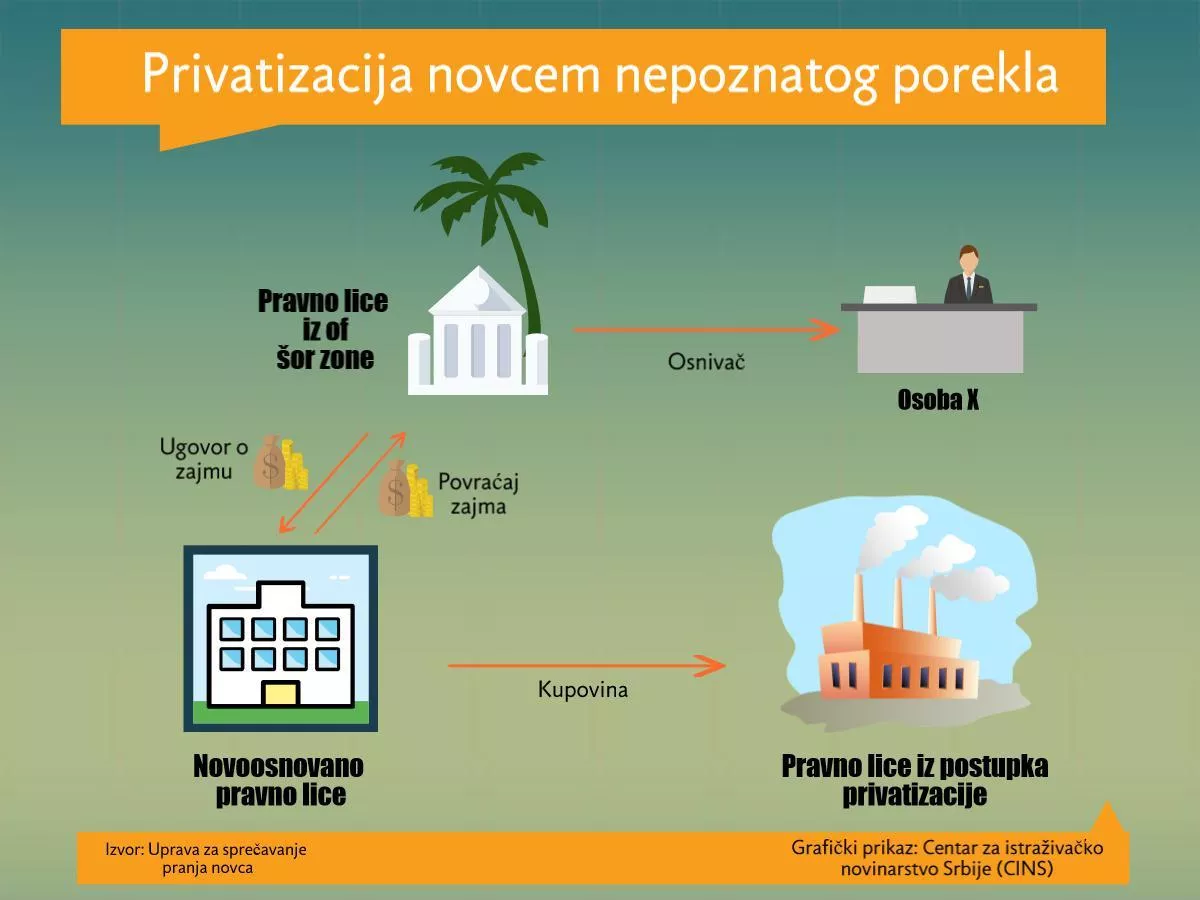
The annual report of the Administration for the Prevention of Money Laundering for 2015 states that offshore companies were used for money laundering through privatization, provision of consulting services, or introduction of money of unknown origin through real estate and consulting.
However, as in Britain, the establishment of a register and the disclosure of real owners will not solve all problems in Serbia, nor will it make the operations of offshore companies completely transparent. For example, Cyprus and the American state of Delaware, where founders of many companies registered in Serbia are located, are not on the EU blacklist.
Cyprus, a country still considered an offshore zone, was a popular destination in the 1990s when large amounts of money were transferred out of Yugoslavia. This Mediterranean island remains the most dominant place where the ownership of Serbian companies is hidden through law firms. Currently, 795 owners of Serbian companies are registered in Cyprus.
Offshore companies were also used in some money laundering cases in Serbia that ended up in court. Data from the Administration for the Prevention of Money Laundering show that since 2005, when the criminal offense of money laundering has existed, final convictions have been issued in 15 cases against 19 individuals, while 23 people have been convicted in two cases based on plea agreements.
Currently, the Prosecutor's Office for Organized Crime is conducting six proceedings for money laundering, one of which involves the use of companies from offshore destinations for the placement of illegal money – the case of Darko Šarić's criminal group.
Šarić's group managed to launder and introduce more than 20 million dollars, earned from selling cocaine, into legal channels, using companies established in Delaware by the agency Harvard Business Services.
The money was invested in the purchase of companies in privatization, real estate, and agricultural farms.
The agency Harvard Business Services, located in a prefabricated house, has registered nearly 150,000 companies at its address since 1981, alongside eight companies associated with Šarić and his associates.
In a written response to CINS, the Administration for the Prevention of Money Laundering stated that as long as there is a possibility of hiding real owners behind offshore legal entities, it "will be one of the most common ways to give the appearance of legitimacy to illegally acquired money."
Miroslava Milenović, a member of the Anti-Corruption Council, says that the new EU rules are significant because they do not prohibit offshore companies but rather introduce order into this area: "You have to disclose who the ultimate owner is, and consequently, the attractiveness of opening offshore companies will decrease and they will lose their significance."
Milenović adds that investors in Serbia have often been companies from offshore destinations such as the British Virgin Islands, Delaware, or Cyprus: "We developed this scheme of establishing companies and transferring money during the war in the nineties, and then after 2000, the economic elite used it in full swing."
Offshore companies were also used in the privatization of several companies from the well-known 24 cases of controversial privatizations and company operations. The acquisition of shares in Luka Beograd and the retail chain C market, as well as the sale of stakes in the company Večernje novosti, was carried out, among other things, through several offshore companies from Liechtenstein and Cyprus. Some of these cases are currently being investigated by the Prosecutor's Office for Organized Crime.
In 2011, CINS published a study on the secret ownership of Miroslav Mišković in Univerzal banka Beograd, which at the time was the only one of the 33 banks in Serbia where no owner held more than a 4.9 percent stake. This unusual structure was a consequence of the Banking Law, according to which, for a company to have more than 5 percent ownership in a bank, it must provide the National Bank of Serbia with information about the ultimate owner.
In the case of Univerzal banka, companies from Cyprus, the British Virgin Islands, and Belize were interconnected and operated with Mišković's Cypriot holding company Hemslade Trade Limited. At the end of 2011, four offshore companies renounced their voting rights in the bank after one of the bank's shareholders, citing CINS's research, complained to the Securities Commission about related companies owned by the bank.
Finally, in mid-2012, the National Bank of Serbia initiated a procedure to control the operations of Univerzal banka, and in 2014, it revoked its operating license, after which the bank went bankrupt.
Komentari (0)
Prijavite se za komentiranje
PrijavaJos nema komentara. Budite prvi!
Minuta
Sve →Iz drugih kategorija

High Representative Not Elected: Germans, French and British Against Americans, New Attempt at End of June

ČOVIĆ WITHOUT MERCY: How Those Who Brought Ademović to Office Created a Political Hell for Him



Sunny Saturday, quite warm



Tragedy in Albanian resort: Two minors drown












