
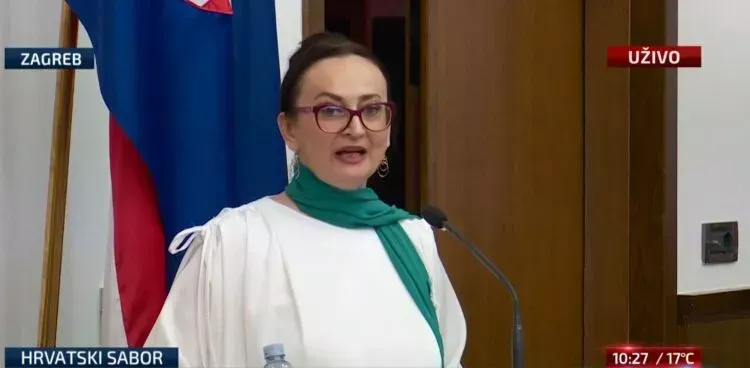
(Patria) - A commemoration for the victims of the Srebrenica genocide is being held in the Croatian Parliament on the occasion of the 29th anniversary, and one of the speakers is Esnefa Smajlović - Muhić, a Srebrenica survivor.
In an emotional address, she described what her family and fellow citizens went through during that fateful period.
“My father was killed in the genocide. I am a survivor of the genocide. How can one speak about genocide, if not through those who were fortunate enough to survive it. The genocide was not only in July 1995, it was also against Bosniak civilians in 1992, 1993, and 1994. I lived in a modest Bosniak family. I finished high school in 1991, my father had big plans for me. My father’s primary goal was for me to finish college,” Smajlović – Muhić said at the beginning of her address.
As a teenager, she hoped for a bright future.
“When the aggression against Bosnia and Herzegovina began, as a 19-year-old girl, I eagerly awaited a bright future. Suddenly, a sea of darkness appeared, war. A war that interrupted my dreams. It separated a family that was living dreams. Every generation has its trials. Many lives were violently cut short during the aggression from 1992 to 1995. It is difficult to revive the past and confront it.”
Esnefa Smajlović – Muhić continued, a period of hunger, suffering, and death followed.
“From the beginning of the aggression, everything was threatened, even the most valuable thing, life. Besides hunger, I also faced the death of my closest relatives. Death followed one after another. My husband was seriously wounded in January 1993, he was 24 years old at the time. He stood up in defense of his family, people, and homeland.”
After that, her brother Emir was wounded.
“My brother Emir, who was not yet 18 years old, was wounded. I can never forget our last meeting in the war hospital in Srebrenica; he was lying on a bed in bloody bandages. When we greeted each other, tears welled up in the corner of his eye. It is impossible to forget the smell of blood in the war hospital in Srebrenica. I still remember the last handshake and my father’s hug; that was the last time I saw him.”
Then they were transferred to Tuzla.
“On March 29, my husband, I, and several wounded soldiers were transferred to Tuzla; we were shot at multiple times. God granted us to reach our destination alive. 14 days after my arrival in Tuzla, the wounded from Srebrenica were transferred to Tuzla for treatment, including my brother Emir. After our departure, Srebrenica was declared a demilitarized zone. Our wishes and plans were to return to Srebrenica.”
“I dreamed of when I would hug my father, mother, and brother. Life went on its course even under wartime conditions. On March 6, 1994, I became a mother, giving birth to my first child, a daughter named Zemira. My father never met his granddaughter. My husband’s recovery from his wounds was slow, and then July 1995 arrived, when my people were dying, disappearing before the eyes of the whole world,” Smajlović – Muhić recounted in her emotional address.
“The cries and pleas of my people were not heard by the deaf ears of the world.
My 45th birthday had symbolism because my father Omer was killed in the genocide at the age of 45. My father was a very important figure in my life,” she said.
The Srebrenica Inferno was performed in the Croatian Parliament, concluding the commemorative gathering.
Komentari (0)
Prijavite se za komentiranje
PrijavaJos nema komentara. Budite prvi!
Minuta
Sve →Iz drugih kategorija

High Representative Not Elected: Germans, French and British Against Americans, New Attempt at End of June

ČOVIĆ WITHOUT MERCY: How Those Who Brought Ademović to Office Created a Political Hell for Him



Sunny Saturday, quite warm



Tragedy in Albanian resort: Two minors drown












