
By: Rasim Belko
Do you know who was the first foreign diplomat that former Croatian President Franjo Tuđman spoke with after his inaugural session in 1992. That first Franjo's guest recalled that conversation 18 years later, at the inauguration of Ivo Josipović. This is Christian Schmidt, today the High Representative of the international community in Bosnia and Herzegovina and an obvious admirer of Croatia and its politics. In the continuation of the text, we will also offer evidence of Schmidt's ties to Serbia, and even Russia.
So, Schmidt's ties with official Zagreb did not begin after he was appointed High Representative. These ties are much deeper and much more dangerous than we in Bosnia and Herzegovina think. However, unfortunately, most of those who call themselves leaders neither see it nor want to see it, but follow instructions and strongly defend the credibility of the increasingly incredible Schmidt.
Because how can you trust someone who is supposed to be the judge and interpreter of the peace agreement if they are biased not only towards one but towards two parties to the conflict.
At the aforementioned inauguration of Josipović, Schmidt, according to his statements, advocated for Croatia's participation in the mission in Afghanistan, as well as supported its European path.
In 2009, Schmidt, as a member of the Bundestag, participated in the General Assembly of HDZ.
In a statement dated July 7, 2009, Schmidt stated that he spoke at the Assembly in the Arena in Zagreb on July 4, 2009.
Schmidt informed the public that he met and spoke with the then Prime Minister Ivo Sanader, his deputy Jadranka Kosor, Minister of Culture and good friend Božo Biskupić, and Minister of Defense Branko Vukelić.
Due to Sanader's resignation, a few days before the HDZ Assembly, Schmidt was quite sad, and he gave a statement to the ddp agency in which he did not hide his sadness.

Schmidt regrets Sanader's departure and blames Europe for his resignation
"Schmidt expressed regret in a statement to ddp about the surprising resignation of the Croatian Prime Minister on Wednesday, July 1, 2009. According to Christian Schmidt (CSU), the surprising resignation of Croatian Prime Minister Ivo Sanader has European political reasons. 'The EU awaits Croatia, which became a member of NATO in April,' Schmidt told the ddp news agency in Berlin.
Schmidt recalled that Croatia is a good ally that is now cooperating with the German armed forces in Kosovo. The same applies to preparations for Afghanistan. Given the good experiences, Europe must do more to bring Croatia into the European community.
'Croatia is a strategically stabilizing factor in the Balkans,' Schmidt added.
Therefore, Schmidt sees the culprits for Sanader's almost forced resignation in the EU's attitude towards Croatia, not in all the scandals for which Sanader is still being prosecuted today. However, we have already understood that law is not something that is very important to Schmidt.
One question that arises based on the archives of Christian Schmidt's political opus is self-evident - is his denial by the political representatives of Republika Srpska actually a trick? Because, long before coming to BiH, Schmidt had quite strong ties with Serbia.

Schmidt in Belgrade announces military-political cooperation and assistance
He stayed in Belgrade from October 2 to 4, 2008, and at that time he spoke with everyone who mattered in the political life of Serbia at the time, except for the radical political circles. Schmidt met with the President of the Serbian Assembly Slavica Đukić-Dejanović, Prime Minister Mirko Cvetković, Deputy Prime Minister and Minister for Economic Affairs Mlađan Dinkić, and Deputy Chairman of the Defense Committee Dušan Bajatović.
During his Belgrade tour, Schmidt also exchanged views with the Chief of the General Staff of Serbia, Zdravko Ponoš, and the heads of the parliamentary groups of political parties.
According to the unanimous statements of his Serbian interlocutors, Germany was assessed as Serbia's key partner in Europe, although different views on the Kosovo issue remained clear. All interlocutors emphasized Serbia's desire for deeper cooperation in the political, economic, and military spheres. In his conversation with Chief of General Staff Ponoš, Christian Schmidt thanked Serbia for its contribution to the 'Partnership for Peace' program and offered the possibility of further training for Serbian officers in Germany as part of the transformation of the Serbian armed forces. Ponoš reported on the progress in training in Serbia, focusing on 'field training'. Significant progress would result in more and better utilization of resources and human resources. Ponoš thanked for the intensive German assistance.
On March 24, 2011, Schmidt met with Serbian State Secretary Tanja Miščević in Berlin to discuss military-political issues. Schmidt announced at the time that the German army had trained 60 members of the Serbian Army, including 16 officers in general staff training. These are the people who today command the army of the pro-Russian Putinist Aleksandar Vučić, who continuously threatens stability in the Western Balkans, in at least three countries. And this is the same army whose units committed terrible crimes, including genocide in Srebrenica. In June 2011, Schmidt was in Belgrade again, and again discussed the same topics with the military-political leadership of Serbia.
However, Schmidt also had his Russian episode. On his website from 2002, in his CV, Christian Schmidt states that he is on the board of the German-Russian Forum organization.
On the website of that organization from 2001, 2003, and 2004, there is evidence that he was on the extended board. This organization 'Deutsch - Russisches Forum' was founded in 1993, its headquarters were in Bonn, and it is now in Berlin.
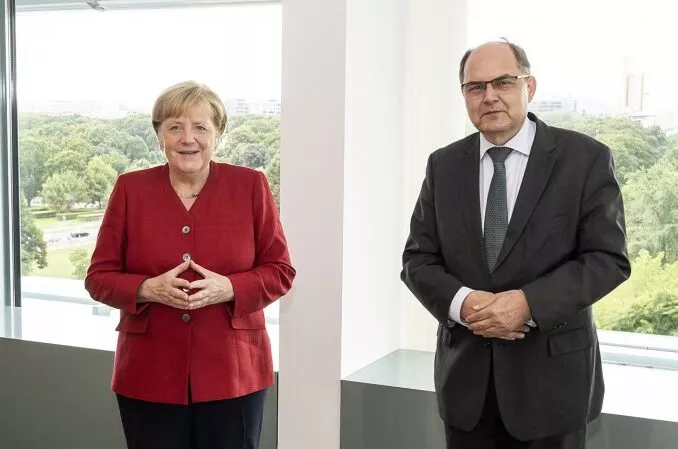
Therefore, Schmidt had excellent connections and cooperation with the official authorities of Serbia and especially Croatia. Countries that had and still have plans and intentions to partition Bosnia and Herzegovina. He pushed their EU accession projects. He did not have such relations with Bosnia and Herzegovina. Just like his boss Angela Merkel, more or less. His first visits during his mandate as High Representative were to Croatia. Before he even got to know the country where he is the supreme interpreter of the Constitution and the person who can change all flows within the country, as well as on the foreign policy level, with his decisions.

High Representative Christian Schmidt, member of the board of the German-Russian Forum (from his official biography)
How can we talk about Schmidt's credibility and impartiality after all this? Why does he have the absolute support of Great Britain and the USA after all this? Perhaps the answer lies in the fact that all three mentioned sides see Serbia and Croatia as regional partners and leaders. In that case, we don't need to be clairvoyant to know what awaits us. But, we must be perceptive and make an effort to oppose it.
Because, the democrat Christian Schmidt, with his Croatian, Serbian, and Russian connections, is no longer acceptable for the position of High Representative!
Komentari (0)
Prijavite se za komentiranje
PrijavaJos nema komentara. Budite prvi!
Minuta
Sve →Iz drugih kategorija

High Representative Not Elected: Germans, French and British Sabotaged Americans, New Attempt at End of June

ČOVIĆ WITHOUT MERCY: How Those Who Brought Ademović to Office Created a Political Hell for Him



Sunny Saturday, quite warm



Tragedy in Albanian resort: Two minors drown












