
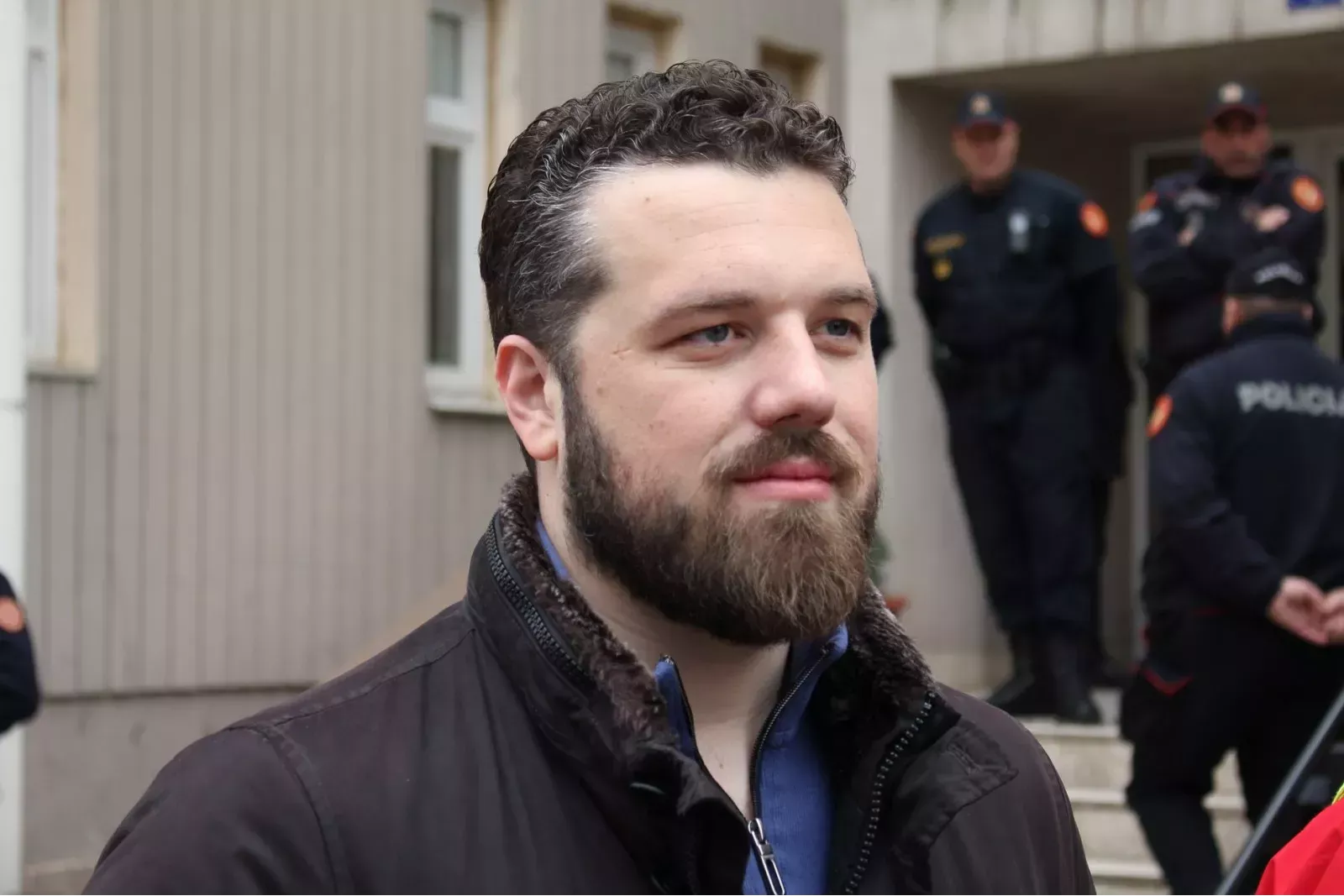
Interview by Nevena Kovačević
The session of the United Nations General Assembly where the vote on the Resolution on the genocide in Srebrenica will be held on May 23, it was officially confirmed this morning.
The Montenegrin Ministry of Foreign Affairs announced on Monday that two Montenegrin amendments had been officially submitted to the proposers of the Resolution. As a reminder, the Government adopted the decision to submit amendments at an electronic session held on May 11 in the evening. Information appeared in the media yesterday that the first Montenegrin amendment concerning
the individualization of guilt for genocide had been accepted. However, the text published today does not contain the Montenegrin amendments, which means they were not included in the final text of the resolution.
We discussed the goals the amendments are aimed at, the consequences of their potential adoption, the messages Montenegro is sending to the region and the international community, and the manipulations in the form of the announced parliamentary resolution on the genocide in Jasenovac, with Stefan Todorović, a teaching assistant at the Faculty of Montenegrin Language and Literature from Cetinje.
What are the goals of submitting Montenegrin amendments, given that the first is already contained in the text of the resolution, and the second is not essentially related to the resolution, but serves to affirm the existence of the RS, more specifically to protect the interests of Milorad Dodik?
Todorović: Half the answer is already in your question. From a legal and logical point of view, the amendments of the Government of Montenegro are meaningless, but from a political point of view, specifically from the perspective of the Greater Serbian political doctrine, they serve to cushion and anesthetize the voter base of the ruling majority in Montenegro and to ingratiate themselves with their political (Aleksandar Vučić), social (intellectual elite of Serbia), and religious (Serbian Church) patrons, whose interests they faithfully serve.
Let us recall, the largest constituent of the ruling coalition at the moment, the 'Europe Now' movement, is a product of Amfilohije's litija counter-revolution and economic experts from Belgrade, which is often overlooked and forgotten, while it is superfluous to even speak about the former members of the Democratic Front on this topic, they do not hide their subservience to Belgrade. When we talk about protecting Milorad Dodik's interests, we should recall the statement of Dodik's son, who said that he helped establish the party infrastructure of Europe Now, which has not been denied by the leading figures of that party.
The aforementioned elements are sufficient to indicate what kind of political structure this is, which verbally allegedly cherishes civic and European values, while in essence it is another derivative of Greater Serbian policy in Montenegro, skillfully camouflaged behind economic issues and EU integration. As we can see, when it comes to value-based issues, such as the Resolution or the vote for Kosovo's admission to the Council of Europe, all their talk about Europe and its values falls apart, and their true face comes to the surface.”
What message does Montenegro send to the region and international partners with such amendments, especially considering the deceptions about American and German mediation in submitting the amendments and the government's ignorant attitude after these claims were denied by the embassies of the mentioned countries?
Todorović: Montenegro is sending an image of a faltering society that has allowed itself to be led by manipulators and dilettantes unworthy of the highest state positions. Montenegro is currently led by people unworthy of its glorious past and people unprepared for the challenges of the modern world, which represents a serious threat to the peace and stability of Montenegro itself, as well as the region, at a time of dangerous geopolitical upheavals in the world.
In a Europe engulfed by war, when wise and skillful foreign and domestic policy is needed, Montenegro is led by people who, under pressure from Greater Serbian circles, are making an unprecedented gaffe towards our Western allies.
It is terrifying to even imagine how they will behave if they are in power in even more difficult geopolitical circumstances that undoubtedly lie ahead. Therefore, Montenegrin society needs to free itself from political dilettantes and economic brokers as soon as possible if it wants to get through the coming times with as few scars as possible, so that it does not happen that in the new geopolitical rearrangement, like in 1918, we lose our state and national identity.
Pro-Serbian parties, after the Prime Minister's statement that he will support the resolution on Srebrenica, are proposing the adoption of a resolution on the genocide in Jasenovac. Is this another indication of the abuse of crimes and manipulation of victims for political purposes?
Todorović: Of course it is. It would be more accurate to speak of Greater Serbian parties in Montenegro instead of pro-Serbian parties, because they have not abandoned the Greater Serbian policy formalized by the introduction of multi-party systems in the former Yugoslavia. And it is precisely this policy that does not give up on abusing crimes and manipulating victims for political purposes.
The core of the aforementioned policy is precisely the crimes and manipulation of victims on which it survives and largely holds the Serbian people hostage to a retrograde policy. Unfortunately, as long as Serbian politicians in Montenegro, Bosnia and Herzegovina, Kosovo, and Serbia do not confront Greater Serbian policy and condemn its criminal actions, we will witness various abuses of crimes and manipulations of victims like the one mentioned.
From the moment the Prime Minister announced that the government would support the resolution, the pressure from Belgrade and Banja Luka has not subsided, and the SPC has also actively joined the whole story. Andrija Mandić said at the commemoration of the victims of the crimes in Jasenovac that coalition partners are also pressuring Spajić to abandon his support for the resolution. Do you think that internal and external pressures can lead Spajić to change his stance, or do you expect Montenegro to vote for the resolution?
Todorović: Although I do not exclude the possibility that Spajić will change his decision and Montenegro will not vote for the Resolution, because, as I have already stated, these are manipulators and dilettantes who are not bound by previous promises or any moral values, I still expect Montenegro to vote for the Resolution due to the pressure from the political West.
I am deeply convinced that if there were no internal (civic) and external (Western) pressure on the current Montenegrin government, it would not vote for the Resolution, and there would be no need for any pressure from Belgrade, Banja Luka, and the Serbian Church, because the individuals who currently hold the highest state positions in Montenegro come from the ideological-political incubator of the Serbian Church and the former Bulatović, or rather Milošević's SNP in Montenegro.
Nevertheless, Montenegro's vote for the Resolution on Srebrenica will be an indicator that Montenegro has not yet completely fallen under Belgrade's rule, but the Montenegrin government's behavior on the issue of the Resolution tells us that we are well on our way to completely sinking into the mire of Greater Serbian policy, which is another alarm for Montenegrin society to strongly and uncompromisingly move towards changing this government.
After DNP's announcement about reconsidering support for Spajić's Government, do you expect that a possible reconstruction and further functioning of the executive power could be called into question?
Todorović: I don't believe so. This is another performance for the public, or rather, the aforementioned anesthetizing of the voter base. Besides, Mandić himself said in his speech regarding the suffering of Serbs in Jasenovac that although they are not attached to their positions, they seek understanding for their survival in power due to alleged higher goals, which is to prevent the return to power of someone who "discriminated and destroyed Serbianness (read: Greater Serbianness) in Montenegro."
The reason why both Mandić and Knežević will overlook the decisions on the Resolution and Kosovo's admission to the Council of Europe is that they are not sure, if they were to overthrow the government, whether they would be part of the ruling majority again in some new constellation of forces. Currently, this is too great a risk for them because Montenegrin society is not yet sufficiently deluded by Greater Serbian propaganda for something like that to be possible at this time.
Another reason is that they are currently very comfortable and at ease in power, where they strategically work without obstruction and problems to take over all vital points in Montenegro, from Elektroprivreda Crne Gore, as the strongest economic entity in the country, to the announced complete takeover of the education system.
If they also implement the announced changes to the Law on Citizenship, it will be a definitive defeat for the idea of civic Montenegro. The question is whether Montenegrin society could ever recover from this Greater Serbian blow, designed to permanently distance Montenegro from the Euro-Atlantic direction.
Komentari (0)
Prijavite se za komentiranje
PrijavaJos nema komentara. Budite prvi!
Minuta
Sve →Iz drugih kategorija

High Representative Not Elected: Germans, French and British Against Americans, New Attempt at End of June

ČOVIĆ WITHOUT MERCY: How Those Who Brought Ademović to Office Created a Political Hell for Him



Sunny Saturday, quite warm



Tragedy in Albanian resort: Two minors drown












