
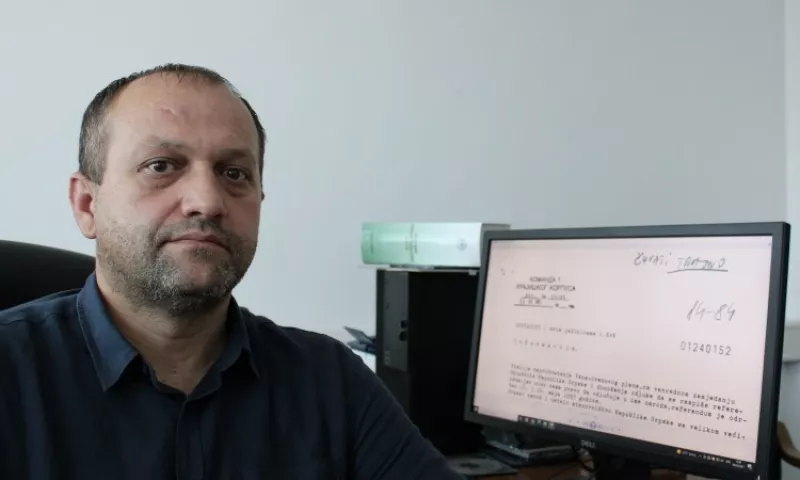
Interview by Delvin Kovač
Bosnia and Herzegovina celebrates Statehood Day today, the date when, exactly 80 years ago, the First Session of the State Anti-fascist Council of National Liberation of Bosnia and Herzegovina (ZAVNOBiH) was held. Decisions on the restoration of Bosnia and Herzegovina's statehood were made in Mrkonjić Grad on November 25, 1943.
This was the reason for a conversation with historian and senior research associate at the Institute for Research of Crimes Against Humanity and International Law of the University of Sarajevo, Amir Kliko.
Congratulating all citizens of Bosnia and Herzegovina, Kliko spoke about the significance of the First Session of ZAVNOBiH, the decisions made at that time, and our continuous struggle to preserve our only homeland, Bosnia and Herzegovina, and defend it from the frequent and incessant attacks of "neighboring occupiers".
Where is Bosnia and Herzegovina today, 80 years after the First Session of ZAVNOBiH?
Kliko: The decisions made at the First Session of ZAVNOBiH on November 25, 1943, in Mrkonjić Grad are of the utmost historical importance for our country. It is the most significant legal act in the modern history of Bosnia and Herzegovina, upon which its current independence is also based.
Bosnia and Herzegovina did not, as its enemies try to portray it, emerge in Mrkonjić Grad as a communist creation at the expense of Serbia and Croatia. Those who made these decisions 80 years ago were extremely well aware that a sovereign Bosnian state had existed in the territory of present-day Bosnia and Herzegovina several hundred years earlier, that this area was a distinct geographical entity.
Therefore, the communists did not invent BiH in 1943, but decided to restore its statehood and make it equal to the other members of the future Yugoslavia. When this resolution was adopted, it was emphasized that Bosnian Muslims would also be equal to other peoples, which enabled the resolution of the national question of Bosniaks, who had not been recognized until then and were called by various names, even considered Serbs and Croats.
Although the national question of Muslims began to be resolved at the First Session of ZAVNOBiH, the conclusions from that session in Mrkonjić Grad were not fully respected even decades later, and it was only in the 1971 census that Muslims, not only from Bosnia and Herzegovina but also from Sandžak and other Yugoslav territories, could declare themselves nationally.
The 1974 Constitution rounded off the process of their national identification as a separate nation. That Constitution also expanded the meaning of the decisions made at ZAVNOBiH, as the republics practically became states within the SFRY. This would prove particularly important 17 years later, at the end of 1991, when the process of Yugoslavia's disintegration began and the international community became involved in resolving that crisis by forming an arbitration (Badinter) commission to examine the situation in Yugoslavia.
The commission determined that Yugoslavia was not undergoing secession, but dissolution, which is a significant difference. Therefore, it proposed to the international community that all Yugoslav republics be allowed to move towards their independence. The Badinter Commission also recognized Bosnia and Herzegovina as an equal republic, and Muslims as a nation.
The international community proposed that Bosnia and Herzegovina move towards independence on the condition of a referendum of its citizens. The referendum question posed to the citizens of Bosnia and Herzegovina on February 29 and March 1, 1992, was: "Are you for a sovereign and independent Bosnia and Herzegovina, a state of equal citizens, the peoples of BiH - Muslims, Serbs, Croats, and members of other peoples living in it?". This referendum question literally asked citizens if they were for Bosnia and Herzegovina as defined by ZAVNOBiH in Mrkonjić Grad in 1943.
Bosnia and Herzegovina's path to internationally recognized independence is completely clear and legal in every segment, unlike the entity of Republika Srpska, which has been announcing secession for a long time, but has no legal basis to achieve it. What Milorad Dodik is announcing is completely different from Bosnia and Herzegovina's path to independence. The creation of RS in January 1992 was completely illegal and illegitimate, and the story of its independence has not a single legal element that anyone in the international community would support.
We are in a constant situation for the past 30-odd years of fighting for the preservation of Bosnia and Herzegovina. In fact, this has not lasted only 30 years, but since the 19th century, when autonomous principalities were formed within the Ottoman Empire – the Montenegrin and Serbian principalities, which already then showed clear intentions of territorial expansion into the territory of Bosnia and Herzegovina. From then until today, this constant struggle, the plundering of Bosnian territory by neighboring countries, has continued.
We have been living this situation for 30 years, but generations before us lived it too. Only the communists blocked these ideas for several decades with their state. More precisely, from 1945, the League of Communists of Yugoslavia interrupted this story of Serbia, Montenegro, and Croatia claiming Bosnia, i.e., the story of their mutual division of our country's territory, for 40 years. With the collapse of Yugoslavia, this story became relevant again and continues to this day.
For generations, we in Bosnia and Herzegovina have been forced to fight for the survival, territorial integrity, and independence of our country. In the last 15 years, we can say that Montenegro has no territorial ambitions towards Bosnia and Herzegovina, because part of the territory of Bosnia and Herzegovina that Montenegro desired has now gone to Republika Srpska, which is eastern Herzegovina. If it had such ambitions, they would be towards RS and eastern Herzegovina, which of course it must not even attempt due to fear of Serbia. Thus, the problem of Bosnia and Herzegovina remains only with territorial claims between Serbia and Croatia, which we experience daily.
Besides fighting external enemies, our western and eastern neighbors, in Bosnia and Herzegovina, we are also faced with internal anti-Bosnian forces that are practically outposts of these external enemies. How to deal with that?
Kliko: In the past, it has been shown that these great occupiers, first the Ottomans, then the Austro-Hungarians, and even the Germans, ruled Bosnia and Herzegovina by force of arms and their own armies, and did not need to consolidate their power here through methods of genocide, persecution, and the destruction of the local population. But these small occupiers, formerly Montenegro, and still Serbia and Croatia, do not have the strength to rule Bosnia and Herzegovina with their own armies and weapons and consolidate their power. And so, in the 19th century, they decided to nationalize some Bosnian peoples into their own nation.
Bosnian Orthodox Christians did not consider themselves Serbs until the 19th century. The Principality of Serbia first carried out the Serbification of Bosnian Orthodox Christians, and then imposed on them the idea that all Serbs should live in one state. In this way, they began to use them as a means to achieve their territorial goals in Bosnia and Herzegovina. Croatia did the same.
With the arrival of Austria-Hungary in Bosnia and Herzegovina, national influence spread from Croatia to Bosnian Catholics, although there was some resistance to Croatization among them. However, by the mid-20th century, Bosnian Catholics were Croatized, and the idea was imposed on them that they must live in the same state as Croats from Croatia.
The Independent State of Croatia (NDH) in World War II attempted to forcibly Croatize Bosnian Muslims as well, in order to impose on them the idea of unifying Bosnia and Herzegovina with Croatia. The enemies of Bosnia and Herzegovina are certain political forces in Zagreb and Belgrade, but they are forced to use a part of the BiH population against Bosnia and Herzegovina. Bosnian Serbs and Croats who seek to destroy Bosnia and Herzegovina are actually a means to achieve the great-state goals of Serbia and Croatia.
How do they do that?
Kliko: Since no nation has an absolute majority in Bosnia and Herzegovina, these small occupiers from our neighborhood strengthen the position of the nation on which they rely their policy through methods of genocide. Serbia cannot rule Bosnia and Herzegovina with the current percentage of Serbs in Bosnia and Herzegovina without committing genocide and reducing the number of the Croatian and Bosniak populations. The same applies to Croatia.
Here is an example of the NDH, which committed genocide against Serbs using Bosnian Catholics and Muslims. It could not plan its rule here long-term without demographically strengthening the nation it relied on during the occupation. And it strengthens it by using that nation to commit genocide against the problematic nation.
In the 1990s, since both Serbia and Croatia wanted to divide Bosnia and Herzegovina among themselves through local - Bosnian Serbs and Croats - the large number of Bosniaks became an obstacle. And for that reason, they resorted to methods that the whole world condemns – methods of genocide, persecution, ethnic cleansing.
How to deal with all that?
Kliko: We from Bosnia and Herzegovina cannot deal with that. Territorial pretensions from Serbia and Croatia have been ongoing for over 150 years, meaning they are strong and have continuity. It is an uninterrupted policy that has been ongoing. Frequent attempts to realize them show that it is not easy to deal with. We from Bosnia and Herzegovina cannot deal with it. The inhabitants of Bosnia and Herzegovina who are for Bosnia and Herzegovina as defined at the ZAVNOBiH session, in the referendum question, but ultimately also by the Dayton Agreement, cannot change anything.
It can change if Bosnian Serbs and Croats stop being a tool for achieving the great-state policies of Serbia and Croatia. Therefore, no one from Sarajevo can convince anyone in Banja Luka, Grude, or Livno that this is the homeland of all inhabitants of Bosnia and Herzegovina, regardless of their religious and national affiliation, and that they should support Bosnia and Herzegovina. Only those who control them can convince them, and that is Zagreb and Belgrade.
But I am sure that this will not happen, especially not in Belgrade and Serbia. In Serbia, a policy that will turn the page, sincerely support Bosnia and Herzegovina, and persuade Bosnian Serbs to accept Bosnia and Herzegovina and resolve their status within it, as one of its constituent peoples, through legal and legitimate means, will never come to power. Serbia will always strive to tear Bosnia and Herzegovina apart and claim a significant part of it for itself. This was also outlined in the past aggression from 1992-1995 with the contours of Republika Srpska.
In contrast, in Croatia, both in the government and among the population, there are always forces that support Bosnia and Herzegovina – whole, independent, as it is, and try to suggest to Bosnian Croats that they accept Bosnia and Herzegovina as their homeland.
History has shown that this can only be resolved in a repressive manner, as the communists did. They maintained it with their repressive apparatus. In Mrkonjić Grad, they defined what Bosnia and Herzegovina is, and everyone who works against such Bosnia and Herzegovina has a problem with the law and will be sanctioned. And since we have exhausted all possibilities, the only thing left for us is the international community, which has mechanisms of coercion and persuasion to solve the problem, in a similar way to how the communists did.
In March 1992, the international community firmly stated that Bosnia and Herzegovina is an internationally recognized state, we support it, and then a series of recognitions followed. However, unfortunately, everything stopped there. After the unequivocal recognition of Bosnia and Herzegovina as an independent state, the international community – although verbally – has never fundamentally stood behind the Bosnia and Herzegovina it recognized. It has its High Representative here, ambassadors, and through them, it can sanction all politicians, institutions, non-governmental organizations, and individuals who work against Bosnia and Herzegovina. Some mechanisms have already been initiated, such as the American "black list", which, however, seems to mean nothing in practice.
The international community can simply politically eliminate Milorad Dodik. If it had the will, it could resolve the situation repressively, not with gulags, as was done in Yugoslavia, but there are various forms of repression. Therefore, politicians and individuals who work against Bosnia and Herzegovina should be denied entry into their countries, denied hospitality, and their actions sanctioned in various ways. And through persuasion methods, i.e., money, by preventing investments.
If we are powerless and if everything depends on the international community, what is our fate then?
Kliko: Well, without any doubt, our near future will be the same as our long past. And that is – while we sleep, while we walk, while we work – to fight for Bosnia and Herzegovina. For the past 30 years, we have been doing this daily, each in our own way. And our future will be like that. Nothing will change unless the international community exerts pressure. And it is up to us to persevere in the fight to preserve Bosnia and Herzegovina; that is our destiny.
But it seems it is not only ours; it seems to be the destiny of Montenegrins as well. Montenegrins and Bosniaks are the only two European nations that are the majority in their countries and are the most endangered. Montenegrins, since the declaration of independence, have been constantly fighting to preserve it from nationalist and centralist forces from Serbia. And of course, Albanians in Kosovo, although the conditions are different there.
Bosnia and Herzegovina, Kosovo, and Montenegro will clearly have to invest a lot of energy in the future to preserve their state independence and territorial integrity. These three nations that care about their homelands being states must take on this task and be aware that they will have to fight this battle and pass it on to their generations.
We in Bosnia and Herzegovina are fighting to preserve our homeland as a civilized society of equal peoples, citizens, and individuals, and we must pass this fight on to our descendants. They must continue it. As long as the continuity of attacks on Bosnia and Herzegovina lasts, so must the resistance from Bosnia and Herzegovina, i.e., opposition to these occupying aspirations from the neighborhood. We must not fall.
The fact is that the political situation is such that it truly seems that those elements in Bosnia and Herzegovina who are for Bosnia and Herzegovina are now on the defensive, but that does not mean they are defeated. Because, it has been shown that the intensity of the enemy offensive awakens this Bosnian element, strengthens it, and aligns it into one echelon, one formation. And in the past, as long as the continuity of attacks on Bosnia and Herzegovina lasted, so did the continuity of resistance. It wasn't just us in the 90s who resisted the division of Bosnia and Herzegovina; generations before us also resisted it. Even these ZAVNOBiH decisions are the clearest indicator of resistance to the division of Bosnia and Herzegovina between Serbia, Montenegro, and Croatia.
We who are now fighting for Bosnia and Herzegovina have received this fight as an inheritance from our previous generations. As long as the attacks on Bosnia and Herzegovina continue, the resistance to these attacks must also continue. It is our obligation to teach the generations we are now bringing into the world to fight for Bosnia and Herzegovina in peacetime through diplomatic, political, and various other means, and God forbid, not to fight in war as we did.
We must not give up before those who work against Bosnia and Herzegovina. And it seems to me that they have now figured out how to throw a bone into the corpus of those who are for Bosnia and Herzegovina, so that we exhaust ourselves among ourselves, and then they would triumphantly enter an empty battlefield. This must not happen.
Komentari (0)
Prijavite se za komentiranje
PrijavaJos nema komentara. Budite prvi!
Minuta
Sve →Iz drugih kategorija

High Representative Not Elected: Germans, French and British Against Americans, New Attempt at End of June

ČOVIĆ WITHOUT MERCY: How Those Who Brought Ademović to Office Created a Political Hell for Him



Sunny Saturday, quite warm



Tragedy in Albanian resort: Two minors drown












