
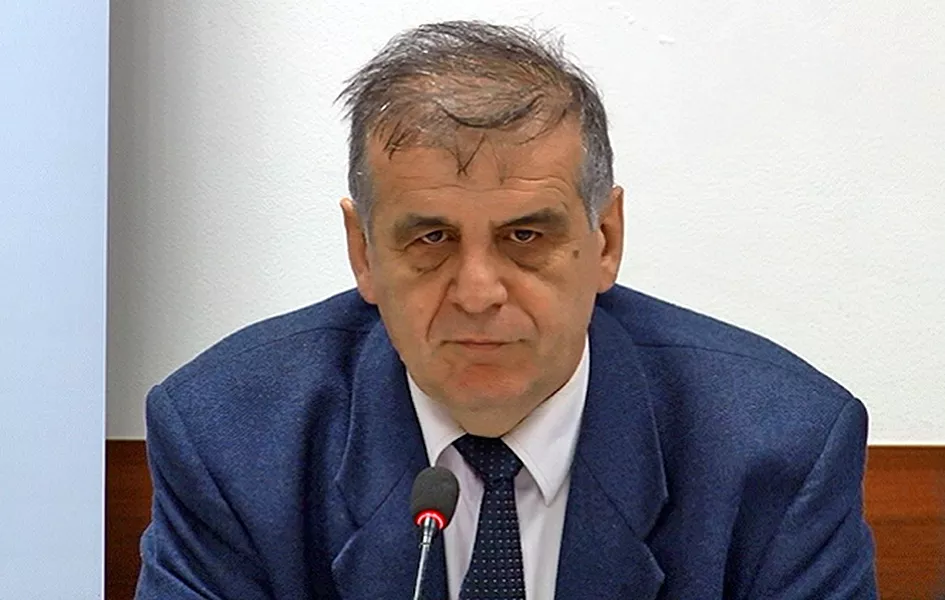
(Patria) - The Serbian intellectual elite sensed global geopolitical changes when they wrote the famous memorandum in 1986, but the guidelines of that memorandum were disastrous not only for neighbouring peoples but also for the Serbian people themselves. The guidelines of that memorandum were the basis of Slobodan Milošević's policy, which the current political leadership of Serbia has not renounced either. The difference is that Milošević tried to implement those guidelines brutally through ethnic cleansing, while the current political leadership of Serbia does so through a sophisticated policy that the West has tolerated so far, said Prof. Dr. Nexhmedin Spahiu from the Faculty of Political Sciences in Pristina, speaking at today's session of Krug 99.
"From the fall of Milošević's regime until now, the policy of the carrot, not the stick, has been applied towards Serbia. The results have been minimal. After the outbreak of the war in Ukraine, the West's policy towards Serbia is changing. In fact, since Vladimir Putin came to power, in all hotspots around the world where the West and Russia were behind the scenes, Russia was the winner. This applies to Afghanistan, Iraq, Syria, Lebanon, Libya, Kazakhstan, and elsewhere. Ukraine has become too big a bite for Russia, and for almost a year now, Russia has been in great trouble.
Serbia, which has pursued a policy between the West and Russia for almost two centuries, is also in great trouble. In 1844, the then Minister of Internal Affairs of Serbia, and later Minister of Foreign Affairs, and twice Prime Minister of Serbia, Ilija Garašanin, outlined the guidelines of Serbian foreign policy between Russia and the West. This policy has, over time, sometimes yielded more and sometimes less fruit, but it has always been the foundation for Serbia's political class. It was most fruitful during the time when the Serbian state—called Yugoslavia—was led by the Croat Tito, and most disastrous so far when the Serbian state was led by Milošević.
The war in Ukraine and Western pressure on Serbia are putting Serbia's policy to a great test. Either to renounce its centuries-old policy or to confront the West. If Serbia decides to oppose the West, war will flare up again in the Western Balkans. There are two potential battlefields: Kosovo and/or Bosnia. In my opinion, in that case, it will be Kosovo. Negotiations with Kosovo are ongoing, and it will be shown there whether Serbia will abandon its centuries-old policy and turn a new page or enter into armed conflicts, first with Kosovo and then, in a further phase, with NATO.
Bosnia's intellectual elite should consider how Bosnia will behave in both cases. That is, in the case that Serbia yields to the West and Western values, and in the case that it decides to oppose them. In both cases, it will be a test for Bosnia. The test for Kosovo is not only in relations with Serbia but also with Albania. Since the Balkan Wars of 1912-1913, when Serbia conquered Kosovo, the Novi Pazar Sandžak, and North Macedonia, and Albania became independent, relations between Kosovo and Albanian politicians have been mostly conflictual. During the First World War, the most influential politician in Albania was Esat Pasha Toptani. He was in conflict with Hasan Prishtina, Kadri Prishtina, Bajram Curri, Rexhep Mitrovica, Dervish Mitrovica, Ajdin Draga, Bedri Pejani, and others who represented the Kosovo political elite. Esad Pasha Toptani was considered a friend of Serbia, who enabled the Serbian king, government, and army to retreat through Albania to Corfu.
Between the two world wars, the most powerful politician in Albania was King Zog. He physically liquidated Bajram Curri, Elez Isufi, Hasan Prishtina, and forced Dervish Mitrovica, Rexhep Mitrovica, Bedri Pejani, and many others to flee Albania.
During the Second World War, especially in 1943-44, the government in Tirana was held by politicians from Kosovo, but this caused a civil war in Albania. Serbian communists created the Communist Party of Albania in November 1941. Albanian communists were mostly concentrated in southern Albania, where Orthodox Albanians live, although among the communists there were also those of Muslim and Catholic origin. In 1945, there were only 20 communists of Albanian origin in Kosovo.
The victory of the communists in the civil war in Albania made it possible for Kosovo, through the Prizren Assembly in July 1945, to secede from Albania (to which it had been annexed in 1941) and be annexed to Serbia, i.e., Yugoslavia. When this act of annexation of Kosovo to Serbia was confirmed, the building where the assembly was held was surrounded by partisans from Albania.
However, the darkest episode in relations between Tirana and Pristina comes after the death of Josip Broz Tito, that is, with the Kosovo demonstrations in 1981. The essence of these events is the flirtation between Belgrade and Tirana over the abolition of Kosovo's autonomy. After the democratization of Albania, we have a conflict between President Sali Berisha and Ibrahim Rugova, and after the Kosovo war, between Edi Rama and Ramush Haradinaj, and between Edi Rama and Albin Kurti.
In the verbal conflicts between Albin Kurti and Aleksandar Vučić, Edi Rama has more often sided with Vučić than with Kurti. These historical facts are an indicator of the creation of a Kosovo national identity that will develop even more strongly with Kosovo's membership in international organizations (except perhaps the UN, due to the presumed Russian veto), which is to be expected with the development of geopolitical movements caused by the war in Ukraine.
In Kosovo's national interest, it is currently important to develop relations with Bosnia, Montenegro, and Macedonia, which could be much better. With all understanding for the position of constitutionally constrained Bosnia and Herzegovina, relations between Bosniaks and Kosovars could be much better and more fruitful.
Maintaining Đukanović's rule in Montenegro is an important matter, both for Kosovo and for Bosnia. Macedonia does not border Bosnia, but the democratic order and civil approach of the current Macedonian president and the Macedonian government can always serve as an example for Bosnia, and even more so for Kosovo as its important neighbor.
And finally, creating a spirit of understanding and cooperation among all others in the Western Balkans will also help Serbia, as the most powerful state, to sober up from its imperial policy towards its neighbors," concludes Spahiu.
Komentari (0)
Prijavite se za komentiranje
PrijavaJos nema komentara. Budite prvi!
Minuta
Sve →Iz drugih kategorija

High Representative Not Elected: Germans, French and British Sabotaged Americans, New Attempt at End of June

ČOVIĆ WITHOUT MERCY: How Those Who Brought Ademović to Office Created a Political Hell for Him



Sunny Saturday, quite warm



Tragedy in Albanian resort: Two minors drown












