
By: Prof. Dr. Hazim Bašić, member of the Presidency of Krug 99
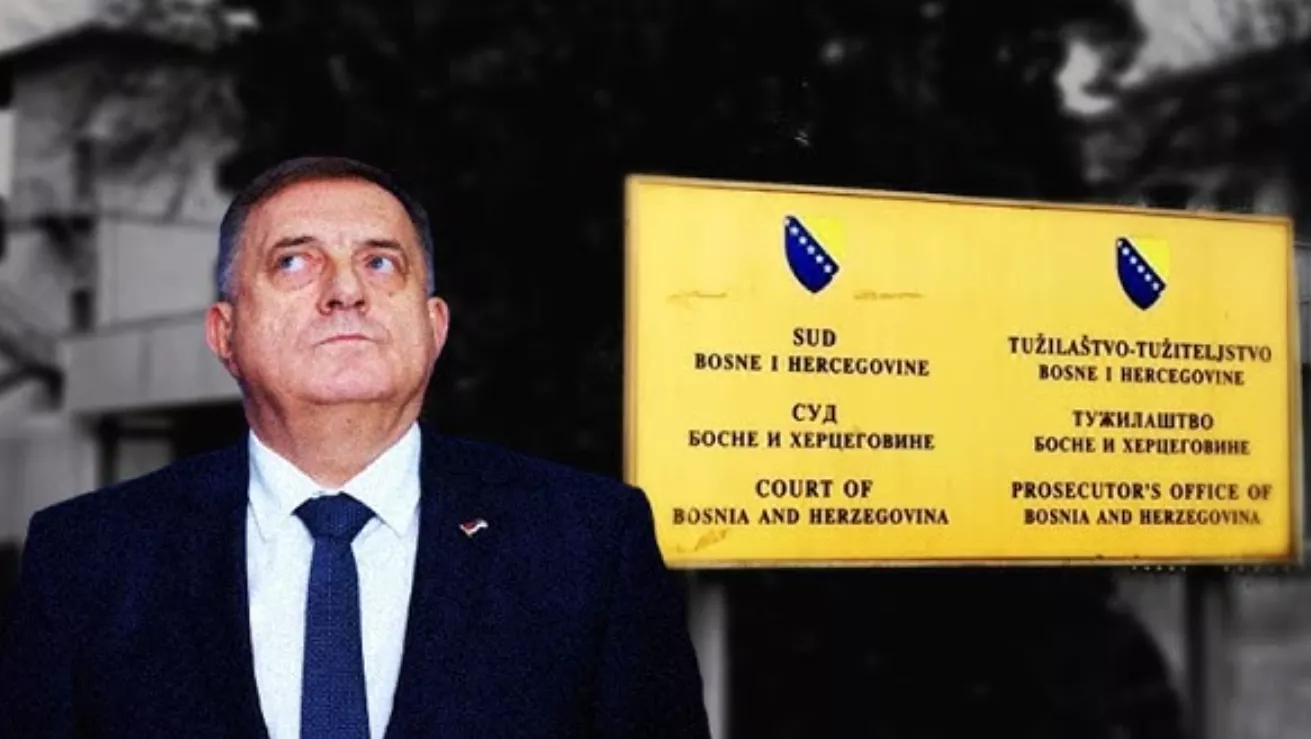
The announcement of the final verdict and the revocation of the mandate of RS President M. Dodik have sparked broad political and legal debates beyond the borders of Bosnia and Herzegovina. Scant support for the convicted comes from a few autocrats like Vučić and Orban, and there is also the expected support from Russia.
The worn-out rhetoric that this is a verdict against the entity or even against the 'entire Serbian people' (the notorious I. Dačić, the notorious A. Brnabić, and the notorious ambassador M. Đurić) is exhausted and intellectually empty. Criminal verdicts always affect individuals, not collectives. In this case, the individual is the entity president who has continuously undermined the Dayton Peace Agreement and knowingly violated state laws. Incidentally, he is on the US black list and under sanctions from several European countries.
The main actor in this story, perhaps to gauge the pulse of the public and opposition political parties, launches new ideas for his salvation daily: a general protest, the formation of a 'government of national unity', a referendum on the court decision (!?), blocking the European path (which has been realistically blocked for years), leaving institutions...
A series of offensive messages towards Bosniaks was not absent, some of which have elements of fascism at their root, and the final one read: "All this is done by Muslims (because they are Muslims) to us Serbs (because we are Serbs).".
Serbia's National Security Council as a legal arbiter in BiH?
The most dangerous precedent from institutional Belgrade in the form of a political assassination comes from the National Security Council (SNB) of Serbia. This Council, which is part of the executive branch, presumes to comment on the judicial verdict of another sovereign state. This is an act of political aggression where the SNB wishes to arbitrate in the judicial affairs of BiH. This is not the first time that Vučić, by misusing the SNB as his pocket joker, has crossed the borders of good neighborly relations and brutally interfered in the sovereignty of Bosnia and Herzegovina.
Similarly, Russia every now and then calls for some consultations at the UN Security Council regarding the 'situation in Bosnia and Herzegovina'. The common denominator of Serbian and Russian policies is the effort to turn a legal procedure into a 'situation', an escalation, a crisis in which they would be the bearers of 'de-escalation'.
Vučić's reaction, imbued with recognizable pathos and generalization, attempts to equate Dodik with the entire Serbian people and the verdict with an attack on the entity. His discourse implies that there must be people in BiH who are above the law, which is nothing other than a continuation of the same pattern that Vučić has been applying in Serbia for years. Where he rules, the judiciary is subordinate to political interests, and criminal affairs are not processed but covered up. This is also the cause of the almost continuous eight-month student protests in Serbia.
Vučić, preoccupied with his own political survival, seems to only verbally mourn Dodik's fate. Behind the scenes, the Russian agency has already done important work for him - it has cushioned the student revolt by introducing anti-Western and pro-Russian elements that have distorted the initial noble student demands. In such a context, shifting the focus to Bosnia and Herzegovina is welcome. Vučić does not hesitate to use this case for new rounds of nationalist mobilization.
In Serbia, there is currently no potential or will for the rule of law, so Vučić cannot accept when it begins to be established in BiH. Therefore, Serbia still faces the question: where does the interest of a hegemonic authoritarian regime end, and where does respect for the sovereignty of a neighboring country begin?
The Verdict as an Opportunity
Paradoxically, this verdict benefits the citizens of RS - it liberates them, at least symbolically, from years of tyranny, systemic corruption, and autocratic rule that has led the entity to political, economic, demographic, and moral collapse. Citizens of RS may for the first time have a legally articulated confirmation that no one is above the law, not even Dodik. The verdict, therefore, is not a blow to the entity, but to corruption, impunity, and political usurpation of rights.
The sovereignty of a state is reflected precisely in its ability to judge its citizens. The borders of a state's sovereignty are defended today by the judicial system. The verdict against Dodik has shown the institutional capacity to implement state will. However, the real strength of BiH institutions will only be measured in the phase of enforcing the verdict. The implementation of this verdict will mark an important moment in the recent political and legal history of Bosnia and Herzegovina.
Ultimately, the verdict against Dodik is a legal, but also a deeply political fact. It also represents a potential turning point for the opposition in RS, which has a historic opportunity to position itself as an alternative to the politics of fear, isolation, arrogance, and the spread of inter-ethnic hatred. This is precisely what the citizens who participate in the extraordinary elections will decide. If opposition political parties decide to boycott the extraordinary elections, they do not need to participate in the regular elections next year either, because in that case, the election winner will be known anyway.
Komentari (0)
Prijavite se za komentiranje
PrijavaJos nema komentara. Budite prvi!
Minuta
Sve →Iz drugih kategorija

High Representative Not Elected: Germans, French and British Against Americans, New Attempt at End of June

ČOVIĆ WITHOUT MERCY: How Those Who Brought Ademović to Office Created a Political Hell for Him



Sunny Saturday, quite warm



Tragedy in Albanian resort: Two minors drown












