
By: A. Čorbo-Zećo
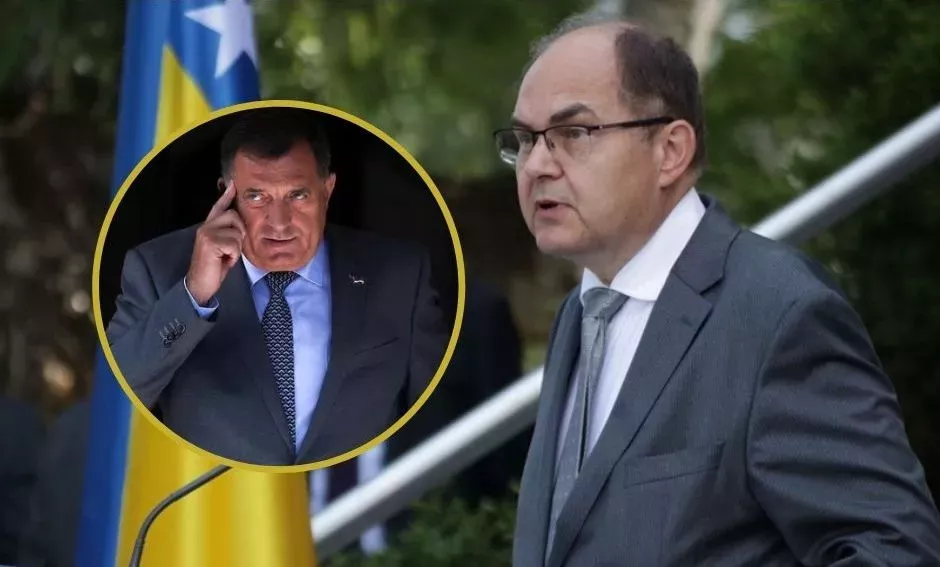
In the talks that High Representative Christian Schmidt held today in Brussels, he emphasized that the implementation of the Dayton Peace Agreement and EU integration are not mutually exclusive or contradictory processes.
On the contrary, Schmidt claims, they complement each other and strengthen common progress. He explained that maintaining instruments for preserving the Dayton Peace Agreement is crucial for curbing secessionist activities and anti-Dayton behavior.
At the same time as Schmidt was holding such talks in Brussels, Milorad Dodik, the President of Republika Srpska, stated on social media that the issue of property is not and will not be a topic.
"That issue was resolved by the Dayton Agreement and the Constitution. The OHR has nothing to assess, except perhaps its closure, which is a condition for further progress of BiH towards the EU," Dodik said.
At first glance, these might seem like opposing statements, but in essence, both, Schmidt's and Dodik's, carry a common message – the Dayton Peace Agreement is a permanent category, and Bosnia and Herzegovina can move within that framework.
Regardless of the fact that half the world sees this agreement, which was also called temporary, as outdated and retrograde, meaning it needs an upgrade. But even the US administration, which most advocated for changes to the DMS, has suddenly fallen silent, and the words of the former High Representative in BiH, Valentin Inzko, who said that "The Dayton Agreement brought peace, but it is not the end, peace is just a starting point," have long been forgotten.
But perhaps it is not so strange that Dodik and Schmidt 'touch upon' opinions if it is known that they allegedly held a meeting near Derventa two or three days ago. The OHR did not respond to Patria's inquiry about the reason for the meeting, and Branislav Borenović hinted at something about it in the show Istraga when he said that there are rumors that Dodik allegedly secretly met with Schmidt, whom, incidentally, he does not recognize.
But obviously, with rakija, an agreement is easily reached. However, it is worth keeping a close eye on state property, for which Schmidt has stated for years that he would 'take action very soon'.
That 'very soon' is still ongoing, and thus the danger to BiH and its property, which Dodik wants to register to the entity at all costs, is increasing. Experts have also repeatedly pointed out that the change of titleholder of state property and public goods cannot be done through legal regulations, given that this issue is a constitutional matter.
Legally, it is only possible to define the conditions for acquiring the right of use over these legal goods by lower administrative-territorial and political units within BiH.
And regardless of the invocation of the Dayton Peace Agreement by both Dodik and Schmidt, the state that was the titleholder of state property in 1990, and which preserved its state-legal identity and continuity, remains the titleholder of that property even after 1995.
In that sense, everything that constituted public goods and state property (RBiH) remained under the same legal regime even after the BiH Constitution came into force.
Dodik certainly knows this, but he is playing a trick and literally sticking to Dayton when it suits him, and we are all used to that, but the question is what Schmidt represents in Brussels now and what his messages mean in the context of resolving the issue of state property, if he too will blindly adhere to the Dayton Peace Agreement.
Komentari (0)
Prijavite se za komentiranje
PrijavaJos nema komentara. Budite prvi!
Minuta
Sve →Iz drugih kategorija

High Representative Not Elected: Germans, French and British Against Americans, New Attempt at End of June

ČOVIĆ WITHOUT MERCY: How Those Who Brought Ademović to Office Created a Political Hell for Him



Sunny Saturday, quite warm



Tragedy in Albanian resort: Two minors drown












