
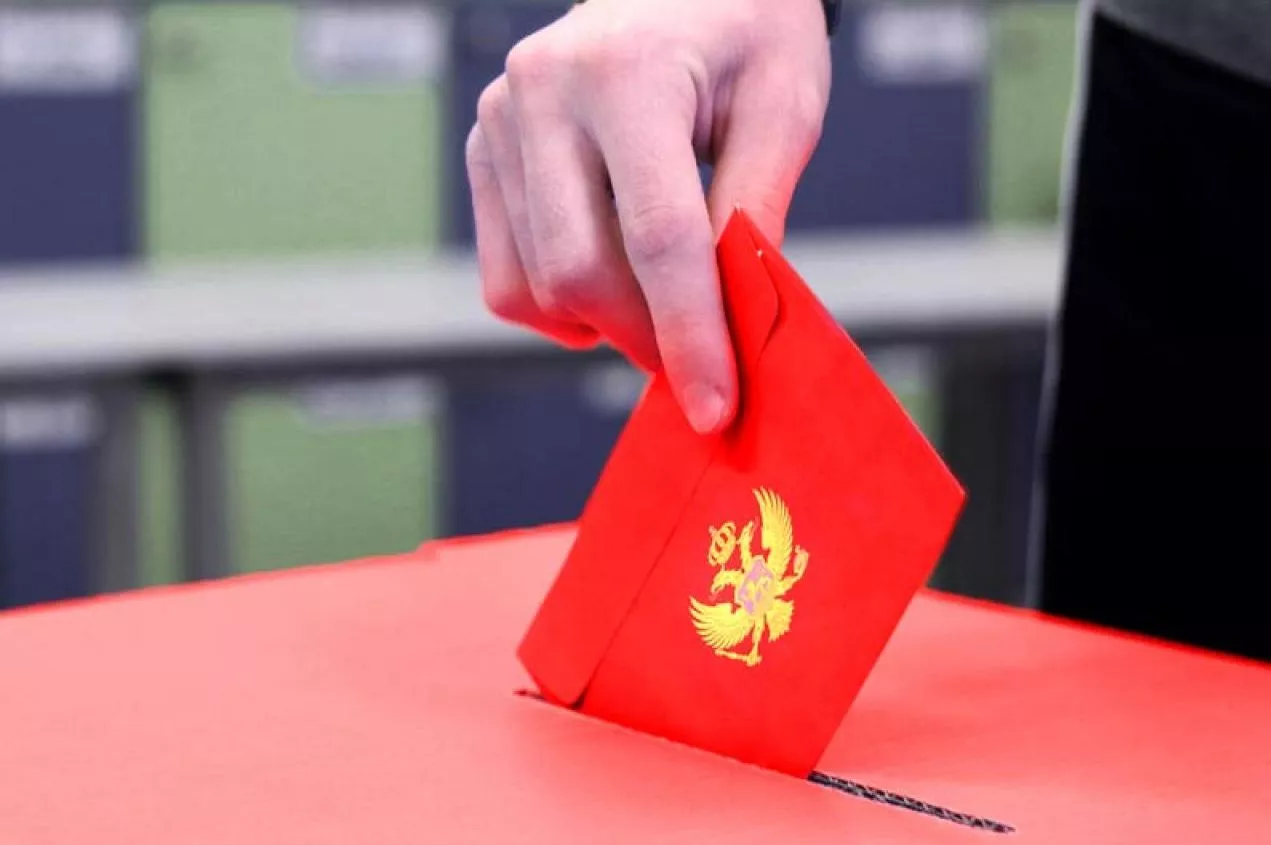
The campaign for the presidential elections to be held in Montenegro on March 19 has largely begun.
It could be said that the campaign started even before the official submission of all candidacies, considering the case of dual citizenship of the leader of Europe Now, Milojko Spajić.
Analyzing this case, it is clear that the State Election Commission acted contrary to its authority by contacting the Republican Election Commission of Serbia and requesting data on Spajić's residence, as well as its subsequent actions, when his candidacy was rejected, even though there was no confirmation from the Ministry of Internal Affairs that proceedings had been initiated to revoke Montenegrin citizenship, which would have been the only valid basis for rejecting the candidacy from a legal standpoint.
Such selective action raises the question of why the State Election Commission and the Ministry of Internal Affairs have not conducted such checks in previous election cycles for years.
Andrija Mandić, the candidate of the Democratic Front, reiterated in his appearance on Vijesti television last night that he holds Serbian citizenship, without wishing to reveal when he acquired it, which he had publicly stated before, but his candidacy was immediately confirmed, without a detailed check of the claims regarding dual citizenship.
Although the State Election Commission undoubtedly made a political decision in Spajić's case, it is much more problematic that the leader of PES, during his tenure as minister in Zdravko Krivokapić's government, grossly misled the Montenegrin public, claiming that he did not have residence in Serbia, and therefore no Serbian citizenship. Instead of Spajić, who continued to mislead the public, the current candidate of the Europe Now movement, Jakov Milatović, apologized to the citizens, who, by submitting his presidential candidacy, gave up his position as mayor of Podgorica.
The names of individual party candidates are not surprising, given the current political and social situation in which the country finds itself, as well as the lack of unity among parties that share similar values.
On one side is the so-called pro-Montenegrin bloc with two candidates, Draginja Vuksanović Stanković, candidate of the Social Democratic Party, and Milo Đukanović, the current president of the country and leader of the Democratic Party of Socialists.
On the other side are the center-right candidates, Andrija Mandić for the Democratic Front and Goran Danilović for United Montenegro, while on the third side, we have candidates who present themselves as the civic center, Jakov Milatović and the leader of the Democratic Montenegro, Aleksa Bečić.
How to defeat Đukanović
If we consider the messages that the presidential candidates are sending us, it can be said that all constituents of the old-new parliamentary majority have only one goal this time as well - to defeat Milo Đukanović.
Except for the candidate of the Social Democratic Party, all candidates have perceived these elections exclusively as a fight against Đukanović and his DPS. The question is - if Đukanović had not run, what would the presidential campaign of the winners of 2020 have been about.
Although Đukanović's candidacy did not surprise the public, his opponents, even before the official decision of the Democratic Party of Socialists, opted for an extremely negative campaign focused on the narrative of the repeated defeat of the thirty-year regime, in which some local and regional media, close to Serbian President Aleksandar Vučić, have been participating for months. The same message comes from the right and the so-called civic center, without knowledge of the constitutional powers of the president and with a lack of a clear vision of the path the president should lead Montenegro on, in light of the complete collapse of the institutional order and the country's deviation from the European agenda.
Another common thread connecting the campaigns of the right and center is the insistence on reconciliation, a narrative that has pushed Montenegro into a political dead end, embodied in ever deeper divisions and an unprecedented government crisis. Despite the polished rhetoric, it is hard for anyone in this country to believe that Andrija Mandić has been reborn and has overnight become a benevolent democrat and European supporter of Montenegro's stay in NATO and its membership in the European Union.
The political and ideological profile of Andrija Mandić and his allies is so exposed that even the world's greatest experts would not help them in their attempt to change public perception of Mandić's character and work through an absurd electoral strategy. Let's recall some of the most recent examples of pro-European actions by Mandić and his party colleagues. Not so long ago, Andrija Mandić, from his position as a member of parliament, called for help from his wartime comrades from the 90s and spoke about arming and warfare from the parliamentary podium, and in mid-December, his party colleagues knelt before Milica Zavetnica in Belgrade, glorifying the Serbian government and humiliating the country in which they were born and in which, unfortunately, they rose to high public office.
Can Andrija Mandić, who does not recognize the genocide in Srebrenica, glorifies the aggressor Vladimir Putin, burns NATO flags, and longs for the creation of a Serb-Russian world, appear to any average citizen as an ideal presidential candidate, ready to switch from a Chetnik ideology to one of freedom and anti-fascism?
And the situation is not much different when we talk about the rest of the liberators, the so-called center parties. Let's recall that Milojko Spajić and Jakov Milatović, and the Europe Now program, are the product of the unsuccessful experiment of the apostolic government, formed in a monastery, under the patronage of the clergy of the Serbian Orthodox Church, and that, while holding ministerial positions, they explicitly supported the actions of the SPC, especially during the enthronement of Metropolitan Joanikije in Cetinje.
The overly ambitious leaders of Europe Now are also using this campaign to convince citizens that the president, just like the mayor of Podgorica back then, will increase their salaries and pensions, even though this is not within the jurisdiction of either.
And Aleksa Bečić's Democrats, who so bravely swear by honor and integrity, have flawlessly squandered every opportunity to prove through actions the superiority of their civic and pro-European commitment, the latest example being their refusal to support the dismissals of municipal presidents and assemblies who reported to Zavetnica in Belgrade.
Therefore - there is no civic center on the political scene of Montenegro, and any classification of the aforementioned parties into this group is detrimental to the national and strategic interests of Montenegro.
Because - at least once, the civic orientation should have prevailed over the civic center, instead of unreserved adherence to the radical right, in order to gain positions of power.
Foreign influences: Serbia and Russia's interference in the electoral process
Foreign interference in Montenegro's electoral processes is not new. Russia has been one of the key financiers of the Democratic Front since 2014. The most obvious example is certainly the 2016 coup attempt, in the preparation of which Serbian and Russian citizens participated, with the help of Democratic Front leaders Andrija Mandić and Milan Knežević. Russia, using soft power, manages to exert significant influence on the outcome of electoral processes, the scope of which is often not taken seriously.
A disorganized voter list, a strong financial and ideological propaganda machine, and a large number of media outlets under foreign ownership are just some of the factors that facilitate the strong influence of Serbia and Russia in electoral processes. The strongest tool of Russian-Serbian influence remains the Serbian Orthodox Church, whose ideological activity was crucial to the outcome of the last parliamentary elections. Bishop Metodije of Budimlja-Nikšić recently appeared at Andrija Mandić's campaign, which means that Mandić is the candidate who enjoys the church's support and on whose campaign intensive activity of propaganda means and Russian intelligence services will be focused.
The fact that Prime Minister Abazović, by replacing Savo Kentera as director of the National Security Agency, blocked the exposure of the Russian spy network, effectively gives the impression that Russian intelligence structures in Montenegro are untouchable.
And Serbia will not lag behind in financially supporting Mandić's campaign, as it was announced at the controversial session of the Committee for Diaspora and Serbs in the Region that there would be three times more financial resources for Serbian organizations compared to last year.
Will there be a second round?
From a political science perspective, it can be concluded that a second round is almost inevitable, primarily due to the fact that there will be a certain scattering of votes within the blocs. The decision of Democrats and Europe Now to run with individual candidates due to the inability to reach an agreement reduces the chances of their candidates entering the second round, which would have been a very real option if they had decided to run together.
There will inevitably be a scattering of votes within the so-called sovereignist bloc as well, as an agreement on a joint candidate has not been reached.
The results of the last local elections showed us that the Democratic Party of Socialists and the Democratic Front are still individually the strongest entities, so Đukanović's and Mandić's entry into the second round is probably the most realistic option. The question is, however, whether in this case, a part of the sovereignist bloc's voters will support Đukanović in the second round, given the absence of substantive internal party reforms, the price of which the entire sovereignist bloc paid with defeat in the Podgorica elections. Although the role of the president is defined as predominantly ceremonial by the Constitution, in the new circumstances, it is very significant for Montenegro. The duty of the president is not to reconcile us and increase salaries, but to determine, at a crucial moment, the strategic direction of state and international policy that the country will follow.
The election of a president must be the beginning of the process of rebuilding a civic and democratic society and a path towards establishing stable institutions, which will be completed in early parliamentary elections. Otherwise, the country's resilience to the influences of imperialist policies will be brought to the breaking point.
Just as we have not forgotten the corruption, nepotism, and other shortcomings of the DPS regime, we must by no means forget the participation of all the liberator candidates in undermining state sovereignty and completely undermining institutional action, and trampling on the constitutional principles of a secular, civic, and anti-fascist Montenegro. Boycott is certainly the worst choice, because voters are the only ones who can, through rational decision-making, return the country to a stable path.
For the parties, it is a measure of strength before the parliamentary elections, for the leaders, a test of leadership confirmation, and for the country, a test of democratic capacity and resistance to pressure and detrimental foreign influences.
Komentari (0)
Prijavite se za komentiranje
PrijavaJos nema komentara. Budite prvi!
Minuta
Sve →Iz drugih kategorija

High Representative Not Elected: Germans, French and British Sabotaged Americans, New Attempt at End of June

ČOVIĆ WITHOUT MERCY: How Those Who Brought Ademović to Office Created a Political Hell for Him



Sunny Saturday, quite warm



Tragedy in Albanian resort: Two minors drown












