
By: Rasim Belko
There is no discussion about the future of the OHR Office in Bosnia and Herzegovina without Bosniak politicians loudly proclaiming that our country needs this protectorate institution and that its departure would bring about difficult times.
There are several reasons for such a unanimous stance and persistence in defending an institution with which Bosnia and Herzegovina has neither a European nor a NATO future, which is declaratively the top priority in Bosniak politics.
In essence, the reason is the fact that for everything they have done poorly over the past three decades, and for everything they fail to do because they don't know how or don't care, they have an excuse in the OHR. Because, while they subserviently relate to aggressive Serb-Croat politics, the OHR is their imagined support, which they almost routinely invoke to solve problems for which they are well paid. So well paid that their Western European colleagues envy them.
The political conformism of Bosniak politics is part of those retrograde forces that are pulling Bosnia and Herzegovina towards Dayton instead of Brussels. And no, I am not writing this for them to argue about it in the election campaign, because the campaign here never stops, but rather to finally establish the correct therapy, along with the continuous diagnosis in public.
From the establishment of the OHR to the present day, High Representatives, in their vassal decisions, have acted against one of the three policies, sometimes against two, but never were all three sides satisfied. And while the OHR made sense in the years when it had military power behind it, that concept is superfluous today for a country that wants to turn over a new leaf and move towards integration into Western alliances.
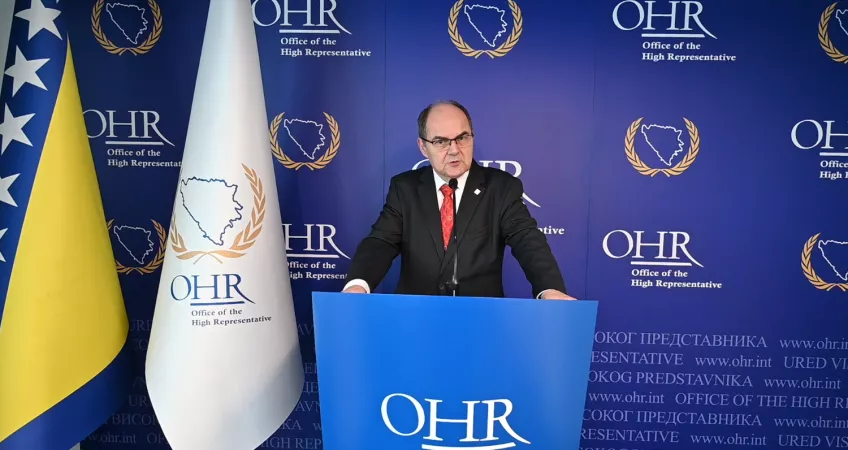
Christian Schmidt's moves in 2022 and 2023 were already a clear indication that the OHR is no longer just an institute for monitoring and implementing the Dayton Peace Agreement, but has become a retrograde element that is introducing apartheid into an EU aspirant. But even then, conformist Bosniak politics was not ready for even a minimum of risk and utilization of the opportunities that arose from such actions by the OHR.
Today, Serb politics, with Russian-Chinese backing, is leading a serious offensive against the OHR, and of course, no one is naive enough to believe that they are doing this for the sake of the state. However, in the case of the OHR, Bosniak politics should not follow the slogan "if it's bad for them, it's good for us," because just three years ago they witnessed that when it is bad for Bosniaks, the OHR is dangerous for their political survival in the institutions of the state in which they are the majority.
World powers will evidently decide on the fate of the OHR again, as the departure of Christian Schmidt is being mentioned more and more loudly, and Russia and China, as I said, are already preparing an offensive at the international level.
Therefore, it is time for forces and wisdom to be found within the Bosniak political spectrum that will, in such a situation, try to achieve a solution that will benefit the state of Bosnia and Herzegovina, not anti-state policies.
Talks about the potential destabilization of Bosnia and Herzegovina with the departure of the OHR are an increasingly weak argument, especially at a time when it is difficult to define which part of the world is stable today, whether due to war conflicts or due to the energy and economic crisis.
Therefore, one of the possibilities that Bosniak politics will advocate for, after abandoning its conformist position, would be to trade the closure of the OHR for NATO membership status and a more favorable position regarding the European Union.
There are quite enough arguments for such an approach, as there are plenty of examples of NATO and EU member states that were overlooked to be drawn into these alliances. For example, Eastern European countries joined NATO ahead of schedule and with far fewer conditions than what is required of BiH, while, for instance, Croatia was drawn into the EU without resolving the issue of its external borders and some other points that are now imposed on us as obstacles.
But none of this will happen with futile pronouncements that mean nothing to anyone. That political conformism has brought us to the brink of a situation where pro-Russian Milorad Dodik and his partner, no less pro-Russian Dragan Čović, will take complete control of Bosnia and Herzegovina.
If anyone doesn't believe this, let them look at the situation with the Southern Interconnection. Čović rejected this project due to state elements during the time of American Democrats, his party voted against it in the FBiH Parliament, and then he agreed with the Americans that the state would not be involved in this project except in a formal capacity, and the project is now in the phase of bilateral negotiations with Croatia.
There is no need to talk about Dodik's policy and his takeover of state levers; all institutions led by his cadres are successfully acting subversively and expanding their influence.
Therefore, if they do not move from their conformist position, Bosniak politicians will soon become an irrelevant factor, and in such a situation, they should not be surprised by the phenomenon that is already visible these days, which is that Bosniaks are publicly saying they will vote for Čović's cadres, even though they have Bosniak candidates for the same position within their own ranks.
Enough said!
Komentari (0)
Prijavite se za komentiranje
PrijavaJos nema komentara. Budite prvi!
Minuta
Sve →Iz drugih kategorija

High Representative Not Elected: Germans, French and British Sabotaged Americans, New Attempt at End of June

ČOVIĆ WITHOUT MERCY: How Those Who Brought Ademović to Office Created a Political Hell for Him



Sunny Saturday, quite warm



Tragedy in Albanian resort: Two minors drown












