
By: Rasim Belko @rasimbelko
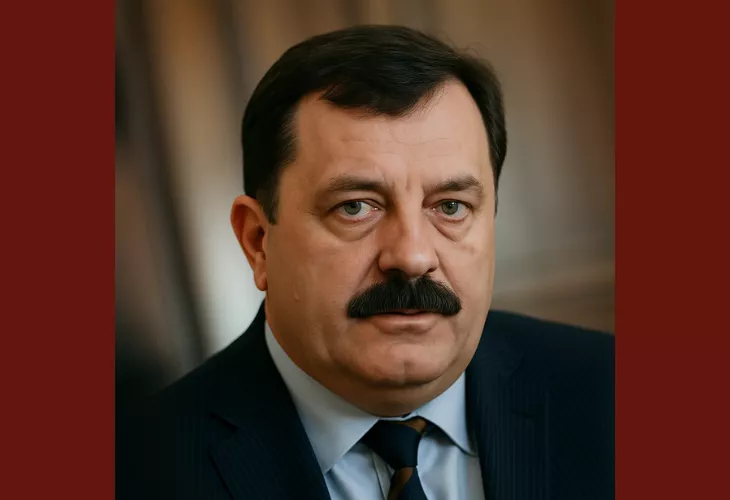
In the world of criminal empires and political intrigues, the story of Joaquín "El Chapo" Guzmán, the legendary leader of the Mexican Sinaloa cartel, has become synonymous with power, corruption, and the ability to evade justice for years. Far from the Mexican deserts, in the heart of the Balkans, in Laktaši near Banja Luka, a figure emerges who, according to many, shares similar traits: Milorad Dodik, a man who has dominated the political scene of the Republika Srpska entity for decades, and equally the state of Bosnia and Herzegovina.
But while El Chapo was protected by a network of bribed officials, the question is – who and how is protecting "El Chapo from Laktaši"? And more importantly, will Bosnia and Herzegovina have to wait for external pressure, like that exerted by the US on Mexico, to finally bring its powerful figure to justice?
Like El Chapo, who controlled Mexican authorities through bribery and blackmail, Milorad Dodik has built a sophisticated network of influence within Bosnia and Herzegovina's judicial and police apparatus. One piece of evidence that Dodik controls the Prosecutor's Office is the sentence he uttered regarding the election of the Chief Prosecutor of BiH, Milanko Kajganić: "If you don't elect Kajganić, you can put thorns on the doors of the Prosecutor's Office."
This statement was a public demonstration of the need for control over an institution that, in an ideal world, should be independent and prosecute those who break the law, including Dodik himself. Kajganić, according to these claims, becomes a key player in Dodik's system, ensuring the Prosecutor's Office remains loyal not to justice, but to Dodik.
However, Dodik's power does not end with the Prosecutor's Office. There are serious indications that he, directly or through his allies, also controls parts of the Court of Bosnia and Herzegovina. Through a network of debtors, friends, and political allies, Dodik has ensured that decisions within the Court reach him before they are fully agreed upon within the institution. This control is not always explicit, but it is effective – judges, aware of political pressures and consequences, often act cautiously when it comes to cases concerning Dodik or his circle.
A Perfect Cover for Police Agencies
Police agencies, such as the State Investigation and Protection Agency (SIPA) or entity police forces, are also under Dodik's influence, either through direct loyalty or via a network of debtors. Although the Prosecutor's Office of BiH issued an order for Dodik's apprehension due to charges of attacking the constitutional order, arrest actions are absent. The reason? Police forces are acting as Dodik's protection, rather than protecting law and order. The Minister of Internal Affairs of RS, Siniša Karan, publicly stated that "no one from the leadership of RS will be arrested," thereby confirming that the MUP of RS serves as a shield, not as an organ enforcing the law.
At the same time, that message served as a perfect cover for police agencies at the BiH level to not even consider arresting Dodik, citing increased risk, which is essentially a staged scene mirroring how Mexican police agencies faked the pursuit of Sinaloa.
And to be clear, whether it's the entity or state police apparatus, Dodik's network is not limited to the Serb ethnic line; I would even dare to say that his support is deeper within parts of the apparatus composed of Croat-Bosniak personnel.
The current situation in Bosnia and Herzegovina poses a key question: is Milorad Dodik running from the judicial-police apparatus, or is that apparatus running from him? The evidence that Dodik is not in a classic flight lies in his public appearances. He does not flee into the shadows like El Chapo, who evaded arrest for years by hiding in the mountains of Sinaloa.
On the contrary, Dodik is present – he travels abroad, holds press conferences, and even celebrates his birthday in the Palace of Republika Srpska under police protection. When Interpol refused to issue an international arrest warrant for him, Dodik used it as proof of his untouchability, traveling to Israel and Russia without fear of arrest.
On the other hand, the judicial and police apparatus appears paralyzed. There is an order for Dodik's apprehension, but its execution is practically impossible without the political will and coordination that should result in an arrest.
Meanwhile, Dodik continues to provoke, announcing parallel institutions, such as the RS court and prosecutor's office, and making public threats. This situation indicates that the judicial system not only fails to prosecute Dodik but also allows him to operate unimpeded, getting out of his way, while institutions remain trapped in a web of fear, corruption, and political pressure.
Will US Pressure Be Necessary?
El Chapo evaded justice for years thanks to corruption within Mexican authorities, but his final arrest in 2016 was the result of strong pressure from the United States, which provided intelligence and operational support. Bosnia and Herzegovina finds itself in a similar situation.
The American magazine Foreign Affairs recently published an analysis claiming that the West has a legal and political basis to stop Dodik, even at the risk of escalation, as passivity would lead to the de facto secession of Republika Srpska. However, while the international community, including the EU and the OHR, shows determination in words, concrete actions are lacking. EUFOR, which has a mandate to maintain security, has so far not signaled readiness for direct intervention in the event of Dodik's arrest, leaving the burden on the already weakened domestic institutions.
US pressure, similar to that in the El Chapo case, could be decisive. US Ambassador Michael J. Murphy previously provided strong support to High Representative Schmidt, but the current administration shows less engagement, giving Dodik room to maneuver. Without strong external pressure, the Bosnian and Herzegovinian judicial and police apparatus will hardly dare to arrest Dodik, especially due to the fear of political and security escalation.
In summary, Milorad Dodik, like El Chapo, rules through a network of loyalty, fear, and corruption. His control over the prosecutor's office, parts of the court, and police forces allows him to evade justice, while the judicial apparatus flees from conflict with him. As Dodik continues to challenge state institutions and the international community, Bosnia and Herzegovina remains in a stalemate, waiting for the moment when political will – domestic or international – will prevail.
Will US pressure be needed to bring "El Chapo from Laktaši" to justice? Probably yes. Without an external impulse, Dodik's network will continue to protect him, while the judicial system will remain powerless before his might. In the meantime, the question is not just whether Dodik is running from justice, but how long justice will run from him. And what price will Bosnia and Herzegovina pay for all of this?
Komentari (0)
Prijavite se za komentiranje
PrijavaJos nema komentara. Budite prvi!
Minuta
Sve →Iz drugih kategorija

High Representative Not Elected: Germans, French and British Against Americans, New Attempt at End of June

ČOVIĆ WITHOUT MERCY: How Those Who Brought Ademović to Office Created a Political Hell for Him



Sunny Saturday, quite warm



Tragedy in Albanian resort: Two minors drown












