
By: Armin Sijamić
On Sunday, a group of armed individuals carried out a terrorist attack on members of the Kosovo Police, after which official Pristina reacted swiftly. For Kosovo, which witnesses frequent violence, such an event is a novelty. By all accounts, the armed group had a plan which, fortunately for Kosovo and Prime Minister Albin Kurti, did not come to fruition.
What exactly happened in the village of Banjska, about 55 kilometres north of Pristina, is still unknown to the public. The Kosovo Police have been reporting on the operation in Banjska for days, leaving little room for official Belgrade to repair the damage caused by the military fiasco of a group that some link to Milan Radoičić, an associate of Serbian President Aleksandar Vučić.
Although the Banjska incident is a new moment in the Kosovo conflict, its announcement came two months ago. The similarity between that announcement and the response to those claims with Sunday's event is incredible.
Namely, in early July, Alicia Kearns, Chair of the UK Parliament's Foreign Affairs Committee, accused the Serbian side of transferring weapons across the border and hiding them in monasteries of the Serbian Orthodox Church in northern Kosovo, and that armed groups were operating there. Kearns said that weapons were being transported in ambulances, and when KFOR came to check, after losing a great deal of time waiting for approvals, the weapons were hidden.
Official Belgrade and the church denied her claims, as did KFOR, which stated that "there is no evidence of alleged smuggling (of weapons) being carried out across the administrative boundary line between Kosovo and Serbia into Orthodox churches using ambulances."
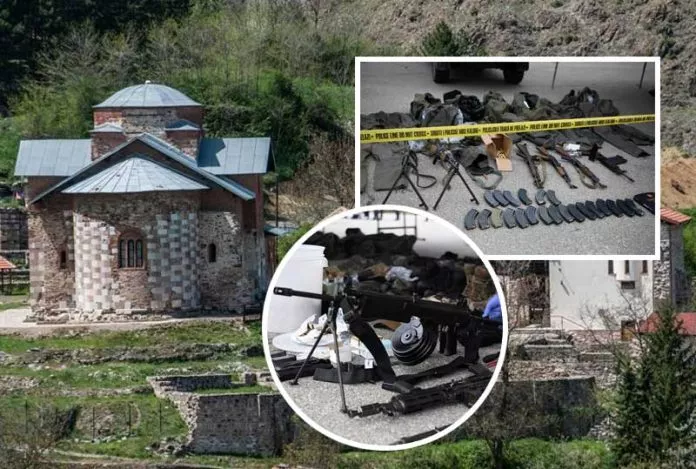
After Sunday's attack, the public learned that a Kosovo policeman had been killed in an ambush and another wounded, that after a chase for the attackers, the group ended up in the Banjska monastery and that from there (under mysterious circumstances) they fled to Serbia. The Kosovo Police later published photos of huge quantities of seized weapons, part of which was seized in the monastery.
Who is behind the attack?
About two weeks before Alicia Kearns' warning, three Kosovo policemen were arrested, or rather abducted, by Serbian services. Belgrade claimed that the Kosovars had illegally entered Serbian territory, while Pristina claimed they were abducted in Kosovo and taken across the border.
Let us add that Belgrade has repeatedly sent troops to the border with Kosovo, meaning there has been an increased presence of Serbian forces on the ground, as well as clashes between Serbs and the police and KFOR at the end of May in several municipalities in northern Kosovo, when Albanian mayors tried to take over local government, which the Serbs, at Belgrade's behest, had abandoned and withdrawn from government and police institutions.
On the other side of the border, groups controlled by Serbia and Radoičić, who is under sanctions from Washington and London, are active. At the end of June, Kosovo declared two such groups, Civil Protection and the North Brigade, terrorist organisations. Kurti said that these organisations "recruited and trained members to use weapons and combat methods in military bases in Serbia with the aim of carrying out attacks on local institutions and international missions in Kosovo."
About fifteen hours after the events in Banjska, Vučić addressed the public and labelled Kurti as "the sole culprit" and "part of the international community that helps him," saying that Kurti's "desire" is to "drag Serbia into a war with NATO" and that "only" Kurti wants war.
In the announcement of his address, pro-government media reported that Vučić would expose Pristina's lies. But the address showed the trap into which Vučić's policy had fallen, as he did not explain who the people who attacked the Kosovo police were, why they did it, and on whose orders. However, at the very beginning of his address, he said it was "a group of Serbs from Kosovo," without further details.
Spin doctors from Serbia, ranging from nominally pro-Western to those who are not, have floated the thesis that Vučić did not know about the attack. In his address, Vučić did not miss the opportunity to call out Kearns, who warned that armed groups were operating on both sides of the border. Is it possible that Vučić did not know what Radoičić was doing, that he did not know about armed groups in Kosovo using churches as hideouts? How is that possible if he knows the details of the conflict in Banjska?
"Kurti's terror" and Serbian nationalists
In the aforementioned address, Vučić said that the only way to avoid conflict is to establish the Community of Serb Municipalities (ZSO), which Kurti opposes. Vučić said that Kosovo Serbs "will not tolerate Kurti's terror," a phrase often repeated by his close media.
That "Kurti's terror" is, in fact, Kurti's desire for all residents of Kosovo to live under Kosovo's laws, while Vučić and Serbian nationalists refuse for Serbs in Kosovo, or anywhere else in the former Yugoslavia, to live as a minority. That is why Kurti, as a victim of Slobodan Milošević's regime, is more criticised in Serbia than former Kosovo Liberation Army commanders Ramush Haradinaj and Hashim Thaçi, whom Belgrade accused of trafficking the organs of Kosovo Serbs.
Kurti's stance during the events in Banjska surprised Vučić. In the aforementioned address, Vučić said, "There is one incredible thing. In just an hour and twenty minutes, those, by our estimates, several dozen Serbs, were completely surrounded. Obviously, this was done with international forces, logistically and in every other way." So, Vučić believes that someone informed Pristina about the attack, but he did not explain how the attackers escaped from "complete encirclement."
Rada Trajković, an opposition figure to the Kosovo Serb List led by Vučić and Radoičić, said that the attackers fled to Serbia with the help of KFOR, because about forty dead Serbs would have inflamed the conflict. Vučić accused KFOR of giving Pristina "carte blanche... to deal with the terrorists and kill as many people as possible."
Vučić said that the international community stopped such conflicts in North Macedonia, likely referring to the Kumanovo case, and that in Kosovo they sought to have the attackers killed. Nevertheless, rescuing the attackers from "complete encirclement" resembles the Kumanovo case, but we are already accustomed to the fact that truth is often the greatest enemy of official Belgrade.
ZSO or conflict
In his address, Vučić called on the international community to form the ZSO "because it is the only way" for Serbs not to be expelled from Kosovo or "to prevent further conflicts." Additionally, he called on KFOR to increase its presence in northern Kosovo and "for Serbs to be police officers in the north."
This offering of "solutions" to the international community may reflect the attackers' plan. The possible goal was to seize territory, hold the achieved lines, call for volunteers from Serbia, and then have KFOR separate the warring parties across Kosovo. Probably, the next step would be a "compromise" reflected in the formation of the ZSO, which would present Kurti with a fait accompli.
And for the lack of a ZSO, Vučić blamed German politician Michael Roth. "Thanks to Michael Roth, we have this situation in Kosovo," was his response to a journalist's question about Roth's statement that he was interested in how Vučić would justify the attack. Let us recall, Roth was an important part of German diplomacy under Chancellor Angela Merkel, and former Albanian Prime Minister and President Ilir Meta said that Merkel prevented Vučić and Edi Rama from partitioning Kosovo.
The day after the attack, German Special Envoy for the Western Balkans Manuel Sarrazin arrived in Pristina, condemning the "criminal and terrorist attack" and expressing "solidarity" with Kosovo.
High Representative of the European Union for Foreign Affairs and Security Policy Josep Borrell stated that "the EU and member states again call on all actors" for "de-escalation," which Kosovo's Minister of Foreign Affairs Donika Gërvalla-Schwarz called "cynicism." The US Ambassador to Pristina, Jeffrey Hovenier, condemned the "incredibly serious attack" carried out by an organised group.
Alicia Kearns also spoke out, demanding that the United States and the EU finally change their policy of appeasing Belgrade and Vučić, as it leads to further violence, and recalled the appeal sent to US Secretary of State Antony Blinken, Borrell, and UK Foreign Secretary James Cleverly by a group of Western parliamentarians, including herself and Roth.
"You can kill us all, but we will not recognise independent Kosovo," Vučić stated in the aforementioned address. In the case of the ZSO, we can conclude that the Belgrade nationalist elite will not abandon the idea of Serbs outside Serbia being governed by Serbs loyal to Belgrade. For starters, until Belgrade comes up with a new spin and finds someone who will look with understanding at the nationalists' plans to subjugate neighbouring peoples, a day of mourning has been declared for the fallen attackers on Kosovo police officers.
Komentari (0)
Prijavite se za komentiranje
PrijavaJos nema komentara. Budite prvi!
Minuta
Sve →Iz drugih kategorija

High Representative Not Elected: Germans, French and British Sabotaged Americans, New Attempt at End of June

ČOVIĆ WITHOUT MERCY: How Those Who Brought Ademović to Office Created a Political Hell for Him



Sunny Saturday, quite warm



Tragedy in Albanian resort: Two minors drown












